Last updated: November 29, 2026
Quick Answer: There are 3 main factors doctors weigh in insulin vs oral medication for gestational diabetes: blood sugar control, pregnancy safety, and how practical the treatment will be. Doctors usually choose insulin when blood sugar needs tighter control, while oral medication such as metformin or glyburide is more often considered when a pill fits the situation and the care team thinks it is reasonable. A qualified ob-gyn or maternal-fetal medicine specialist should make that call for an individual pregnancy, because gestational diabetes varies by person and by blood sugar pattern.
Key takeaways
- Insulin is the more adjustable option, which matters when blood sugar targets are hard to reach.
- Metformin and glyburide are oral choices, but they are not the same as insulin and they do not fit every pregnancy.
- The choice often turns on fetal safety concerns, how well blood sugar is staying within target, and whether a pill is likely to be enough.
- PubMed shows many human records on this topic from 2016–2026, and much of the recent literature is review-based rather than trial-based.
- A doctor’s preference is not random; it is usually tied to control, risk, and the pregnancy timeline.
Because gestational diabetes may not cause symptoms, testing between 24 and 28 weeks is important, according to the CDC. Testing helps start treatment, but the next step is not always obvious. The question is not “Which drug is best in general?” It is “Which option fits this pregnancy best?” For background on screening and diagnosis, see gestational diabetes.
A review of PubMed and ClinicalTrials.gov suggests that this topic has a large but uneven evidence base, with many reviews and fewer direct trials. In the sample used for this article, the 100 most relevant records included more reviews than randomized trials, and ClinicalTrials.gov listed many registered studies across the topic.
What doctors are trying to balance
Doctors are trying to balance blood sugar control, fetal safety considerations, and how practical the treatment will be for the patient. That is why the choice is usually not “pill versus injection” in the abstract; it is “which option is most likely to hold blood sugar in range without creating a bigger problem.”
The blood sugar targets matter because medication is chosen to get readings closer to goal, not just to put a label on treatment. If the pattern is only mildly above target, an oral medication may be part of the discussion. If the pattern is clearly outside target or changing quickly, insulin usually has the edge. For a plain-language overview of treatment goals, see the NIH.
A generic article often misses that doctors also think about timing. Gestational diabetes is found during pregnancy, often late enough that the pregnancy itself limits how much trial-and-error is comfortable. The closer the decision is to delivery, the more the team may favor the option that can be adjusted with the least uncertainty.
Insulin or pills: what is the real difference?
Insulin wins on flexibility; oral medication wins on simplicity. That is the cleanest way to separate them, because the rest of the decision flows from that difference.
| Criteria | Insulin | Oral medication | Winner for this condition |
|---|---|---|---|
| Control flexibility | Can be adjusted closely to blood sugar pattern | Less directly adjustable | Insulin when control is changing |
| Route | Injection | Pill | Oral medication when simplicity matters |
| Typical decision pressure | Used when tighter control is needed | Used when a pill seems reasonable | Insulin for tighter control |
| Fetal safety concerns | Often preferred when the team wants the most established pregnancy option | Considered carefully because the placenta and fetal exposure are part of the discussion | Insulin when the safety certainty is the priority |
| Practical use | Requires injection routine | Easier for people who prefer swallowing a tablet | Oral medication when injection burden is a barrier |
| Medication class | Hormone replacement approach | Metformin or glyburide | Depends on the pregnancy |
| Evidence shape in PubMed sample | Trials are sparse in the most relevant records | Much of the recent literature is review-based | Neither has abundant trial data |
| Trial activity | ClinicalTrials.gov has many registered trials across the topic | Same trial pool, different drug classes | No clear winner from volume alone |
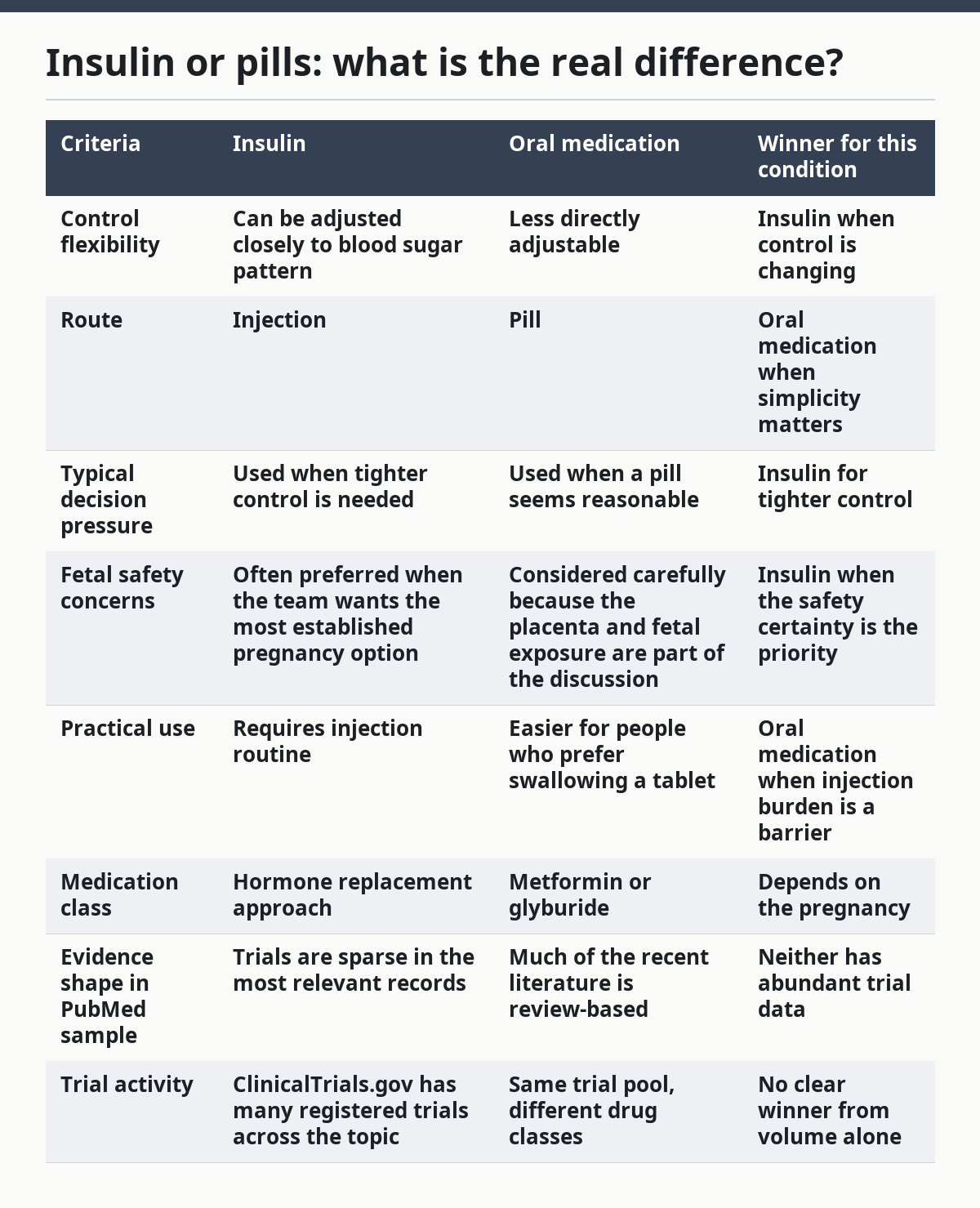
That table hides an important point: the “winner” depends on the condition, not on a ranking website mentality. If a pregnancy needs the most dependable and adjustable option, insulin tends to win. If the care team thinks an oral route is reasonable and blood sugar is not far from target, a pill may be considered first.
The PubMed sample also shows how cautious the literature is. Of the most relevant records, many are reviews and only a few are randomized controlled trials, so much of the public discussion is synthesis rather than fresh head-to-head data. That does not prove one option is better; it does show why doctors lean on clinical judgment, blood sugar logs, and pregnancy context. See PubMed for the underlying literature search.
When does insulin make more sense?
Insulin makes more sense when blood sugar needs tighter control or when a doctor wants the most established pregnancy option. It is the stronger choice when the pregnancy is not forgiving about missed targets, because insulin can be tailored more closely than a pill.
This matters because gestational diabetes is not one pattern. Some people have a mild rise after meals; others have more persistent elevations. Insulin is usually the better fit when the numbers are not staying where they should be, because a medication with more direct control is easier to match to the pattern.
Insulin also tends to win when the care team wants to reduce uncertainty around fetal safety considerations. The reason is simple: insulin is a hormone the body already uses, and the decision can feel more straightforward when the team is trying to avoid a drug with more uncertainty about pregnancy fit. The American Diabetes Association and obstetric guidance both emphasize individualized management.
The drawback is practical, not theoretical. A person who is already overwhelmed by pregnancy appointments may find injections and routine management harder than taking a pill. That is a real cost, and it is one reason insulin is not the automatic answer for every patient.
When do metformin or glyburide fit better?
Because oral medication is an option in pregnancy, metformin or glyburide fit better when a pill seems reasonable and the care team thinks it may be enough. That usually means the blood sugar pattern is not so severe that insulin is the clear first choice.
Metformin is often the oral drug that comes up first in discussion because it is familiar in diabetes care and is easier to take than injections. Glyburide is another oral option named in the gestational diabetes literature, but it is not interchangeable with metformin, and doctors do not treat them as the same choice. For patients considering oral treatment, it is best to review options with a qualified professional and a current guideline source such as the ACOG practice guidance.
The main strength of oral medication is convenience. A pill can be easier to fit into daily life, and that matters in pregnancy, when the number of moving parts is already high. In a person who is likely to struggle with injections, or who is strongly averse to them, that convenience can change adherence.
The weakness is that oral treatment may not be enough for every pregnancy. If glucose control stays off target, a pill can become the wrong tool for the job. That is why oral medication is usually a “maybe” only when the team thinks the numbers and the pregnancy context leave room for it.
The literature snapshot supports that cautious stance. In the most relevant records, recent publications cluster around a middle range of publication years and study durations, which tells the reader two things: the discussion is recent, and it is still built around varied follow-up windows rather than one simple answer.
How doctors choose between them in real life
Doctors usually choose by looking at three things: blood sugar targets, pregnancy safety, and whether the treatment is likely to work fast enough. If one of those factors points hard in a direction, that direction usually wins.
Here is the simplest decision frame.
- If blood sugar is not controlled enough, insulin becomes more attractive.
- If a pill is likely to be enough, oral medication stays on the table.
- If fetal safety concerns or uncertainty are front and center, insulin often gets the edge.
- If the person cannot manage injections well, oral medication may be discussed first.
This is also where the blood sugar logs matter more than the diagnosis label. A diagnosis of gestational diabetes does not tell the whole story. Two people can have the same diagnosis and very different patterns, so the medication choice is not one-size-fits-all.
The ClinicalTrials.gov data reinforce that the field is still active and split. Trial records across the topic continue to appear, with a mix of phases and enrollment sizes. That is not a verdict, but it does show that no single medication class has settled every question.
Which option is safer for the baby?
Insulin is usually the safer-feeling choice for the baby when the care team wants the option with the most established pregnancy use. That does not mean oral medication is automatically unsafe; it means doctors often lean toward insulin when they want the most conservative path.
Fetal safety considerations are part of the choice because the medication has to work during pregnancy, not just outside it. Oral medication can still be reasonable in some pregnancies, but the doctor has to weigh that against the need for strong control and the amount of evidence that applies to this exact situation.
The evidence base is broad but uneven. PubMed shows many human records from 2016–2026, but most of the most relevant records are reviews, not direct trials. That is one reason many clinicians are careful with blanket statements about one drug class being universally safer.
The honest answer is that “safer” depends on what risk is being discussed. If the question is comfort with pregnancy use and flexibility, insulin often wins. If the question is convenience and avoiding injections, an oral drug may feel easier, but easier is not the same as safer.
The verdict: which one should be chosen?
Choose insulin if blood sugar is clearly above target, if the pregnancy needs the most adjustable option, or if the care team wants the most established pregnancy choice. Choose metformin or glyburide if a pill is likely to be enough and the ob-gyn or maternal-fetal medicine specialist thinks oral treatment fits the situation. Neither if the plan is being made without reviewing actual blood sugar readings and pregnancy-specific risks.
That is the practical split. Insulin is the better fit when control and certainty matter most. Oral medication is the better fit when the case is milder and convenience matters enough to influence real-world use.
This is also why the page that sits under the gestational diabetes treatment hub belongs here: it answers the comparison question, not the “how to dose” or “what side effects to report” question. Those are separate decisions and need separate guidance.
What if the choice changes?
The choice flips if the blood sugar pattern changes, if the pregnancy moves closer to delivery, or if the first plan is not holding target. That is normal, not a failure.
A doctor may also change the plan if a pill is not enough to keep readings where they should be. In that case, insulin often becomes the next step because it gives more direct control. If injections are a major barrier, the team may still try to work within an oral plan if that is medically reasonable.
Another flip point is the patient’s ability to follow the plan. A medication that looks elegant on paper can fail if it does not fit daily life. That is one reason oral medication remains part of the conversation even when insulin is the more conservative option.
One more exception is a person with strong concerns about fetal exposure. In those cases, the conversation often moves toward the option with the most established pregnancy use, which is usually insulin. That said, the final choice still belongs with a qualified professional who knows the pregnancy, the blood sugar pattern, and the timing.
Is insulin safer than metformin in gestational diabetes?
Insulin is usually the more conservative choice, but “safer” depends on what risk is being judged. For fetal safety considerations and pregnancy experience, insulin often has the edge because doctors know it well in this setting. For convenience, metformin may be easier, but easier is not the same as safer, and the decision should be made with a qualified professional.
Why would a doctor pick insulin instead of pills?
A doctor would pick insulin instead of pills when tighter blood sugar control is needed or when the pregnancy calls for the most adjustable option. Insulin can be matched more closely to changing readings, which matters when targets are hard to reach. It is also often preferred when the team wants the most established pregnancy option.
Can gestational diabetes be treated without insulin?
Yes, sometimes gestational diabetes can be managed without insulin if the blood sugar pattern and the pregnancy context make an oral option reasonable. Metformin or glyburide may be discussed in those cases. The decision depends on actual glucose readings, pregnancy timing, and the doctor’s assessment of fetal safety considerations.
Drafted with AI; not yet reviewed by a person.