
Last updated: November 27, 2026
When gestational diabetes needs medication usually means blood sugar stays above target despite food changes, activity, and careful monitoring. That decision belongs with a qualified clinician, usually an obstetrician and sometimes a maternal-fetal medicine specialist, because the next step depends on the pattern of readings, not one bad day.
Therefore, PubMed and ClinicalTrials.gov both show ongoing research interest in this topic, and the CDC’s gestational diabetes page and the NIDDK’s blood sugar management page are useful starting points: https://www.cdc.gov/diabetes/basics/gestational.html and https://www.niddk.nih.gov/health-information/diabetes/overview/what-is-diabetes/gestational/manage-blood-sugar.
Key takeaways
- Medication is usually discussed when fasting or after-meal numbers keep missing the target, even after diet changes.
- One high reading is less important than a repeated pattern over days.
- Insulin and metformin are the main medication paths people ask about; the choice depends on the pattern of highs, timing, and clinical judgment.
- Glyburide may come up in discussion, but it is not the same kind of first-line answer for every case.
- If the plan changes, the next steps usually involve closer glucose logs, follow-up visits, and sometimes a maternal-fetal medicine specialist.
Who this applies to
This applies to someone who already has gestational diabetes, is checking blood sugar, and wants to know when the plan may no longer be enough without medication. It assumes the person has already been told to track readings, adjust meals, or walk after meals, and is now seeing numbers that do not settle down.
However, it does not apply to someone trying to diagnose themselves from symptoms alone. Gestational diabetes often has no clear symptoms, and a single reading outside target is not the same thing as a medication need. If blood sugar is repeatedly high, the right move is to speak with an obstetrician; if the pattern is hard to control or the pregnancy is more complicated, a maternal-fetal medicine specialist may be brought in. The CDC and NIDDK both advise professional follow-up rather than self-diagnosis.
Therefore, the threshold is usually practical, not dramatic. Clinicians look at the log, the timing of the highs, and whether the current plan is still meeting the pregnancy’s blood sugar goals. A common source of confusion is that the number itself matters, but the trend matters more.
What blood sugar patterns usually matter?
Blood sugar patterns matter more than a single spike. Repeated fasting highs, repeated after-meal highs, or both are the usual reason medication is discussed.

Specifically, the first pattern that raises concern is a fasting level that keeps running above the target your clinician set. Fasting means the reading taken before breakfast, after an overnight stretch without food. The second pattern is post-meal readings that stay high after breakfast, lunch, or dinner even when portion size, carbohydrate choices, and activity have already been adjusted.
Meanwhile, the clinic may also watch whether highs cluster at the same time of day. A person whose breakfast numbers are high but whose other readings are closer to target may need a different plan than someone whose fasting numbers are the problem. That difference matters because it changes what kind of medication discussion comes next.
For example, a number of women also see mixed logs: some normal readings, some clearly high ones, and no obvious meal trigger. That can still lead to a medication conversation if the pattern keeps repeating. What does not usually drive the decision is one isolated outlier after a large meal or a missed walk.
Two authoritative patient pages that explain the general framework are the CDC’s gestational diabetes page and the NIDDK’s overview of managing blood sugar in pregnancy: https://www.cdc.gov/diabetes/basics/gestational.html and https://www.niddk.nih.gov/health-information/diabetes/overview/what-is-diabetes/gestational/manage-blood-sugar. Those pages are background reading, not a replacement for individualized advice.
How do clinicians decide between insulin and metformin?
Therefore, clinicians usually choose between insulin and metformin by matching the blood sugar pattern, the pregnancy timeline, and the person’s tolerance for each option. The decision is not based on one “best” drug in the abstract.
| Factor | Insulin | Metformin | Glyburide |
|---|---|---|---|
| Main decision point | Often considered when more direct blood sugar control is needed | Often considered when an oral option is being discussed | May come up in discussion, but choice depends on the case |
| Practical issue | Requires injections and more education | Taken by mouth, which some people find easier | Also taken by mouth, but not every clinician uses it the same way |
| Typical trade-off | More treatment steps, more monitoring | Can be simpler to start, but may not fit every pattern | May be less preferred in some situations |
| Who decides | Obstetrician, sometimes maternal-fetal medicine specialist | Obstetrician, sometimes maternal-fetal medicine specialist | Obstetrician, sometimes maternal-fetal medicine specialist |
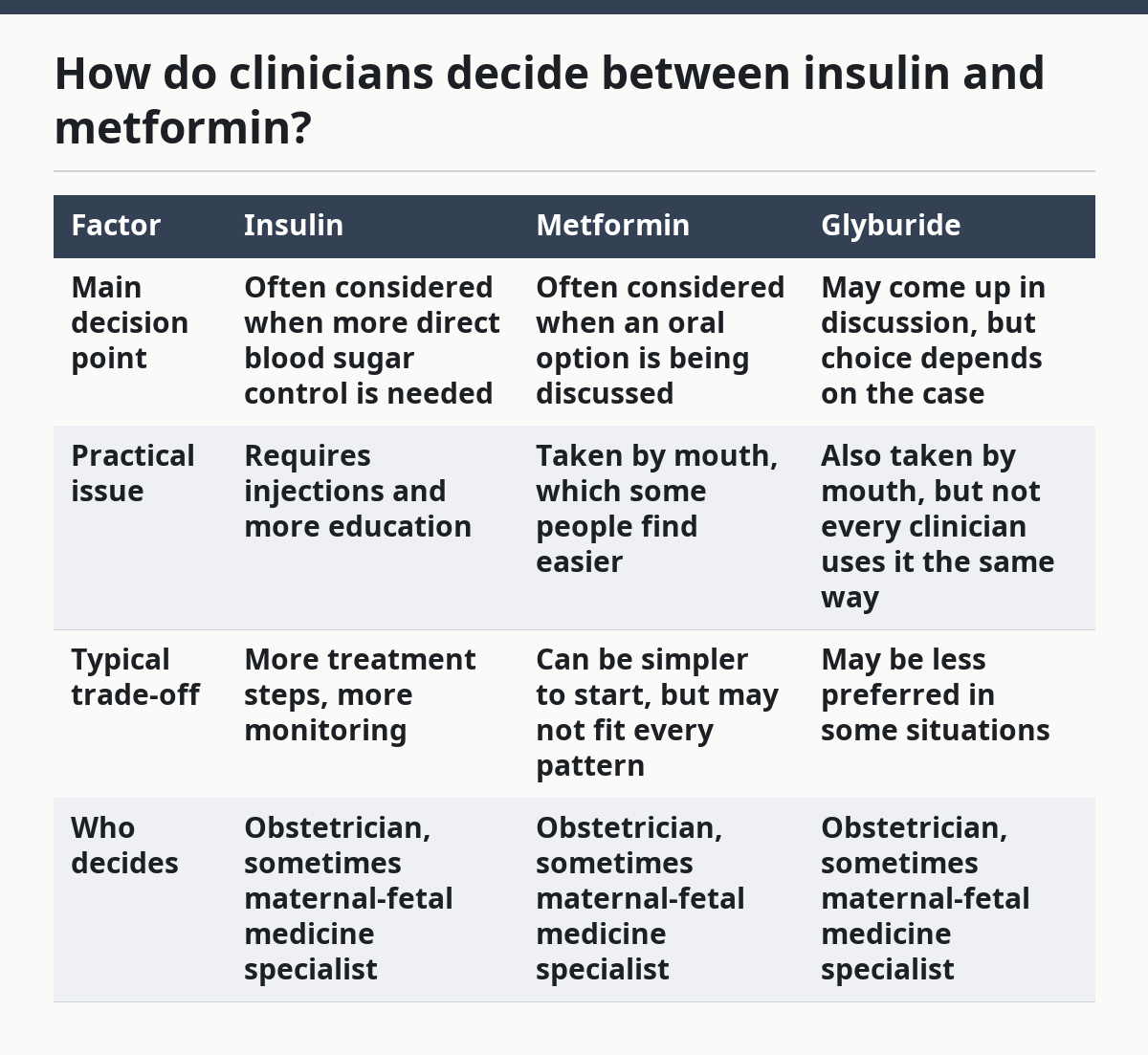
The main trade-off is simple: insulin is often chosen when clinicians want tighter control and do not want to rely on the gut absorption of a pill, while metformin may appeal when an oral medication is reasonable to discuss. Glyburide may still be named in some practices, but the choice is not automatic and varies by clinician and situation.
Because the pattern of highs matters most, if fasting numbers are the main problem, the response may differ from a plan built around after-meal spikes. If the pregnancy is later, the response may also be different from an earlier diagnosis. These are clinical judgment calls, not self-adjusted choices.
The evidence base is active, not settled. In PubMed’s 2016–2026 sample for this topic, review articles and trial reports both appear frequently, which suggests the topic is still being refined rather than reduced to one universal answer. A clinician should interpret the evidence in the context of the pregnancy.
When does diet alone stop being enough?
Therefore, diet alone stops being enough when the numbers keep missing target despite real changes in meals, timing, and activity. The issue is not perfection; it is whether the plan is working often enough to keep blood sugar in range.

A person may have already cut back on large carbohydrate loads, spread meals out, chosen more consistent snacks, or used walking after meals. If the log still shows repeated highs, the plan may need medication support. That is true even when weight gain looks normal or the person feels fine, because blood sugar can drift high without obvious symptoms.
Specifically, the next step is usually not “try harder.” It is “review the pattern and change the plan.” That review may include how often the readings are high, how far above target they are, and whether the problem is fasting, after-meal, or both. It may also include whether the meal plan is hard to maintain in real life.
A good result is not a perfect log. It is a log that moves closer to target with fewer repeated highs. If diet alone is not getting there, medication discussion is reasonable and common. gestational diabetes treatment is usually adjusted to the pattern, not to a single reading.
What happens after the decision?
Once the decision is made, the plan usually shifts to closer review, medication education, and continued glucose logging. The change is about control and follow-up, not a one-time prescription and done.
A typical sequence looks like this:
- Bring the last 1 to 2 weeks of glucose readings to the visit, with fasting and after-meal values clearly labeled.
- Note which meal times are most often high and whether the same pattern shows up on more than one day.
- Review what has already changed, such as meal timing, carbohydrate portions, or post-meal walking, so the clinician can see what has been tried.
- Discuss whether the pattern points more toward fasting highs, after-meal highs, or both, because that shapes the medication conversation.
- Ask which medication options are being considered and why one is favored over another in this pregnancy.
- Confirm how often to check blood sugar after the change, since follow-up commonly depends on trend rather than a single reading.
- Ask what would count as a reason to call sooner, such as repeated high readings over several days or trouble following the plan.
- Keep the log going for the next visit so the team can see whether the pattern has improved.
This stepwise approach matters because the decision is usually made from a chart, not a feeling. In published research databases, the topic continues to appear in studies rather than in a single settled protocol. That tells you the topic is still being studied, but the clinical question in the room is still the same: is the current plan controlling the numbers?
When should the plan change?
Therefore, the plan should change when specific blood sugar patterns keep showing up despite a serious attempt at lifestyle management. The reason for changing is repeated lack of control, not a single off day.

Fasting numbers stay high on several days: This suggests the overnight pattern is not controlled — the clinician may discuss medication rather than asking for more of the same diet plan.
After-meal readings stay high after one or more meals: This suggests the meal plan is not enough on its own — the next step may be medication or a different nutrition strategy.
Highs show up in the same part of the day: This points to a repeatable pattern — a maternal-fetal medicine specialist may be helpful if the pattern is hard to interpret.
Logs are missing or too sparse to judge the pattern: This means the team cannot tell whether the plan is working — more complete tracking is needed before a smart decision can be made.
The person has already changed meals and activity and still sees repeated highs: This means the current approach has been tried — medication discussion becomes more likely.
The pregnancy has other medical risks that make control more urgent: This raises the stakes of staying with an underperforming plan — the obstetrician may move sooner to medication review.
The key point is that “change the plan” does not mean failure. It means the first-line plan has hit its limit. A quick medication discussion is often better than waiting through more weeks of the same numbers.
What mistakes slow the decision down?
The most common mistakes are about reading the log badly, not about effort. They can delay a helpful change for days or weeks.
One mistake is focusing on a single high value. That can lead to panic after one meal and false reassurance after the next. The better alternative is to look for a repeated pattern across several days.
Another mistake is changing three things at once and then not knowing what helped. If the person changes breakfast, dinner, and activity together, the log becomes hard to interpret. The better alternative is to keep changes organized so the clinician can see what happened.
A third mistake is assuming metformin or insulin is a punishment. That belief can delay care. The better alternative is to treat medication as another tool when food changes alone are not doing enough, and to discuss the decision with the obstetrician or a maternal-fetal medicine specialist.
A fourth mistake is waiting until the next routine visit even when the pattern is clearly bad. That can waste time. The better alternative is to ask the obstetrician how to report repeated highs sooner.
A fifth mistake is comparing one pregnancy to another person’s story. That can be misleading because blood sugar patterns, timing, and medical history differ. The better alternative is to use the person’s own log and the clinician’s target range.
What if the usual pattern does not fit?
The usual pattern does not fit when the log is hard to interpret, the pregnancy is more complicated, or the numbers are close to target but not quite there. Those are the cases that need extra judgment, not less.
If a person has very few readings, the log cannot be judged fairly from a scattered record. If a person has one meal that always spikes but everything else looks fine, the response may be different from the response to repeated fasting highs. If a person is diagnosed later in pregnancy, management may also differ from someone diagnosed earlier, so the clinician should review the full picture.
This is where specialist input can matter. A maternal-fetal medicine specialist is often the right person when the pattern is confusing, the pregnancy has added risks, or the response to the first plan is not clear. That does not mean the situation is extreme; it means the decision needs more than a quick glance.
Therefore, the practical standard is this: if the numbers are not telling a clear story, the answer is not to guess. It is to tighten the log, review the pattern, and get the right clinician involved.
FAQ
How do I know if my gestational diabetes needs medication?
If your blood sugar keeps missing the target after you have already changed meals, timing, and activity, medication is worth discussing. A single high reading is not enough by itself. The better sign is a repeated pattern, especially fasting highs or after-meal highs that keep returning over several days.
What blood sugar patterns usually lead to medication?
Repeated fasting highs and repeated after-meal highs are the main patterns that usually lead to a medication conversation. The timing matters because fasting highs and meal-related highs often call for different thinking. Clinicians also look at whether the highs happen on the same days or after the same meals.
Can I still manage gestational diabetes with diet alone?
Yes, some people can still manage gestational diabetes with diet alone if the readings stay close to target. That is most likely when the log improves after real changes in meals and activity. If the same highs keep coming back, the plan may need medication support instead.
Drafted with AI; not yet reviewed by a person.