Last updated: November 27, 2026
Quick answer: ask 5 questions before starting gestational diabetes medication. Ask about the drug name, why it is being chosen, how your blood sugar checks will change, and what side effects or follow-up matter most. A gestational diabetes medication consult should be a clear conversation with your obstetrician or diabetes educator, because the right plan depends on your test results, your pregnancy, and the medicine being considered.
Key takeaways
- Bring the exact question: “Why this medicine for me, and why now?”
- Ask how your glucose checks will change once treatment starts, including what numbers count as a problem.
- Find out which side effects are expected and which ones should trigger a call the same day.
- Compare insulin, metformin, and glyburide by how they are taken, how they are watched, and how often follow-up happens.
- Plan the next contact before you leave the visit, including who to call and when.
What should I ask at the first visit?
Ask whether the plan is insulin, metformin, glyburide, or a different approach, and ask why that choice fits your blood sugar pattern. The evidence in this area is still evolving, so it helps to ask your clinician to explain how the decision was made for your case rather than assuming there is one standard answer.
The first question should be simple: “What problem is this medicine solving in my case?” That matters because gestational diabetes is often found on screening rather than through symptoms, and testing usually happens between 24 and 28 weeks, according to the CDC and the NHS. If you were diagnosed by an oral glucose tolerance test, or OGTT, you may also want to ask how your result affected the medication choice, and your obstetrician or diabetes educator can help interpret that in context.
Ask who will follow the plan with you. An obstetrician may manage the pregnancy side, while a diabetes educator may help with monitoring and day-to-day questions. If both are involved, ask which person should answer urgent questions and which one adjusts the plan.
How do I compare insulin, metformin, and glyburide?
Ask how insulin, metformin, and glyburide differ in use, monitoring, and the kind of follow-up they need. A quick comparison helps you see the trade-offs without guessing, and it is better than asking only whether a medicine is “safe.”
| Option | What to ask | What to verify |
|---|---|---|
| Insulin | How is it taken, and what changes in my routine will it bring? | Whether you know the timing, injection steps, and who reviews readings |
| Metformin | Why is this being chosen instead of insulin or glyburide? | Whether you know what side effects to watch for and how follow-up works |
| Glyburide | Why is this appropriate for me, and what is the backup plan if it is not enough? | Whether you know what to report and when to contact the team |
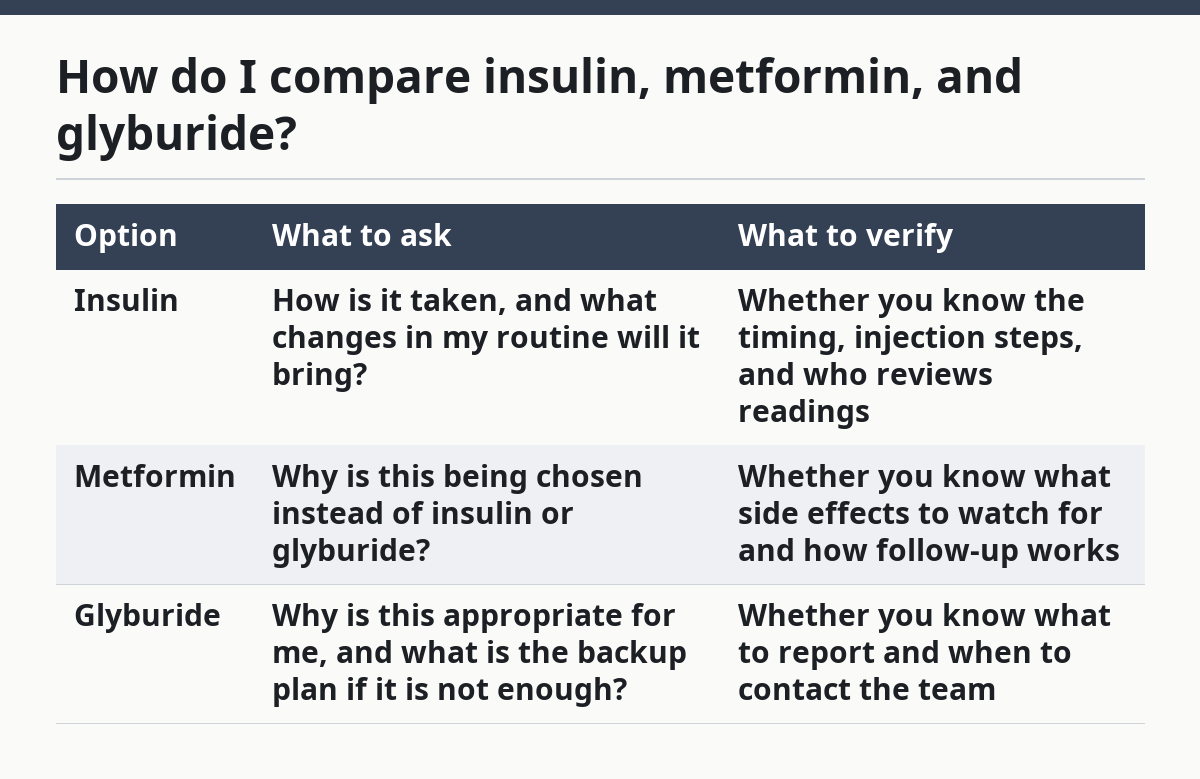
This table is not a treatment recommendation. It is a prompt for a better conversation, because the right answer can change if your numbers, pregnancy timing, or symptoms change. The evidence base is active, and recent PubMed and ClinicalTrials.gov activity shows that clinicians continue to study these choices closely, so ask your care team how they apply the evidence to you.
Also ask whether one option is being suggested because of how quickly it can be started, how it is monitored, or how often it needs changes. That is the practical part people often miss. A medicine can look simple on paper and still require frequent contact in real life.
What should I ask about blood sugar checks?
Ask exactly how often to check your blood sugar, what targets you should use, and what number means you need to call. If the plan changes from diet alone to medication, the monitoring plan usually changes too, and you should know the new schedule before you leave the visit.
Use this checklist during the consultation:
- Ask which readings matter most: fasting, after meals, or both.
- Ask how many times per day you should check and for how many days before follow-up.
- Ask what device or log the team wants you to use.
- Ask what reading counts as too high, and what reading counts as too low for the plan.
- Ask who reviews the log, the obstetrician or the diabetes educator.
- Ask whether your OGTT result still matters once medication starts, or whether day-to-day checks become the main guide.
- Ask when the next adjustment will be made if your readings do not improve.
Each step should end with a clear answer you can repeat back. If you cannot explain the plan in one sentence, the instructions were not clear enough. Since the screening OGTT takes about 2 hours and is done in the morning after 8 to 10 hours without food or drink, it helps to ask how that testing history connects to your new home checks.
What side effects should I watch for?
Ask which side effects are expected, which are common enough to monitor at home, and which need same-day contact. That question matters because the point is not just to start medication; it is to know what counts as a problem, and your clinician can tell you which symptoms fit your specific plan.
The discussion should cover three things for any medicine under consideration: what you might feel in the first days, what should settle with time, and what is not normal for you. For metformin or glyburide, ask whether stomach upset, loose stools, or signs of low blood sugar are concerns in your plan. For insulin, ask how to spot a low sugar episode and what to do if a reading is unexpectedly out of range.
Do not leave with only a promise that “side effects are rare.” Rare is not the same as irrelevant. You want the practical rule: what symptom, what number, and what action.
When should I follow up after starting?
Ask when the first follow-up will be and what will be reviewed at that visit. A good answer includes a time frame, the person responsible, and the kind of data they want to see.
The median study duration in the PubMed abstracts read for this topic was 27 weeks, with a range of 1 to 104 weeks, so follow-up is usually not a one-time event. That is one reason to ask whether you will check in after a few days, a week, or longer, and whether the plan changes after the first review.
Ask these follow-up questions:
- Who do I contact if my readings stay high for several days?
- What should I bring to the follow-up visit?
- Will the dose or drug change if the numbers are not where the team wants them?
- If I start one medicine and it does not work well enough, what happens next?
This is also the right time to ask how care continues after delivery. According to the NHS, you should have a blood test for diabetes 6 to 13 weeks after birth, then yearly if that test is normal. That is not the same as pregnancy follow-up, but it is part of the bigger plan.
When is medication the wrong question?
Medication is not the only question when your diagnosis, symptoms, or appointment timing call for a different step. In a gestational diabetes medication consult, the wrong choice is not usually “no medicine ever”; it is asking for a medication answer when you need clarification, more monitoring, or a different specialist first.
You do not know which medicine is being proposed: that means the visit is too vague — ask for the exact name and the reason for it before you agree to anything.
You have no plan for home blood sugar checks: that means the medicine cannot be judged fairly — ask for the testing schedule and who will review it.
You cannot name the follow-up contact: that means you are carrying risk alone — get the direct line or the office route before you leave.
Side effects were mentioned but not explained: that means the warning signs are incomplete — ask what to watch for in the first days and what needs prompt help.
You are being offered a choice you do not understand between insulin, metformin, and glyburide: that means the decision is underexplained — ask for a plain-language comparison before starting.
That is especially true if your diagnosis came from screening, because many cases are found that way and may not feel obvious at first. The CDC and the NHS both note that gestational diabetes can be found without symptoms, which is why the 24 to 28 week testing window matters so much.
What mistakes should I avoid?
The biggest mistake is agreeing to a medicine without asking how success will be measured. That usually leads to confusion at the next visit, because the team may be looking at blood sugar logs while you are watching only how you feel.
A second mistake is asking only about side effects and skipping the monitoring plan. If you do not know how often to check blood sugar, you cannot tell whether the medicine is helping. A third mistake is assuming every option works the same way. Insulin, metformin, and glyburide are not interchangeable in how they are used, and the care plan may change with follow-up.
A fourth mistake is leaving without a follow-up date or clear contact person. That turns a short visit into a long gap. A fifth mistake is treating the OGTT as the end of the conversation. In reality, the test is part of the story, and the plan after the test matters just as much as the result.
FAQ
What should I ask before starting gestational diabetes medicine?
Ask which medicine is being suggested, why it fits your case, how your blood sugar checks will change, and what side effects to watch for. Also ask who will follow up with you and when. Those questions turn a vague prescription into a plan you can actually use.
How do I talk to my doctor about medication choices?
Start with one direct sentence: “Why are you recommending this medicine for me?” Then ask how insulin, metformin, and glyburide compare for your situation. If the answer is unclear, ask the obstetrician or diabetes educator to explain the next step in plain language before the visit ends.
What questions help me compare insulin and metformin?
Ask how each one is taken, what monitoring changes with each choice, and what side effects matter most. Then ask which one the team would choose first if your blood sugar readings do not improve, and how quickly they would review your logs. That comparison is more useful than a general label of “better” or “worse.”
Sources
According to the NHS, the screening test is called an oral glucose tolerance test, or OGTT, and it takes about 2 hours; it is done in the morning after 8 to 10 hours without food or drink, though water is usually allowed, and another blood sample is taken after 2 hours of resting. According to the CDC, gestational diabetes may have no symptoms, so testing between 24 and 28 weeks is important. The PubMed and ClinicalTrials.gov figures in this article were computed on 2026-11-27.
Drafted with AI; not yet reviewed by a person.