Last updated: November 27, 2026
Quick answer: this FAQ focuses on three medicine names people usually ask about — insulin, metformin, and glyburide — and it is meant to help you understand the terms, not replace a pregnancy-specific plan. This FAQ answers the natural questions people ask about gestational diabetes medications: answered clearly, including insulin, metformin, glyburide, and blood sugar terms, and it points you toward the deeper pages that cover treatment choices and individual medicines. For your own pregnancy, speak with a qualified clinician before acting on any medication question, because the right answer varies by person and by week of pregnancy; see ACOG and NICE.
Key takeaways
- Gestational diabetes medication is not one single drug; it is a group of options used when blood sugar needs extra help.
- Insulin is the standard name many readers see first, but metformin and glyburide also appear in the literature.
- The main question is usually not “what is the strongest medicine?” but “when is medicine used at all?”
- This page explains the words and the decision points, but it does not replace a full treatment plan or a personal medication decision.
- The research base is active: 353 PubMed records matched this topic for 2016–2026, and 22 ClinicalTrials.gov records were registered for it, using the method stated below.
What is gestational diabetes medication?
Gestational diabetes medication is any medicine used to help control blood sugar during pregnancy when diet and activity are not enough on their own. That usually means insulin, and in some discussions metformin or glyburide also come up.
The term “blood sugar” means the amount of glucose in the blood. In this topic, “medication” does not mean a cure or a replacement for prenatal care; it means a tool used alongside monitoring and pregnancy care. If you are looking for a full treatment plan, that belongs on a separate page about gestational diabetes treatment and medication decisions, and a clinician should help with the personal choice.
The research landscape is broad enough to show why people get confused. PubMed search results for this topic show 353 human records for 2016–2026, with the 100 most relevant read and summarized here; the median publication year in that sample is 2022, and 28 of those 100 are tagged as Review, 12 as Systematic Review, 6 as Meta-Analysis, 6 as Randomized Controlled Trial, and 4 as Observational Study, all from PubMed, computed on 2026-11-27 using the stated query and selection rule.
That mix matters because many readers are seeing reviews, trial reports, and clinical summaries at the same time. A page like this is for orientation, not for choosing a dose or deciding on a prescription by yourself.
When is medication used?
Therefore, medication is generally discussed when blood sugar stays above the target range despite the first steps in care. Those first steps are usually not the same for every person, which is why a clinician has to interpret the numbers in context.
A common misunderstanding is that medication means the pregnancy is “worse.” That is not a safe conclusion. The need for medicine often reflects how a body is responding in pregnancy, not blame or failure. Another misunderstanding is that one high reading settles the question. In practice, repeated patterns matter more than one isolated number, but the exact target range and timing of checks belong to the care plan, not a general FAQ.
Meanwhile, the clinical-trial record also shows that this field is still being studied. ClinicalTrials.gov lists 22 registered trials for this term, and the first 22 were read for this summary; 8 are completed, 5 are not yet recruiting, 5 are recruiting, and 3 are active not recruiting. Among those 22, 19 are recorded at Na, 1 at Phase 3, and 1 at Phase 4, with a median planned enrolment of 200 participants, all computed from ClinicalTrials.gov on 2026-11-27 using the stated selection rule.
That does not tell a reader which medicine to take. It does show why readers see mixed advice online and why a single article can’t safely replace a pregnancy-specific discussion.
How do insulin, metformin, and glyburide differ?
Next, they differ in how they are discussed, how they are used, and how much detail readers are usually given in general summaries. Insulin is the classic medication name people see first; metformin and glyburide are the other two names that show up often enough to cause confusion.
| Term | What a reader should know | Common misunderstanding |
|---|---|---|
| Insulin | A hormone medicine used to help move glucose out of the blood | It is not automatically a sign that the pregnancy is dangerous |
| Metformin | An oral medicine that appears in gestational diabetes discussions | It is not the same thing as insulin |
| Glyburide | Another oral medicine that appears in the literature | It is not a “milder” version of insulin |
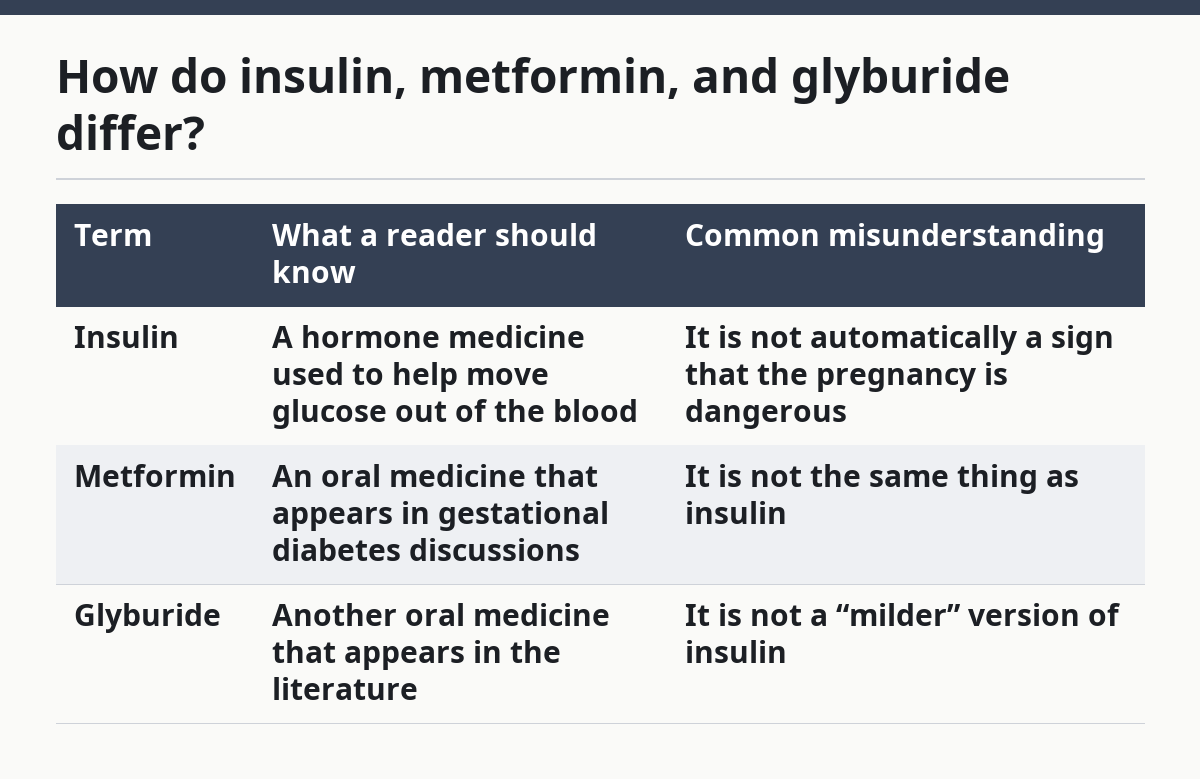
The point of this table is terminology, not prescribing. A generic article often gets this wrong by treating the medicines as interchangeable. They are not, and a qualified clinician should help compare them for any one pregnancy. They are different names, different forms, and different clinical conversations.
The abstracts in the PubMed sample also show how varied the topic is. Across 35 dose figures stated in abstract text, the median dose figure is 81 mg, with a range of 4–162 mg, and across 48 duration figures stated in abstract text, the median study duration is 27 weeks, with a range of 1–104 weeks, all from PubMed (NCBI) records read for this topic. Those are study details, not recommended doses or schedules.
That is why this page does not tell a reader what dose to start or what medicine is “best.” The numbers in the literature do not turn into a personal plan without a clinician.
How do I sort the questions people ask?
So, start by separating the question about the name of the medicine from the question about whether medicine is needed at all. That keeps the reader from mixing terminology with treatment decisions.
- Write down the exact question: Is it about “what is it,” “when is it used,” or “which medicine is common?” Verify that the question fits one of those three buckets. If it mixes all three, the answer will be confusing.
- Check whether the issue is blood sugar, not a label: Look for the word blood sugar in the source or note it in your chart. If the question is really about numbers, the medication name comes second. A problem is asking about a drug before the glucose pattern is clear.
- Identify the medicine class: Decide whether the text is talking about insulin, metformin, or glyburide. Verify the class before comparing anything else. If the source never names the drug, it is too vague to trust for a decision.
- Look for timing language: Search for phrases like “when medication is used,” “after monitoring,” or “if targets are not met.” That tells you the article is about decision points, not a prescription. If it jumps straight to a drug name, it may be skipping context.
- Check whether the page mentions pregnancy-specific care: Gestational diabetes sits inside prenatal care, not generic diabetes care. Verify that pregnancy is part of the discussion. If not, the article may be too broad to answer your question well.
- Look for any statement about what the page does not cover: A useful page will say when it stops, such as not covering full treatment decisions or insulin types. That boundary matters. If the page claims to cover everything, it is probably too shallow.
- Confirm where to go next: A good navigation page should point you to the next layer, such as a treatment page or a medicine-specific page. If the next step is missing, you may end up rereading the same summary. That wastes time and keeps you from the answer you actually need.
This is the place where many readers get stuck. They want a single yes-or-no answer, but the real question is often whether they need a medicine discussion, a monitoring discussion, or a full treatment discussion. Those are not the same thing, and mixing them leads to bad searches.
Which misunderstandings come up most often?
However, the most common misunderstandings are that medication always means insulin, that medicine means the pregnancy is failing, and that one general article can safely answer every pregnancy question. None of those is reliable.

One mistake is treating metformin and glyburide as if they were just alternate spellings of insulin. The consequence is confusion about how the medicine is discussed in studies and in clinic notes. The correct alternative is to name the drug and its class before comparing it to anything else.
Another mistake is assuming medication is always needed. The consequence is unnecessary fear. The correct alternative is to remember that medication is considered when blood sugar patterns need extra help; it is not a default for every case.
A third mistake is reading a trial summary as a personal prescription. The consequence is false certainty. A trial with a median planned enrolment of 200 participants does not tell one person what to do in a specific pregnancy.
A fourth mistake is focusing on dose figures without context. The consequence is misuse of numbers. The correct alternative is to treat figures like the median 81 mg abstract dose as study text, not as a recommended amount.
When should this page stop and a clinician take over?
Therefore, this page should stop whenever the question moves from terminology into personal care decisions. That boundary is not a formality; it protects the reader from using the wrong answer.
If blood sugar readings are persistently outside the expected range: that means the topic is no longer just educational — speak with a qualified pregnancy-care clinician about next steps.
If the medicine name is already on your chart and you are unsure why: that means you need individualized explanation — ask the clinician who prescribed or reviewed it.
If you are trying to compare insulin with metformin or glyburide for yourself: that means the question is treatment choice, not definition — use the treatment-specific page or ask a clinician.
If you are reading about doses online: that means you are in a high-risk area for misunderstanding — do not copy a number from a study abstract, because study figures are not instructions.
If you have a question about side effects, other conditions, or a past pregnancy: that means the answer depends on your medical history — get a personalized review rather than a general FAQ.
That is the honest limit of a navigation page. It can define the terms and show the map. It cannot replace the person who knows your pregnancy, your readings, and your chart.
What does the evidence landscape look like?
Overall, the evidence landscape is active, mixed, and not dominated by one study type. That is why readers encounter review articles, trial reports, and clinical summaries all at once.
PubMed shows 353 matching human records for 2016–2026 on this topic, and the 100 most relevant had a median publication year of 2022. Of those 100, 28 were Reviews, 12 were Systematic Reviews, 6 were Meta-Analyses, 6 were Randomized Controlled Trials, and 4 were Observational Studies, all from PubMed.
ClinicalTrials.gov also shows that the topic is still under study. Of the 22 registered trials read, 8 are completed and 14 are not yet complete or not active in the same way, with most recorded at Na and only one Phase 3 and one Phase 4 among the records read. The median planned enrolment is 200 participants, which suggests many studies are modest in size rather than huge.
A reader should take one clear lesson from that pattern: this is a living topic, not a settled slogan. That is why the safer use of a page like this is orientation, not self-direction.
What is gestational diabetes medication?
Meanwhile, gestational diabetes medication is medicine discussed for blood sugar control during pregnancy when non-medicine steps are not enough. The name usually refers to insulin, and sometimes metformin or glyburide appears in the discussion.
It is not a single drug and it is not a cure. For a personal plan, a qualified clinician should interpret your pregnancy, your readings, and your other medical history.
Is medication always needed for gestational diabetes?
However, medication is not always needed for gestational diabetes. Some people manage blood sugar with non-medicine steps, while others need a medicine discussion if readings stay above the expected range.
The exact answer depends on the person and the pregnancy. If you are trying to decide for yourself, that is the point to speak with a qualified clinician.
Which medicine is most common for gestational diabetes?
Finally, insulin is the name most readers hear first, so it is often the most familiar medicine in this topic. Metformin and glyburide also appear in the literature and in patient questions.
Familiar does not mean best for every person. The right medicine discussion depends on the pregnancy, the blood sugar pattern, and the clinician’s plan.
Drafted with AI; not yet reviewed by a person.