Last updated: November 19, 2026
A teaspoon of sweetness can get complicated fast in pregnancy. If you have gestational diabetes and want something sweet, the safest short answer is to ask your care team about stevia, sucralose, and sugar alcohols before you use them regularly. This article on Gestational Diabetes Safe Sweeteners: Which Ones to Ask About sorts out what each one is, what labels can hide, and which sweeteners deserve a real question at your next visit.
The count below uses public research records: 714 PubMed human records match this topic for 2016–2026, and the 100 most relevant plus 21 registered ClinicalTrials.gov studies were read and counted on 2026-11-08. For a quick answer, the best-supported starting point is to ask about 3 sweetener groups: stevia, sucralose, and sugar alcohols.
Speak with a qualified professional about your own situation before you change what you sweeten.
Key takeaways
- Stevia, sucralose, and sugar alcohols are the main sweeteners people with gestational diabetes usually ask about first.
- Label reading matters as much as the sweetener name because many foods mix sweeteners with sugar, starches, or fats.
- Beverages and desserts are the easiest places to get surprised by added sweeteners.
- Sugar alcohols can still raise blood sugar in some people, and they can also cause stomach upset.
- The right choice depends on your glucose readings, the food you want to sweeten, and what your clinician says fits your pregnancy.
What should I ask about first?
Ask about stevia, sucralose, and sugar alcohols first. Those are the sweeteners most people run into in drinks, yogurt, gum, candies, and “sugar-free” desserts, and they are the ones most worth a label check.
Mixed products are the catch. “Safe” does not mean “free pass.” A sweetener can be low in carbohydrate and still come wrapped in a product that has plenty of starch, sugar alcohols, or serving-size tricks. The label, not the front-of-pack promise, is where the answer usually lives.
A quick way to think about it:
- Stevia: plant-derived sweetener used in packets and drinks.
- Sucralose: very sweet, often in tabletop packets and diet drinks.
- Sugar alcohols: often used in “sugar-free” candy, baked goods, and gum; examples include erythritol, xylitol, sorbitol, and maltitol.
The literature picture is broad but uneven. On PubMed, 714 human records match this topic for 2016–2026, and in the 100 most relevant records, 58 are tagged Review, while only 7 are Randomized Controlled Trial and 2 are Systematic Review, all counted on 2026-11-08 from PubMed (NCBI). That means many pages and many opinions exist, but fewer high-grade trials than readers often assume. And honestly, that gap matters. The same search also shows why Gestational Diabetes Safe Sweeteners: Which Ones to Ask About deserves a careful, source-based approach rather than a quick assumption.
Stevia: the sweetener people ask about most
Stevia is usually the first sweetener to ask about because it gives sweetness without sugar grams. In drinks, tea, coffee, and some desserts, it can be a practical way to lower sugar exposure without giving up sweetness.
Because stevia is easy to spot once you know the name, it often appears as “stevia leaf extract,” “steviol glycosides,” or a brand blend in packets and beverage mixes. That helps when you are trying to keep a routine cup of tea or a plain yogurt from feeling bare.
The best part, for some people, is that stevia can simplify a familiar routine. It is not a universal fix, but it can be one option among several. Some blends also add dextrose or maltodextrin to help the packet measure and pour, so the front label can look sugar-free while the nutrition label tells a more complicated story.
Who should ask about stevia first:
- People who want a tabletop sweetener for beverages
- People who want to sweeten plain yogurt or oatmeal without adding sugar
- People who do not tolerate the aftertaste of some other non-sugar sweeteners
Who should be cautious:
- People who react badly to blended packets with fillers
- People choosing packaged desserts that use stevia but still contain flour, syrup, or other carbs
- Anyone using multiple sweetened products in the same day and assuming “stevia” means no impact at all
A practical caution: some studies and reviews in this area focus on sweetener exposure in general, not on gestational diabetes alone. That limits how directly any one finding applies to you. Ask your clinician how stevia fits your glucose targets and your meal plan, not just whether it is “allowed.”
Sucralose: where it helps and where it disappoints
Sucralose is the better pick when you want a very sweet taste in a small amount and you need it for drinks or tabletop use. It is common in packets, diet beverages, and some reduced-sugar foods, so it is often the easiest substitute to find.
On a shelf, “sugar free” can look reassuring. Keep the rest of the label in view. Sucralose may be the sweetener that makes that claim possible, but the ingredient list still decides whether the food fits your day.
The main strength of sucralose is convenience. It is intensely sweet, so small amounts do the job. That matters in coffee, iced tea, and some desserts where you want sweetness without spooning in sugar.
The main weakness is that sucralose often shows up in processed foods, not whole foods. That means the sweetener is only one part of the label. A “light” pudding or a frozen dessert can still have enough starch or fat to change how it fits into a meal. Like a flashy wrapper on a plain box, the front can oversell the inside.
Worth asking about if:
- You want a beverage sweetener that is widely available
- You are comparing tabletop packets and diet drinks
- You need a small amount of sweetness without adding table sugar
Less useful if:
- You are choosing a product mostly for its label claim, not for the rest of the ingredient list
- You are very sensitive to aftertaste
- You want a sweetener mainly for baking, where the rest of the recipe matters more than the packet
The trial picture still looks limited. ClinicalTrials.gov shows 21 registered studies matching this topic; 8 are completed, 5 recruiting, 3 active not recruiting, and 2 terminated, counted on 2026-11-08 from ClinicalTrials.gov. That says the field is active, but not settled enough for sweeping claims. For readers comparing Gestational Diabetes Safe Sweeteners: Which Ones to Ask About with product labels, those numbers support caution more than certainty.
Sugar alcohols: the label trap to watch
Sugar alcohols are the ones most likely to surprise you because they can still affect blood sugar and they often cause stomach trouble. They are common in sugar-free candy, gum, mints, and some baked goods, especially products built to look like dessert without using sugar.
“Sugar-free” does not mean “carb-free.” That is the trap. Some sugar alcohols are absorbed differently from table sugar, but that does not make them invisible to your body. Effects vary by person and by type.
The biggest drawback is digestive upset. Bloating, gas, and loose stools are common complaints with this group, especially when more than one sugar alcohol shows up in the same day. That matters in pregnancy because you do not want a stomach upset hiding your real meal pattern or making you avoid food you actually need.
Useful examples on labels include:
- Erythritol
- Xylitol
- Sorbitol
- Maltitol
Two label details matter here:
- The sweetener may be mixed into a product with other carbohydrates.
- The serving size may be tiny, which makes the per-serving number look friendlier than the amount people actually eat.
Sugar alcohols may be worth a question if you like:
- Sugar-free gum
- Hard candy
- Packaged brownies, cookies, or ice cream bars labeled sugar-free
They are a poor fit if:
- You are already dealing with nausea, bloating, or loose stools
- You tend to eat several “sugar-free” servings in one sitting
- You want a sweetener that is easier on the stomach than most sugar-free candy ingredients
For a reader trying to connect all this to the bigger picture, the hub page on gestational diabetes nutrition and meal planning is the right place to start after this one, because this article is only about sweeteners and label questions.
How do I read a nutrition label without getting fooled?
Read the ingredient list and the carbohydrate line together. The sweetener name alone does not tell you whether a food is likely to fit your plan, especially in beverages and desserts.
Package fronts can be persuasive. The label is where the real answer lives. You may pick up a yogurt cup, a drink mix, or a frozen dessert, and the front says “no sugar added.” That does not answer the real question. The nutrition label and ingredient list tell you whether the sweetness comes from stevia, sucralose, sugar alcohols, sugar, starches, or a blend.
The label checkpoints that matter most:
- Total carbohydrate: this is the number that usually matters more than the sweetener name alone.
- Added sugars: useful, but not the whole story.
- Ingredient order: ingredients near the top usually matter more by weight.
- Sugar alcohol line: if present, it tells you the product uses that group.
- Serving size: the tiny print can make a product look smaller than it is in real life.
A few product types need extra care:
- Beverages: sweeteners can hide in “diet,” “zero,” or “light” drinks.
- Desserts: sugar-free does not mean low-carb.
- Yogurts and puddings: often use a mix of sweeteners and thickeners.
- Candy and gum: sugar alcohols are common and can add up fast.
The most common mistake is treating the front of the package like the final answer. It is advertising. The label is the evidence, and if you are unsure, consult a clinician or dietitian before you make it a routine choice.
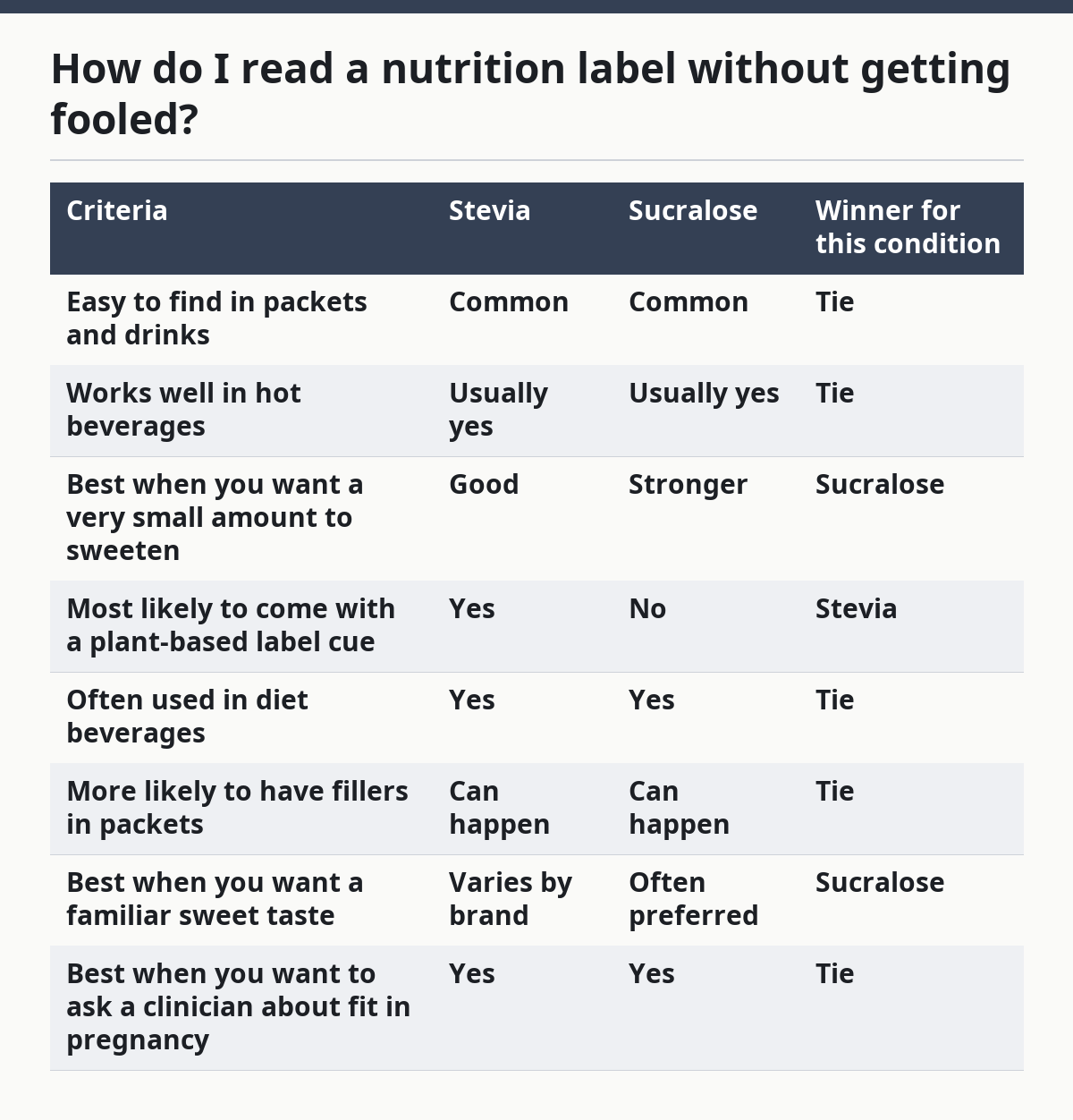
| Criteria | Stevia | Sucralose | Winner for this condition |
|---|---|---|---|
| Easy to find in packets and drinks | Common | Common | Tie |
| Works well in hot beverages | Usually yes | Usually yes | Tie |
| Best when you want a very small amount to sweeten | Good | Stronger | Sucralose |
| Most likely to come with a plant-based label cue | Yes | No | Stevia |
| Often used in diet beverages | Yes | Yes | Tie |
| More likely to have fillers in packets | Can happen | Can happen | Tie |
| Best when you want a familiar sweet taste | Varies by brand | Often preferred | Sucralose |
| Best when you want to ask a clinician about fit in pregnancy | Yes | Yes | Tie |
Which sweetener should I ask my doctor about?
Ask about the sweetener you will actually use most, not the one you saw once on a label. If your daily routine includes coffee, tea, flavored water, or a dessert swap, bring that exact product name or ingredient list to your visit.
Since routines differ, start with the options that show up most often in your own food routine:
- Stevia if you want packets or plant-derived sweetening
- Sucralose if you use diet drinks or tabletop packets
- Sugar alcohols if you eat sugar-free candy, gum, or baked goods
- Any mixed product that lists more than one sweetener
The real question is not “Is this sweetener safe in the abstract?” It is “Does this sweetener fit my blood sugar pattern, my stomach, and the food it comes in?” That is why the same ingredient can be fine in one setting and annoying in another.
A few situations deserve a closer question:
- You see multiple sweeteners in one product.
- The product is a dessert with a long ingredient list.
- You rely on the item every day, not once in a while.
- You notice stomach upset, headaches, or a stronger sweet craving after using it.
One thing the research record makes clear: this topic is full of reviews, but the number of completed trials is still modest. On ClinicalTrials.gov, the median planned enrolment across the 21 registered studies is 99 participants, with a range from 5 to 3,442, counted on 2026-11-08. That is enough to justify questions, not enough to pretend every answer is settled. Gestational Diabetes Safe Sweeteners: Which Ones to Ask About is therefore best used as a discussion starter, not a substitute for individualized advice.
What should I skip for now?
Skip any sweetener or product that leaves you guessing about the label, the serving size, or your own symptoms. That includes mixed sweeteners, sugar-free desserts that are really carb-heavy, and sugar alcohols. Some people are touchy about aftertaste or stomach effects, so it makes sense to pause, check the ingredient list, and only try it again if it still fits your day.
Drafted with AI; not yet reviewed by a person.