
Last updated: November 19, 2026
Key Takeaways
- Handle a 2 a.m. reading by keeping the room dim, sampling fast, and logging the result before sleep returns.
- Check the setup before standing so the test stays quick and sleep disruption stays small.
- Don’t treat the nighttime check like a casual glance at the meter; ask your care team if anything seems off.
- Stop treating it as routine when the result or situation no longer looks routine; contact a professional for guidance.
A 2 a.m. glucose check for gestational diabetes can feel like the hardest part of the night because it breaks sleep. For Gestational Diabetes Nighttime Glucose Checks: How to Handle 2 a.m. Readings, the practical answer is to keep the room dim, check with the glucose meter, record the number, and call your care team if the reading or pattern worries you. The steps below settle how to do the check, how to log it, and what makes a nighttime reading worth a callback.
Who this applies to, and what you should already know
This applies if your prenatal team has already told you to do an overnight glucose check with a glucose meter, often because they want one specific night reading tracked for gestational diabetes monitoring at home. It assumes you already have the meter, strips, lancet, logbook, and an alarm, and that you know your team’s target range for fasting or overnight checks.
If you have never been told to check at night, do not add a 2 a.m. reading on your own. Timing changes can make the pattern harder to interpret, and your clinic may be using a different schedule for a reason. The best fit here is usually a person who has an order, a meter, and a simple logbook entry to make, but your clinician should confirm the plan.
A practical note: this topic is about the overnight check itself, not bedtime snacks, fasting length, or the full testing schedule. Those belong on other pages in the hub on gestational diabetes monitoring at home. For your own situation, speak with a qualified professional about what your numbers mean.
How do you handle a 2 a.m. glucose reading?
You handle a 2 a.m. reading by keeping the room dim, taking the sample fast, and writing down the result before you go back to sleep. PubMed shows 1,207 matching human records for 2016–2026; the 100 most relevant were read, and the figures below are computed from that sample, using PubMed (NCBI) on 2026-11-10. ClinicalTrials.gov lists 39 registered trials for this term; the first 39 were read, with the same kind of count-based method on 2026-11-10.
- Set the alarm for the exact time your team gave you, then place it across the room if you tend to sleep through it. Verify that it is loud enough to wake you once, not multiple times. A problem is an alarm you keep snoozing, because that turns one clean reading into a broken sleep pattern.
- Switch on the bedside lamp before you stand up, and keep the main room dark. Verify that you can see the meter screen and strip slot without turning on harsh overhead light. A problem is bright light that makes it hard to fall back asleep.
- Prepare the glucose meter on the nightstand with a strip already ready, if your device and instructions allow that. Verify that the meter is turned on and the strip is inserted correctly before you prick your finger. A problem is fumbling for supplies while half asleep.
- Clean your hands if your clinic has told you to do so, then dry them fully. Verify that your fingers are dry before the sample, because water, lotion, or food residue can skew the strip. A problem is a reading that seems out of line with the rest of your pattern.
- Lance the side of a fingertip and collect the blood sample as directed by the meter. Verify that the strip fills properly and the meter gives a clear reading, not an error code. A problem is repeated strip errors, which usually means the sample was too small or the strip was not seated well.
- Record the number in your logbook right away, along with the time and any note that matters, such as “woke naturally” or “had trouble returning to sleep.” Verify that the entry is legible and complete. A problem is a naked number with no time attached, because that is hard to interpret later.
- Put everything back in the same place and go back to bed without starting another task. Verify that the meter is closed, the lancet is safe, and the lamp is off. A problem is staying up to recheck “just in case,” which can leave you fully awake for an hour.
What does a good overnight setup look like?
A good setup is boring on purpose. Because your meter, strips, lancet, and logbook sit together, the bedside lamp gives enough light to read the screen, and the alarm is the only thing that forces a wake-up, the whole sequence should take a few minutes, not a long overnight project.
If you need to walk through another room, search drawers, or turn on bright ceiling lights, the setup needs work. The goal is a single reading with the least sleep disruption possible. A repeated battle with the routine usually means the supplies are not staged well.
What should the log entry include?
A useful log entry has the reading, the time, and the context in one line. Write “2:00 a.m., 94, woke by alarm,” or a similar plain note your clinic can read without guessing. If your meter stores time stamps automatically, still keep the paper or app note if that is your usual process.
The logbook is not just for the number. It helps your care team tell the difference between a true overnight pattern and a one-off disturbed night. Without the time, the result has less value.
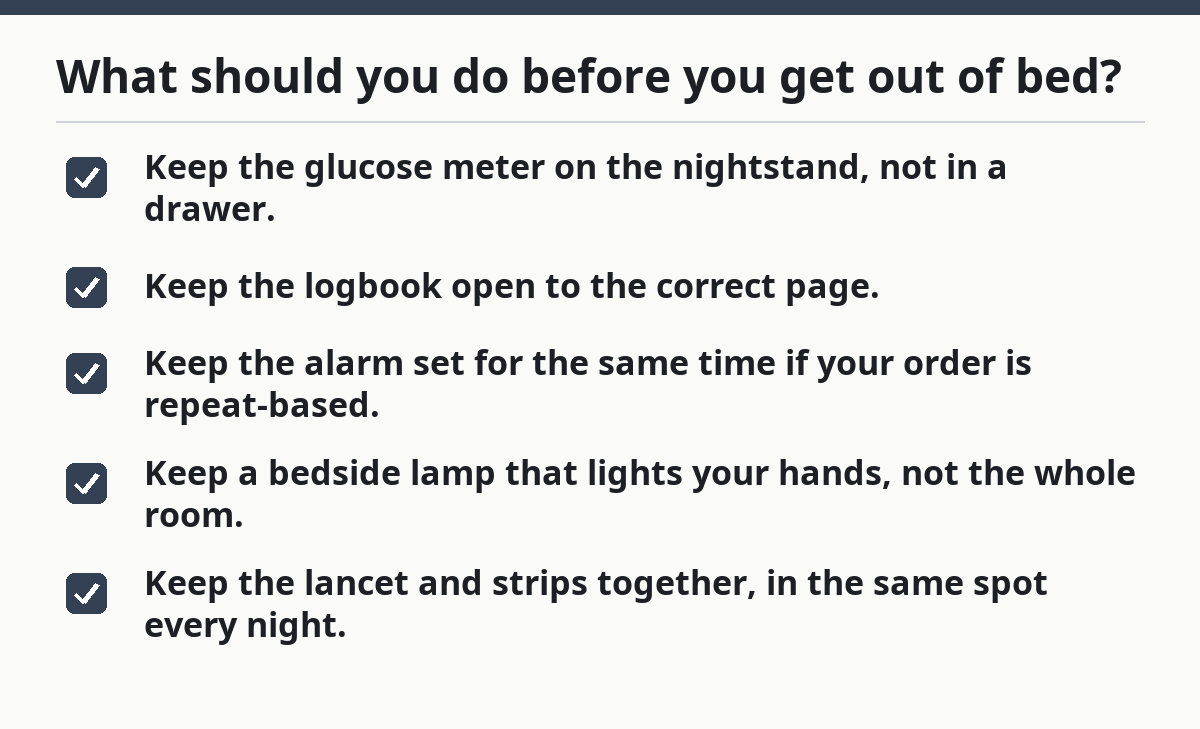
What should you do before you get out of bed?
You should check the setup before you stand up so the reading stays quick and your sleep disturbance stays small. The first few seconds matter more than most people expect, because a forgotten strip or dead meter can turn one check into a long wake-up.
- Keep the glucose meter on the nightstand, not in a drawer.
- Keep the logbook open to the correct page.
- Keep the alarm set for the same time if your order is repeat-based.
- Keep a bedside lamp that lights your hands, not the whole room.
- Keep the lancet and strips together, in the same spot every night.
The catch is that a neat setup is part of the medical task, not a comfort extra. A messy one raises the chance of a missed strip, a bad sample, or a reading that has to be repeated. That is why the setup matters even on nights when you are tired.
When is a nighttime check ordered, and when is it not?
A nighttime check is ordered when your prenatal team wants one more piece of data about your glucose pattern, usually because the day readings alone do not tell the whole story. It is not something every person with gestational diabetes needs every night. The schedule varies by individual.
Here’s the catch: the order may be looking for a specific point in the night, not a random wake-up reading. That means your assignment is to follow the instruction as written, not to improvise based on how you slept. If the time is unclear, ask the clinic that gave the order.
Situations that change the plan
Your instructions mention a specific hour: that time is the target, not a loose window — use the exact alarm your clinic gave you.
You wake before the alarm: the reading may still be useful, but only your care team can say whether to log it as the scheduled check — ask how they want early readings recorded.
Your meter gives an error: the sample or strip likely failed — repeat the check once with fresh supplies, then contact your team if it keeps happening.
You missed the check completely: the data point is missing, and guessing does not fix that — record that it was missed and tell the clinic if the pattern matters to them.
You feel shaky, sweaty, or unwell: symptoms matter more than the routine — get qualified help quickly, because a symptom-based problem should not be managed as a simple log entry.
What mistakes make 2 a.m. readings harder to use?
The most common mistake is treating the nighttime check like a casual glance at the meter. It is a structured reading, and small errors in timing, lighting, or logging can make it much less useful. These problems are common enough that they deserve a short checklist.
- Bright overhead light: it wakes you fully and makes it harder to return to sleep. Use a bedside lamp instead.
- Late logging: the number gets forgotten or written wrong. Write it down immediately in the logbook.
- Missing the time: the reading loses context. Add the exact hour.
- Using wet or sticky fingers: the sample can be unreliable. Dry hands before the fingerstick.
- Hunting for supplies in the dark: the process gets longer and more disruptive. Stage the meter, strips, and lancet before bed.
On the flip side, simple and repeatable is the right standard here. You are not trying to make the room bright, the check perfect, or the night “productive.” You are trying to collect one trustworthy data point and go back to sleep.
When should you stop treating it as a routine check?
You should stop treating it as a routine check when the result or the situation no longer looks routine. The point of the overnight glucose check is to gather data, not to push through warning signs.
A reading that is clearly outside your team’s target: this may need follow-up — contact the qualified professional who is managing your gestational diabetes.
Repeated meter errors: this suggests the device or strip process is failing — check the setup once, then get help if it keeps happening.
New symptoms during the night: shaking, sweating, dizziness, or feeling faint change the situation — seek prompt medical guidance rather than waiting for the next scheduled test.
You are too sleepy to do the step safely: a rushed fingerstick can lead to a bad sample or a spill — sit down, reset, and try again only if you can do it safely.
The schedule conflicts with your sleep in a way you cannot manage: the plan may need adjustment — ask the team that ordered the check how they want it handled.
How do you avoid fully waking up?
You avoid fully waking up by making the check short, quiet, and predictable. A bedside lamp, a prepped meter, and a logbook within reach do more for sleep than any clever trick. The fewer decisions you make at 2 a.m., the better.
Use a lamp with just enough light to see the strip and screen. Keep the room cool and dark otherwise. Then finish the reading, write it down, and return to bed without checking messages or starting a second task.
The truth is, some sleep disruption is unavoidable. The goal is not to eliminate it. The goal is to keep it brief enough that you can fall back asleep without turning one reading into a wakeful hour.
Why this page stops here, and what belongs elsewhere
This page stops at the overnight check itself, because that is the question a person asks when they are awake at 2 a.m. It does not tell you what to eat before bed, how long to fast, or when to schedule all home tests.
That separation matters. A bedtime snack page answers food choices, a fasting page answers the overnight gap before blood work, and the monitoring hub answers the broader home-testing plan. This page only covers the practical reality of the overnight glucose check: safe lighting, sleep disruption, logging, and what to do when the reading looks off.
For more context on the broader pattern, the monitoring hub on gestational diabetes monitoring at home is the right next stop. This page is the narrow tool.
Frequently asked questions
Do I need to wash my hands for a nighttime check?
Yes, if your clinic has told you to wash before testing, follow that instruction. Clean, dry hands help prevent an inaccurate sample from lotion, food residue, or damp skin. If your hands are already clean and dry and your care team has given different instructions, follow the plan you were given.
How do I avoid fully waking up?
Use a bedside lamp, keep the meter and logbook within arm’s reach, and do the same sequence every night. The less you search for supplies or turn on bright lights, the easier it is to fall back asleep. A short routine is better than a perfect one.
Should overnight readings be logged differently?
Yes, they should be logged with the time and a short note that says it was an overnight check. That gives the reading context, which matters when someone reviews patterns later. If your clinic uses a paper logbook or an app format, match the way they want overnight entries labeled.
What if I miss the alarm?
Write down that the reading was missed instead of guessing a value. Then tell the team that ordered the check if the result changes how your pattern is being interpreted. A guessed number is less useful than a documented miss.
Drafted with AI; not yet reviewed by a person.