
Last updated: November 19, 2026
Quick answer: Gestational diabetes carbs at lunch can be lower than dinner when your glucose stays steady and your care team agrees. Talk with a qualified professional about your own numbers before changing your daily carbohydrate distribution. The steps below show how to keep lunch workable when dinner is your largest meal.
Key Takeaways
- Lunch does not have to match dinner gram for gram.
- The goal is a steadier carbohydrate budget across the day, not a perfect split.
- A lunch plate built around protein, vegetables, and a measured carb portion often works better than a plain sandwich or a big bowl of pasta.
- If dinner is the biggest meal, the fix is usually planning, not skipping lunch.
- Meal timing matters as much as meal size for many people.
- If your readings run high or low after changing meal size, the plan needs a professional review.
Who this applies to, and what it assumes
This approach applies to someone with gestational diabetes who already has a meal plan, knows their blood glucose checking schedule, and needs lunch to stay smaller because dinner is the family’s biggest meal. It assumes you are not trying to redesign the whole day from scratch.
The practical question is how to shape your daily carbohydrate distribution so lunch stays manageable without making dinner a carb free-for-all. PubMed lists records matching this topic for 2016–2026; the literature is broad enough that a focused search can turn up recent reviews and clinical studies. Use the search rule: gestational[Title/Abstract] AND diabetes[Title/Abstract] AND nutrition[Title/Abstract] AND humans[MeSH Terms], filtered to PubMed, publication date, 2016–2026, sorted by relevance.
A lot of the literature is review-heavy. That is one reason practical guidance still leans on mixed evidence and clinical judgment.
- Map your lunch window by writing down the 4 to 6 hour span that usually separates breakfast, lunch, and dinner; verify that lunch is not being pushed so late that you arrive at it ravenous, because that is where oversized portions tend to happen.
- Set one lunch target with your care team or meal plan, then keep lunch within that single target instead of letting it drift day to day; a changing target is a common reason readings get hard to interpret.
- Build the lunch plate around protein, non-starchy vegetables, and one measured starch, such as bread, rice, beans, fruit, or milk; verify that the starch is the only part that is “free to grow,” because the rest should stay steady.
- Shift carb load earlier if lunch is light but you feel shaky by mid-afternoon; move a small amount of carb from dinner to lunch and verify that dinner still leaves room for a normal reading, not a rebound spike.
- Trim lunch extras such as juice, sweet coffee drinks, dessert, or oversized chips; verify that the meal still contains enough food to prevent a crash two hours later, because too little lunch can backfire.
- Keep the snack intentional if lunch has to stay small; choose a planned snack between lunch and dinner so the gap does not become a grazing session, and verify that the snack is part of the day’s budget, not “bonus” food.
- Check the same timing for a few days in a row, using the schedule your clinician gave you; verify that you are comparing like with like, because a 2-hour reading after one lunch means something different than a 1-hour reading after another.
- Record the pattern of what you ate, when you ate it, and what your reading showed; verify that the issue is truly lunch size and not sleep, stress, or a later dinner, because those can muddy the picture.
The best part is that you do not need a perfect lunch to make this work. You need a repeatable one.
Should lunch be smaller if dinner is the biggest meal?
Yes, lunch can be smaller than dinner if your glucose pattern stays in range and your plan allows that shape. The point is not equal meals; it is a steady daily carbohydrate distribution that your body handles predictably.
Here’s the catch: a very small lunch often looks harmless on paper and feels fine for an hour, then turns into strong hunger before dinner. That is where people overcorrect at the next meal. A lunch plate that includes protein, fiber, and some carb usually works better than a tiny “diet” lunch.
What usually helps is a lunch that is modest, not empty. If dinner is the larger meal, lunch often needs enough food to prevent afternoon grazing, but not so much starch that it crowds out your evening plan. That trade-off is the heart of the problem.
How do I spread carbs across the day without making lunch miserable?
You spread carbs by protecting the lunch plate from hidden extras and moving some of the day’s starch where it fits best. A carbohydrate budget is just the total amount your plan allows across meals and snacks, then divided in a way you can live with.
The literature does not give one perfect split for everyone. Current research is broad, with recent reviews and clinical studies both contributing to the picture, so a one-size-fits-all lunch formula is not realistic.
- Count the carb parts on lunch and keep them to one main source.
- Choose one starch instead of stacking bread, chips, fruit, and dessert.
- Add protein such as eggs, chicken, tofu, fish, beans, or yogurt.
- Add non-starchy vegetables like salad, cucumber, peppers, broccoli, or green beans.
- Move extra starch to dinner only if dinner readings stay acceptable.
- Use a planned snack if the gap between lunch and dinner is long.
- Keep timing steady for several days before judging the pattern.
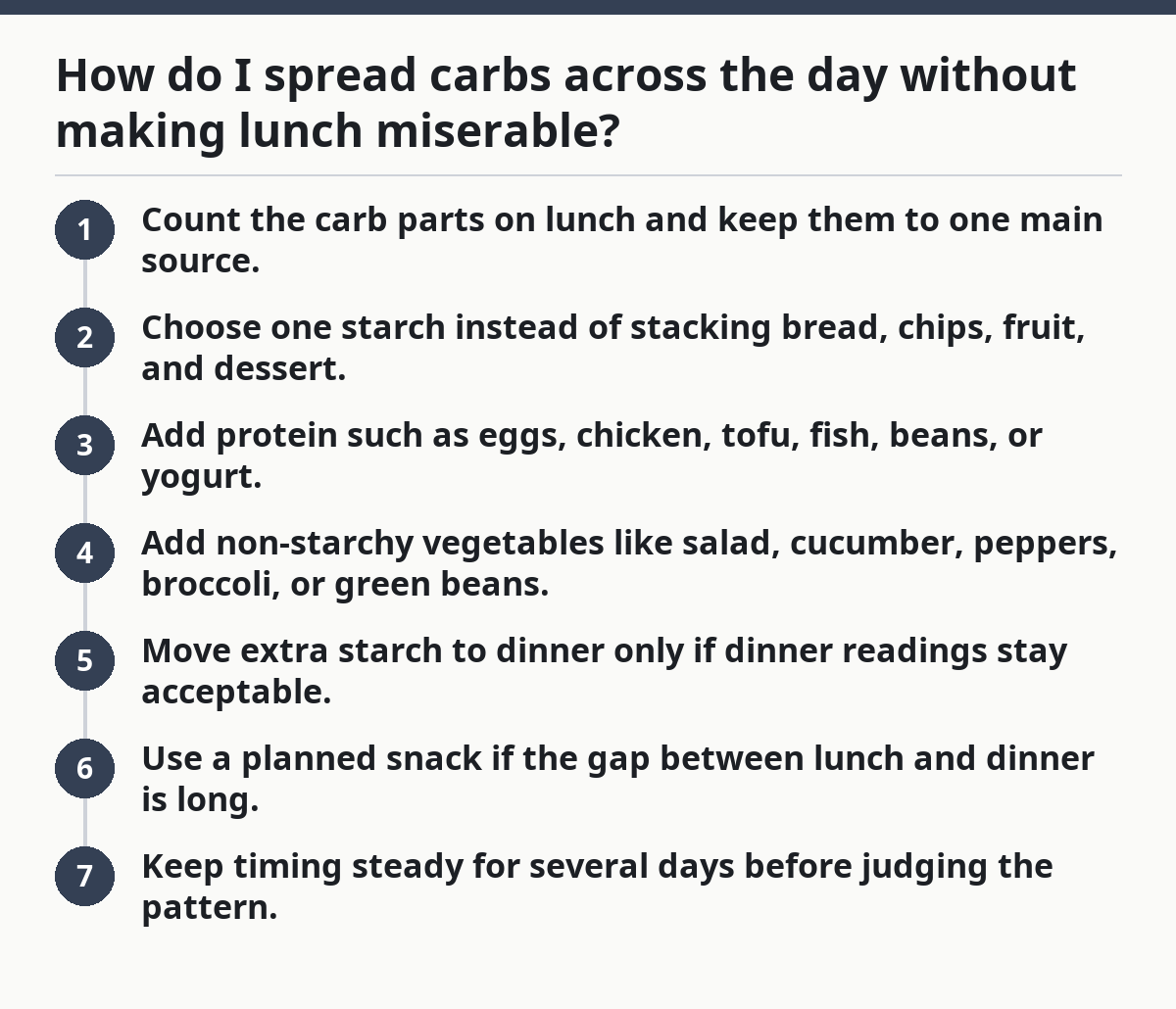
A lunch plate that is built this way often feels less restrictive than it sounds. The trick is that the lunch meal stays complete. It is not a skipped meal with a label on it.
What should a lunch plate look like in real life?
A lunch plate should look boring enough to repeat and balanced enough to hold you until the snack or dinner. That means one measured carb, a clear protein source, and something with fiber. It does not need a recipe list to be useful.
A generic article often gets this wrong by talking only about “healthy choices” and never saying what that means at the table. For lunch, that can be a turkey sandwich on whole grain bread with vegetables, a salad with beans and a roll, or leftovers that keep the starch visible and not doubled up.
The practical test is simple: if lunch is finished in 10 minutes and you are hungry again in 60, it was probably too light.
Use the lunch plate to protect the rest of the day.
- One starch source, not three.
- One protein anchor.
- Vegetables that add bulk without turning lunch into a carb bomb.
- Water or an unsweetened drink instead of sugar drinks.
- A snack only if the schedule needs it.
What if dinner has to stay the biggest meal?
Dinner can still be the biggest meal, but it should not be the meal that swallows the whole day’s carb budget. If the family eats one dinner, the adjustment is usually in the size and shape of lunch, not in pretending dinner is easy to change.
On the flip side, making lunch too small so dinner can be huge often backfires. Hunger makes portion control worse, and a long stretch from lunch to dinner can push you into extra snacks. A better pattern is a normal lunch, a planned snack if needed, and a dinner that is large in volume but not automatically high in starch.
The plain rule is this: keep the dinner meal the largest by volume if that is your life, but watch the starch load. A big dinner can still be built around protein and vegetables with a measured side of rice, pasta, potatoes, bread, or dessert only if it fits your plan.
If the dinner table is nonnegotiable, lunch is the place to create room. That is the trade-off.
When should this plan change?
This plan should change if your blood glucose readings, hunger, or meal timing show that the current split is not working. In gestational diabetes, the same lunch structure can behave differently from one week to the next, and that is normal.
Frequent mid-afternoon hunger: lunch is too small or too light on protein — add more protein or fiber, not just more starch.
Repeated high readings after lunch: the lunch carb load may be too large or too fast — reduce the starch portion and check whether the carb source is less refined.
Low energy before dinner: there may be too large a gap between meals — a planned snack may fit better than a bigger lunch.
Dinner gets out of control: lunch may be too restrictive — move some carbs earlier so dinner is not the first real meal feeling of the day.
Meal timing keeps changing: readings become hard to compare — stabilize the schedule before changing the food pattern again.
These are not rare problems. They are the usual ones.
The mistakes that make lunch harder than it needs to be
The most common mistake is making lunch so small that dinner becomes a rescue mission. That often leads to overeating later, and the evening reading can rise because the meal was too large or too fast.
Another mistake is calling a meal “low carb” while stacking bread, crackers, fruit, and a sweet drink. That looks controlled but behaves like a much larger carb load. The same goes for lunch salads that hide a lot of croutons, sweet dressing, and a sugary beverage.
- Skipping lunch entirely: leads to intense hunger and bigger dinner portions.
- Treating snacks as free food: adds carb load without a clear place in the day; ask a clinician how snacks fit your meal plan.
- Changing lunch and dinner at once: makes it hard to tell what fixed the problem.
- Using liquid carbs at lunch: juice and sweet drinks can push glucose up fast.
- Ignoring timing: a late lunch can change the reading even when the food looks the same.
The fix is usually simpler than the mistake. Keep lunch visible, measured, and repeatable.
What can a clinician help sort out here?
A clinician can help you decide whether the issue is meal size, meal timing, or the carb type at lunch. That matters because gestational diabetes management is individual, and the same lunch pattern does not behave the same way for everyone.
The evidence base supports that individualized nutrition planning is the norm, not a one-size-fits-all meal split. The abstracts in the PubMed sample include a median study duration of 28 weeks and a median dose figure of 66 mg where dose was reported, but that dose figure is not a recommended amount and does not translate into a lunch plan.
A professional review is especially useful if your readings change after a meal timing shift, if nausea limits lunch, or if you are trying to keep family meals intact while still meeting your glucose targets. That is where a plan gets refined instead of guessed at.
Can I eat fewer carbs at lunch and more at dinner?
Yes, some people can shift carbs from lunch to dinner, but only if the overall day still works. The trade-off is that a lighter lunch can leave you hungry, and a larger dinner can raise readings if the starch load is too high or the meal is too late.
The safer pattern is usually a modest lunch, not a bare one, and a dinner that stays within the plan. If you want to shift the balance, do it in small steps and watch the response for a few days.
Should carb intake be even across the day?
No, carb intake does not have to be perfectly even across the day. A steady pattern matters more than a mathematically equal one, and many people need dinner to be larger for real-life reasons.
What matters is that the split is intentional. If lunch is much smaller, there should be a reason for it and a plan that keeps hunger, timing, and glucose readings in check.
How do I adjust if dinner is the biggest family meal?
Keep dinner big in volume, but not automatically big in starch. That usually means letting the meal stay family-style while you give the starch portion a clear boundary and make vegetables and protein do more of the work.
If the family meal is fixed, adjust lunch first and use a planned snack if needed. That keeps the day from turning into one very small meal and one very large one.
For broader meal timing questions, the hub page on gestational diabetes nutrition and meal timing is the better place to start before you change the whole schedule.
Drafted with AI; not yet reviewed by a person.