Last updated: November 19, 2026
Quick Answer: Bring 5 questions, 1 glucose log, and 1 clear goal to your next visit. Gestational Diabetes Care Questions to Ask at Your Next Visit should focus on your glucose logs, your meal plan, medicine options, and when to call sooner. The best next step is usually to bring your ob-gyn a short list of questions about blood sugar targets, food changes, testing, and delivery planning. This page helps you turn a routine pregnancy follow-up visit into a useful one. If you’re unsure what applies to your case, speak with a qualified professional about your own situation.
Key Takeaways
- Bring questions about numbers, not just symptoms: your glucose meter readings, meal plan, and any notes you’ve made since the last visit.
- Ask what counts as “in range” for your care plan, because targets can vary by person and by clinic.
- Medication, testing, and delivery timing are all fair topics for this visit.
- If something changes fast — fewer movements, very high readings, vomiting, or signs that worry you — ask what should trigger a call before the next appointment.
- The point of the visit is to leave with clear next steps, not guesswork.
What should I ask at a Gestational Diabetes Care Questions to Ask appointment?
Ask about your numbers, your plan, and your next checkpoint. The visit is a chance to compare your glucose logs with the care plan, then clear up anything that feels vague or hard to follow.
Picture this: you’re sitting in the exam room with your appointment notes open, your glucose meter in your bag, and a page of half-formed questions in your phone. You do not need a perfect script. You need a few sharp questions that match what is actually happening in your pregnancy.
Instead, start with these:
- What blood sugar range should I be aiming for before and after meals in my case?
- Do my glucose logs show a pattern that changes my meal plan?
- Which readings matter most to you — fasting, after breakfast, after dinner, or all of them?
- At what point would you want to talk about medicine instead of food changes alone?
- How often should I send or bring my glucose logs before the next visit?
These questions keep the visit anchored to data, not guesswork.
Use the visit to ask for a plain-English summary of the plan:
- What should I eat if I miss a meal or have morning sickness?
- Which snacks fit the meal plan best for my schedule?
- What do you want written in my appointment notes so I remember the next step?
If your ob-gyn is juggling several issues at once, ask for the one change that matters most this week. One clear change is easier to follow than five loose suggestions.
How do I prepare questions for a follow-up visit?
Write down the problems you’ve had in the last 7 days, then turn each one into one direct question. A follow-up visit goes better when your questions come from real patterns in your glucose meter readings, meals, and symptoms.
Picture this: you’ve got glucose logs on paper, in an app, or scattered across sticky notes. The job before the visit is not to make them pretty. It is to spot the places where your day keeps going off track.
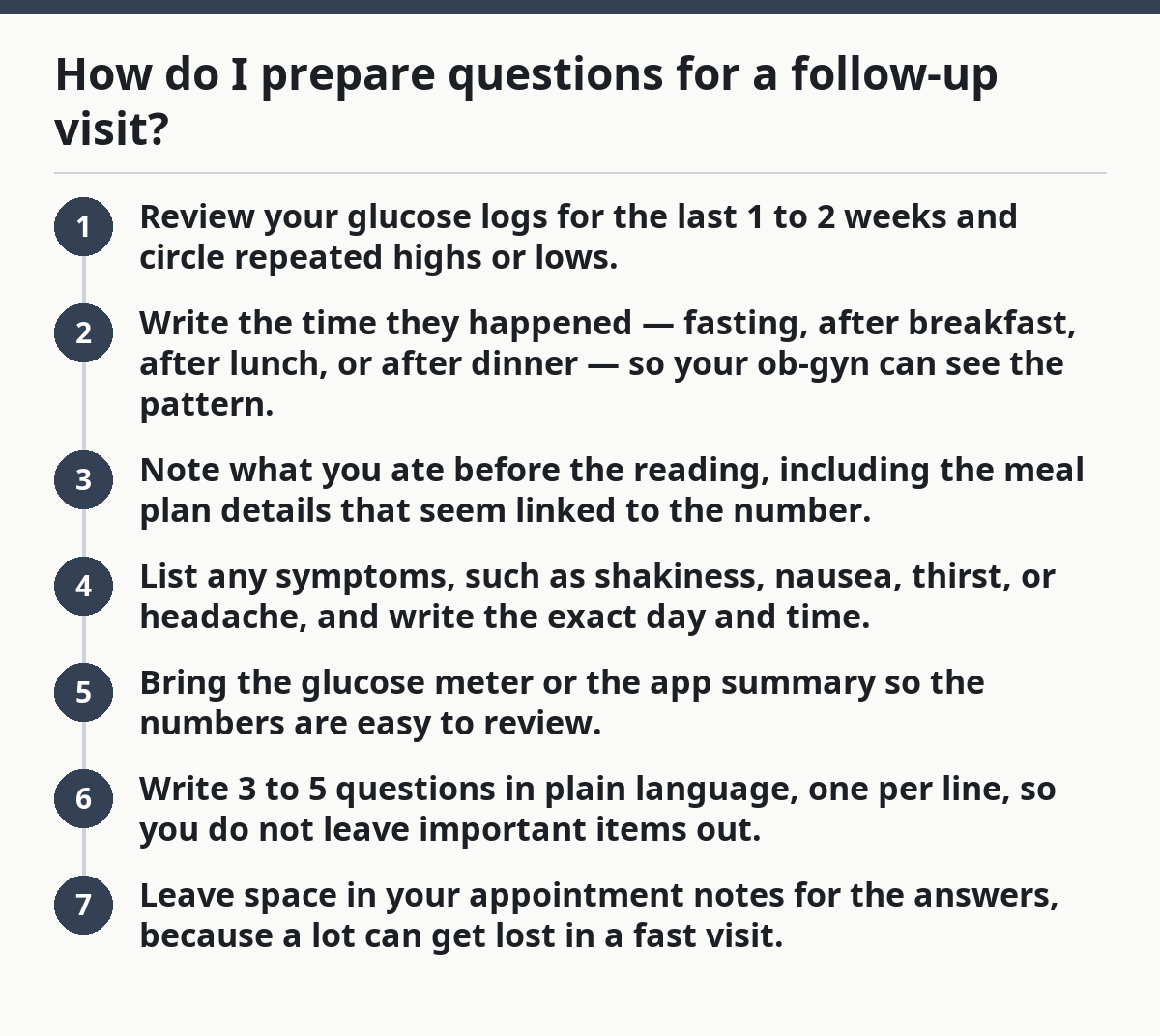
A simple way to prepare:
- Review your glucose logs for the last 1 to 2 weeks and circle repeated highs or lows.
- Write the time they happened — fasting, after breakfast, after lunch, or after dinner — so your ob-gyn can see the pattern.
- Note what you ate before the reading, including the meal plan details that seem linked to the number.
- List any symptoms, such as shakiness, nausea, thirst, or headache, and write the exact day and time.
- Bring the glucose meter or the app summary so the numbers are easy to review.
- Write 3 to 5 questions in plain language, one per line, so you do not leave important items out.
- Leave space in your appointment notes for the answers, because a lot can get lost in a fast visit.
Now, you might be wondering what makes a question “good.” A good question points to a decision. “Should I change my meal plan if my after-breakfast numbers are high three mornings in a row?” is better than “Is this normal?” because it gives your clinician something specific to assess.
Here’s the catch: if your logs are incomplete, say so. A half-finished log is still useful if it shows a pattern. The point is clarity, not perfect recordkeeping.
Which medication questions matter most?
Ask how medicine fits into the plan, what it is meant to change, and what side effects or follow-up it may bring. Medication questions matter because gestational diabetes care can change if food changes and activity alone are not enough, but that decision varies by individual and should be discussed with a qualified clinician.
Picture this: you’ve already done the hard part of tracking meals and readings, and now the conversation shifts. That can feel like a turn you didn’t expect. A good medication question does not ask for a dose. It asks how the next step is chosen.
Bring these questions to the visit:
- What signs in my glucose logs would make you consider medication?
- If medicine is discussed, what is it trying to change — fasting readings, post-meal spikes, or both?
- How will you check whether the plan is working over the next 1 to 2 weeks?
- What side effects should I watch for, and what should I do if they show up? Please discuss this with your clinician and ask whether any reliable source or handout applies to the medicine being considered.
- Will my meal plan or testing schedule change if medicine is added?
Gestational diabetes care research in PubMed has focused heavily on management choices rather than one single answer. PubMed contains thousands of related records in recent years, and that breadth is one reason individualized care matters.
The truth is, a medicine conversation should also include logistics:
- How often will you need to check your glucose meter readings?
- What happens if the readings improve after a few days?
- What should you do if you miss a planned follow-up?
If medicine comes up, ask for the reason in one sentence. If the answer is vague, ask again. You are not being difficult; you are asking for the logic of the plan.
What should I ask about testing and glucose logs?

Ask what to test, when to test it, and how the team wants the results recorded or shared. Testing questions sound simple, but they shape whether the numbers can actually guide care.
Picture this: you’ve been checking sugars at home, but you’re not sure whether the pattern in your notebook is the pattern your clinician cares about. That gap is common, and it is fixable in one visit.
Useful testing questions:
- How many times a day should I check my blood sugar with the glucose meter?
- Which readings matter most for my pregnancy follow-up visit?
- Do you want the results in a paper log, an app, or both?
- What counts as a reading that needs a same-day call?
- If I have one unusual reading, should I repeat it or just note it?
Some clinics want fasting and post-meal numbers only. Others want more context if the pattern is unclear. Ask which of your readings will drive decisions, because that makes logging more useful than copying every number without a plan.
Use the visit to clarify your appointment notes too:
- Who should receive the logs?
- When should they be sent?
- What should the note say if a meal, illness, or stress changed the reading?
A common mistake is to ask only, “Are my numbers okay?” That is too broad. Ask which number, on which day, after which meal, and what the team wants to see next.
What should I ask about my meal plan?
Ask what changes are realistic for your day, not just what foods are “good” or “bad.” A meal plan works best when it fits your schedule, cravings, nausea, budget, and the way your body responds.
Picture this: you are trying to follow a meal plan while managing work, childcare, or morning sickness. A plan that looks tidy on paper can still fail at 4 p.m. Ask questions that match real life.
Questions worth bringing:
- Which part of my meal plan should I change first if my numbers stay high?
- Do you want me to change breakfast, dinner, snacks, or the timing of meals?
- What should I do if I feel hungry between meals?
- What food combinations should I ask about so I can better understand my post-meal readings?
- If I can’t follow the plan one day, what matters most to restart the next day?
The conversation should be practical. If a plan depends on foods you never buy or prep you cannot sustain, say that out loud. A meal plan that you cannot repeat for 2 weeks is not a useful plan.
On the flip side, do not ask for a long list of forbidden foods and stop there. That kind of question often leads to a vague answer and a frustrated week. Ask for the smallest change that could improve the log.
A useful follow-up question is, “What should I write in my notes after a day when I eat differently?” That helps the next visit make sense of the numbers instead of treating them like random noise.
What should I ask about delivery planning?
Ask how gestational diabetes may affect the timing, monitoring, and staffing of delivery planning in your case. Delivery planning matters because the conversation often changes as pregnancy moves forward, and the plan can depend on glucose control, fetal growth concerns, and other pregnancy factors.
Picture this: the visit starts as a blood sugar check and ends with talk about labor, induction, or newborn monitoring. That can feel like a lot in one sitting. It’s not a sign something is wrong; it’s a sign the pregnancy has moved into a new phase.
Bring these questions:
- Does my gestational diabetes change how you think about the timing of delivery?
- What would make you want to revisit the plan before the next appointment?
- Will my baby need any monitoring right after birth because of my blood sugar history?
- What should I expect from my ob-gyn team in the last few weeks of pregnancy?
- If my readings improve, does the delivery plan change?
Delivery questions are not about predicting a date. They are about understanding what information would change the plan. If the answer depends on future readings or growth checks, ask when that decision point will be reviewed again.
This is also a good time to ask how your care team communicates. If your ob-gyn, diabetes educator, or maternal-fetal medicine clinician is involved, ask who is responsible for what. Misunderstandings often happen when more than one person is following the chart.
When should I call sooner?
Call sooner if your readings, symptoms, or pregnancy changes stop fitting the plan you were given. A routine follow-up visit is not the right place to wait out new warning signs.
Picture this: it’s been 3 days since your last log review, and something feels off. You don’t need to wait for the calendar if the pattern has changed. Ask now what the clinic wants you to do before the next appointment.
Ask about calling sooner in these situations:
- Repeated high glucose readings: this may mean the current plan is not enough — contact the clinic for guidance.
- Repeated low readings or symptoms of low blood sugar: this can signal a safety problem — ask what threshold should trigger a call.
- Vomiting, illness, or not keeping food down: your meal plan may not be workable that day — ask whether to change the testing schedule or contact the office.
- Sudden change in fetal movement: this is not a glucose-log issue — contact the obstetric team promptly.
- You cannot follow the testing plan for a day or more: the team may need to adjust how they interpret the next set of numbers — let them know.
- You are confused about which readings matter: confusion itself is a reason to call — ask for the plan in plain language.
Now, you might be wondering whether this means every odd number needs a call. Not always. One off reading can happen. What matters is a pattern, a symptom, or a change that makes your current plan hard to trust.
Ask for the office’s call rules before you leave. “Call if X happens” is far more useful than “call if needed.”
What mistakes do people make at the next visit?
People often bring data but not decisions, which makes the visit less useful than it could be. The fix is simple: connect each number or symptom to one question that asks for a next step.
Picture this: you’ve done the work, but the appointment turns into a quick scan and a few vague reassurances. That usually happens when the visit lacks a clear focus.
- Bringing numbers without context. The consequence is that the team cannot tell which meal, time, or symptom mattered — add notes to the glucose logs.
- Asking only yes-or-no questions. The consequence is a short answer that doesn’t tell you what to do — ask what changes the plan.
- Leaving out the meal plan details. The consequence is missed patterns — write what you ate before a high reading.
- Not asking when to call sooner. The consequence is waiting too long when something changes — get the clinic’s threshold.
- Assuming delivery planning is fixed. The consequence is surprise later in pregnancy — ask what could change the plan.
- Forgetting to write answers down. The consequence is leaving with half the plan in your head — use appointment notes during the visit.
A strong visit is not about asking more questions. It is about asking the right ones in a way that makes the answer usable on Tuesday, not just reassuring on the day of the appointment.
You can also bring one final question: “What is the one thing you want me to focus on before the next visit?” That question helps cut through noise fast.
Asked in plain English, what should I bring up?
Bring up the numbers, the food, the next test, and the next decision. That is the short version, and it fits in a phone note.
Drafted with AI; not yet reviewed by a person.