Last updated: November 19, 2026
Key Takeaways
- A changed reading after exercise usually reflects movement, timing, food, or stress, not a broken meter.
- Look for the same shift across several checks, not one result.
- Exercise can lower, leave unchanged, or raise glucose in gestational diabetes.
- Check the context before trusting the pattern.
A new exercise routine can change your gestational diabetes readings, sometimes lower, sometimes not, and the meaning depends on the pattern, the timing, and your usual range. Gestational Diabetes Reading After a New Exercise Routine: How to Interpret the Change starts with one simple question: what changed after the workout, and by how much? Don’t read one number in isolation. The sections below show what a real change looks like and when it needs a review from your provider or dietitian.
What a changed reading after exercise usually means

A changed reading after exercise usually means your body is responding differently to movement, timing, food, or stress—not that the meter is wrong. If you’re checking a post-exercise reading with a blood glucose meter, the number has to be read against your earlier pattern, not against a single target alone.
The evidence base is broad but uneven. A focused search can surface many PubMed records and registered trials, but the mix of reviews, trials, and observational studies is not uniform. On ClinicalTrials.gov, 24 registered trials matched the term, with 12 completed and a median planned enrolment of 202 participants.
Here’s the catch: exercise can shift readings in more than one direction.
- A lower reading after a new routine can fit a real change in glucose handling.
- A higher reading can happen if the workout was hard, short, stressful, or too close to a meal.
- A “normal” one-off number may hide a new pattern if the rest of the week is drifting.
The question is not “Did exercise work?” It’s “What changed, when, and in what direction?”
Who this is for — and who should get a review first
This applies to you if you have gestational diabetes, you just started a new exercise routine, and you want to know whether your numbers mean the plan is helping, hurting, or just shifting the timing of glucose changes. It assumes you already know how your care team has asked you to check readings and that you can compare new values with your earlier log.
If you’re seeing repeated highs, repeated lows, symptoms that don’t match the meter, or readings that move a lot from one day to the next, this is not a solo puzzle. A dietitian or other qualified clinician can help sort out food timing, exercise timing, and whether the meter pattern needs a closer look.
That matters because a post-exercise reading can be misleading if you don’t know what came before it.
- A reading taken after a brisk walk means something different from one taken after stairs, strength work, or a stressful class.
- A reading taken right after food means something different from one taken after a 20-minute cooldown.
- A reading taken on a day with poor sleep may not match your usual pattern.
If you’re unsure which number your provider wants you to watch, use the one they told you to use. If you have not been given a plan, ask before changing your routine again.
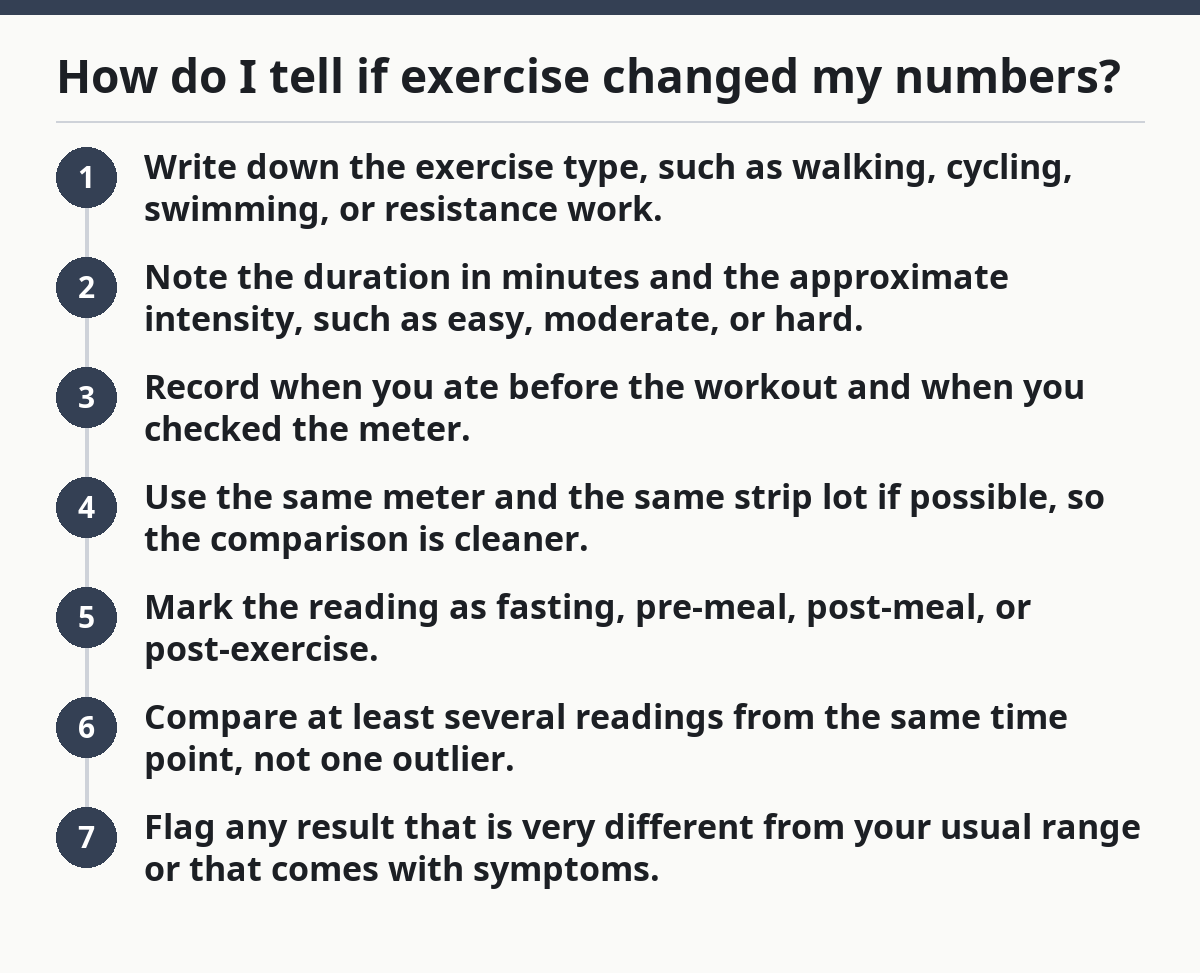
How do I tell if exercise changed my numbers?

You tell by looking for a repeatable shift across several checks, not by reacting to a single result. A true change usually shows up as a pattern across days, at the same timing of checks, with the same meal timing, similar exercise intensity, and similar sleep and stress.
Start with the reading that matters most in your routine. If your team wants a fasting number, compare fasting to fasting. If they want a post-meal number, compare the same meal window each time. A reading that is lower by chance once or twice does not prove much.
You can make the pattern easier to see with a simple log.
- Write down the exercise type, such as walking, cycling, swimming, or resistance work.
- Note the duration in minutes and the approximate intensity, such as easy, moderate, or hard.
- Record when you ate before the workout and when you checked the meter.
- Use the same meter and the same strip lot if possible, so the comparison is cleaner.
- Mark the reading as fasting, pre-meal, post-meal, or post-exercise.
- Compare at least several readings from the same time point, not one outlier.
- Flag any result that is very different from your usual range or that comes with symptoms.
A problem shows up when the numbers move in one direction over several days, not just once. A single lower value can be noise. A string of lower values, or a string of highs after the new routine, is information.
Why a workout can raise or lower a reading
A workout can lower glucose, leave it unchanged, or raise it, and all three can happen in gestational diabetes. The direction depends on what your body is doing with stored glucose during and after the activity.
Moderate movement often brings a gentler pattern than short, intense bursts. Hard effort can trigger stress hormones, which may push glucose up for a while. Food timing matters too. If you exercise soon after a meal, the reading may reflect both digestion and muscle use, not exercise alone.
A few common pattern shifts are worth knowing.
- Lower than usual after activity: often seen when the workout is steady and not too intense.
- Higher than usual after activity: can happen after hard intervals, uphill walking, or a workout done when you were already stressed.
- No clear change: may mean the routine is too brief, the timing is off, or the check is too far from the activity to show an effect.
This is why a “good workout” is not always a “lower reading.” The body does not always respond to exercise the same way.
What should I check before I trust the new pattern?
You should check the context of the reading before you trust the pattern. The number on the screen is only one part of the story, and a change in routine can alter several moving pieces at once.
Think through the check itself first. Did you wash your hands? Was the strip fresh? Was the reading taken at the same time relative to food as before? A meter can only show the blood sample it gets.
Then think through the day.
- Meal timing: A meal within the usual check window can change the result.
- Exercise intensity: Harder sessions are more likely to create a temporary rise.
- Hydration: Dehydration can make patterns look less stable.
- Illness or poor sleep: Either can push readings away from the usual range.
- Stress: A tense day can blunt the expected effect.
If the new routine is making the numbers look “better” but your checks are also drifting later, the change may be timing, not physiology. If the numbers are “worse” but you’ve changed to more intense exercise, that may be a temporary response rather than a sign the plan failed.
When should I stop reading the change as a normal adjustment?
You should stop treating it as a normal adjustment when the pattern is repeated, extreme for your usual log, or paired with symptoms that don’t fit a simple routine change. That’s the line where a provider review matters.
Repeated readings higher than your usual range: This can mean the routine is not matching your current glucose response — contact your provider or dietitian for a review of timing, food, and activity.
Repeated readings lower than your usual range: This can mean the new routine is shifting glucose more than expected — ask your care team how they want you to track the lows.
A single reading that feels wrong and you have symptoms: Dizziness, shakiness, or feeling unwell makes the number less useful on its own — recheck as instructed and seek clinical guidance.
The meter value changes a lot day to day at the same time point: This suggests the pattern is not stable yet — bring the log to your next visit rather than guessing.
The change started after a much harder workout than usual: The new intensity may be the main driver — tell your provider if you plan to keep that level up.
The consequence is simple: once the pattern stops being predictable, you need professional review instead of more self-experimenting.
The mistakes that make new exercise data hard to read
The biggest mistake is comparing a post-exercise reading with an old reading taken under a different setup. That gives you a false comparison and can make a normal shift look alarming.
Another common error is changing too many variables at once. New workout, new meal timing, new check time, new meter strip box. Then the result says almost nothing.
Here are the ones I see most often.
- Checking at random times: the result won’t line up with your old pattern. Use the same window each time.
- Judging one number: one reading can be a fluke. Look for a run of results.
- Ignoring workout intensity: a gentle walk and interval training are not the same exposure.
- Forgetting food context: a snack before exercise can change the reading more than the workout does.
- Assuming lower is always better: a lower number can be fine, but only if it stays in the range your team asked you to watch.
The fix is boring but reliable: compare like with like, write down the details, and bring the pattern to a clinician who knows gestational diabetes monitoring. That’s also where the hub on gestational diabetes monitoring and targets belongs if you need the bigger picture.
When the standard interpretation does not fit
The standard interpretation does not fit when your routine, your symptoms, or your checking schedule are unusual. That’s common in pregnancy, where fatigue, nausea, pain, and schedule changes can all interfere.
A few edge cases need special caution.
If you changed from short walks to longer sessions, the reading may reflect duration more than exercise itself. If you moved exercise closer to meals, the reading may look higher because the meal is still peaking. If you started exercise after long periods of sitting, the first week may look different from the second.
A few situations need extra care.
- You’re checking only once a day: that may miss the real shift.
- You switched to strength work: the glucose pattern may differ from walking.
- You now exercise at a different hour: the time of day can matter.
- You have another condition affecting glucose: the pattern may not follow the usual script.
- Your provider gave a different target window: follow that window, not a generic one.
The point is not to label the change good or bad right away. It’s to stop pretending every new routine should produce the same shape of reading.
What a useful log looks like
A useful log ties the number to the action. It does not need to be fancy, and it does need to be consistent for at least several days.
Write down the date, the exercise type, the minutes, the check time, the meal before or after the workout, and the reading itself. Add a short note if anything was unusual: poor sleep, a long meeting, nausea, or a harder-than-usual class.
A good log lets your provider answer a better question than “Is this normal?” It lets them ask, “What changed first—the routine, the timing, or the reading?”
- If the numbers fell after moderate movement and stayed steady, the pattern may be settling.
- If the numbers rose after harder sessions, the intensity may need review.
- If the numbers bounced around, the schedule may be too variable to interpret yet.
A log with 3 to 7 days of repeated checks at the same time point is usually more useful than a vague memory. It gives your team something they can actually read.
When to bring the pattern to your provider or dietitian
You should bring it up when the pattern is new, persistent, or hard to explain. Don’t wait for it to become a crisis if the readings are clearly different from your earlier baseline.
Bring the log if the change started after a new class, a new walking plan, or a new check schedule. Bring it if the readings are lower and you’re not sure that’s okay. Bring it if they’re higher and you’re tempted to keep experimenting on your own.
The review does not have to mean anything is wrong. It can simply mean the pattern needs a better lens. A dietitian can help connect the reading to meals and timing. Your provider can decide whether the shift fits the rest of your pregnancy care.
That’s the right use of this page: not to diagnose a trend from one number, but to help you see whether the new exercise routine changed the story the meter is telling. If the pattern still seems unclear, consult your provider or dietitian before changing the plan again.
Why did my numbers change after I started exercising?
Your numbers changed because exercise changes glucose use, stress signals, and timing, and those effects do not all pull in the same direction. A steady walk, a hard interval session, and a workout right after a meal can all produce different readings.
What matters is whether the change repeats under similar conditions. If the pattern is new and persistent, bring the log to your provider or dietitian.
Should I expect lower readings after workouts?
Not always. Many people see lower readings after moderate movement, but some see no change or even a temporary rise, especially after harder exercise or when the check is close to a meal. That variation is common in the clinical literature, including guidance from the American Diabetes Association and pregnancy exercise recommendations from ACOG.
If the result is lower, compare it with your usual range and the timing of the check. One low reading is not the whole story.
When should I tell my provider about the change?
Tell your provider when the pattern is repeated, hard to explain, or outside your usual range. A single odd reading can happen, but a string of changed readings after a new routine deserves review.
It’s also worth speaking up if you have symptoms, if the exercise intensity changed a lot, or if you’re not sure the timing of your checks still matches the plan you were given.
Drafted with AI; not yet reviewed by a person.