Last updated: November 19, 2026
Quick Answer: For most readers, the safest approach is to follow the fasting and meal timing plan your obstetric or diabetes clinician gives you, because the right schedule depends on the test, the log, and your own pattern of readings. Gestational diabetes fasting and meal timing can change the number you see, so this guide helps you sort out what usually matters, what can distort a test, and when to ask a qualified professional about your own plan.
Gestational Diabetes Fasting and Meal Timing — The Complete Guide is a practical guide to how fasting windows, meal spacing, and morning checks interact in gestational diabetes. Use the steps below to sort out what usually matters, what can distort a test, and when to ask a qualified professional about your own plan.
On PubMed, 2,188 human records match this topic for 2016–2026; the 100 most relevant were read and the medians, ranges, and shares below are computed across those records, using PubMed (NCBI) data computed on 2026-11-06. ClinicalTrials.gov shows 6 registered trials for this term, and the first 6 were read with every share, median, and range computed across them, using ClinicalTrials.gov API v2 on 2026-11-06. For background on gestational diabetes care, see the American Diabetes Association Standards of Care.
Key takeaways
- Meal timing matters because long gaps, skipped meals, and uneven carb intake can push glucose readings in the wrong direction.
- Fasting numbers are often the first thing clinicians look at, but the context around the fast matters just as much.
- The timing plan your care team uses with your glucose log is usually more useful than a generic internet schedule.
- PubMed has 2,188 matching human records for 2016–2026, and the sample is weighted toward reviews: 16 reviews, 11 systematic reviews, 10 meta-analyses, 6 randomized controlled trials, and 5 observational studies among the 100 most relevant, according to PubMed (NCBI), computed on 2026-11-06.
- The evidence base is active but not huge in high-trial volume terms: ClinicalTrials.gov lists 6 registered trials, 4 completed and 2 recruiting, with a median planned enrolment of 78 participants, according to ClinicalTrials.gov on 2026-11-06.
- For a practical overview of daily monitoring, see the NHS guidance on gestational diabetes.
Picture this: you’re trying to get a clean fasting reading in the morning, but dinner was late, the snack was tiny, and breakfast can wait or can’t wait. The answer is not “eat less” or “skip meals.” The answer is consistent timing with a professional plan, because that gives the numbers meaning. If you need a broader pregnancy diet overview, the Mayo Clinic gestational diabetes page is a useful reference.
Why fasting and meal timing matter more than most people think

Gestational diabetes fasting and meal timing change the story behind a glucose reading, not just the number on the screen. If you fast too long, eat at irregular times, or stack carbs close together, the result can look different even when the food choices seem fine.
That matters in gestational diabetes because the goal is usually pattern recognition, not one-off heroics. A single high fasting reading after a rough night is not the same thing as a stable trend across several mornings, and a log with times is more useful than isolated numbers.
Here’s the catch: the word “fasting” sounds simple, but in real life it depends on how long, what you ate before bed, and whether the test is a home check or a lab draw. Those details can shift the reading enough that a generic chart becomes misleading.
- A bedtime snack may blunt overnight hunger for some people.
- A very long overnight fast can make morning numbers harder to interpret.
- Large gaps between meals can lead to rebound hunger and less steady intake later.
- Late-night eating can complicate the next morning’s result.
The PubMed sample makes one thing clear: this topic is studied a lot, but the evidence is mixed in type. Among the 100 most relevant records, PubMed (NCBI) shows 16 reviews, 11 systematic reviews, 10 meta-analyses, 6 randomized controlled trials, and 5 observational studies, computed on 2026-11-06. That mix usually means readers should expect guidance, not a single magic rule.
The practical takeaway is simple. Meal timing is a control knob, not decoration. If your readings are hard to predict, timing is one of the first things a qualified professional will look at.
What is the fasting window in gestational diabetes?
The fasting window is the overnight stretch before a morning glucose check or lab test, and the exact cutoff depends on the test your clinician ordered. For gestational diabetes, the word often refers to the hours between the last calories of the night and the first morning reading.
That sounds obvious until the details show up. A bedtime snack at 10 p.m. and a test at 6 a.m. is a very different fast from no food after dinner until 11 a.m., so the instructions matter.
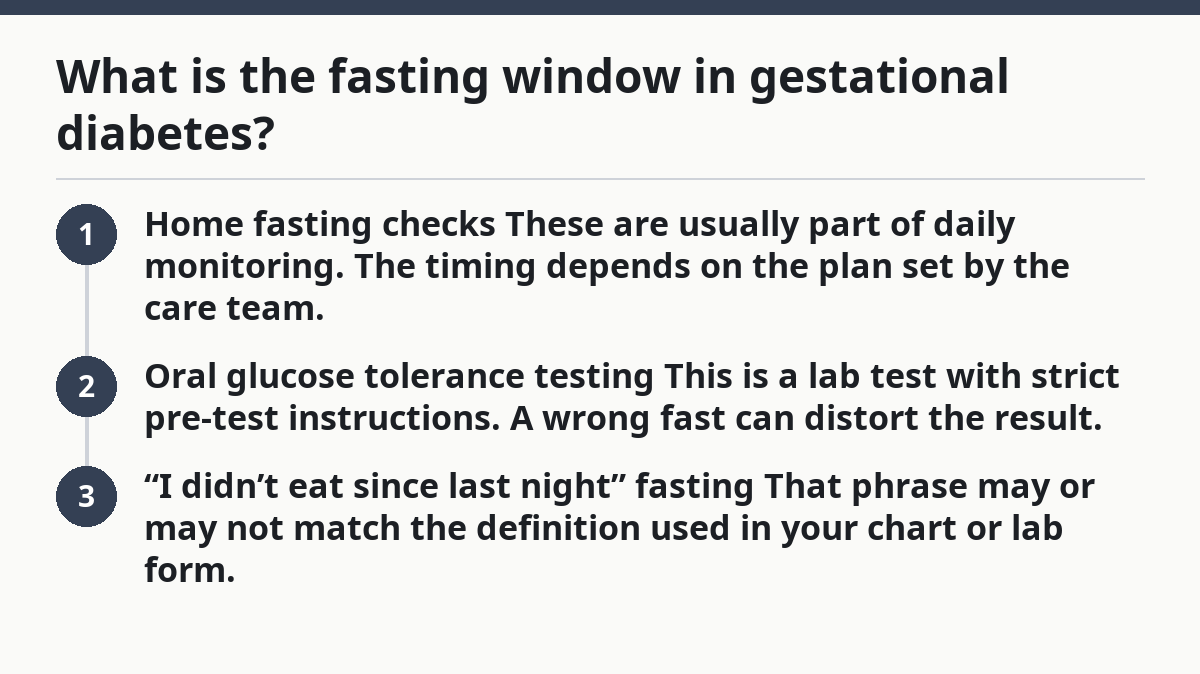
The truth is, readers often mix up three different things:
-
Home fasting checks
These are usually part of daily monitoring. The timing depends on the plan set by the care team. -
Oral glucose tolerance testing
This is a lab test with strict pre-test instructions. A wrong fast can distort the result. -
“I didn’t eat since last night” fasting
That phrase may or may not match the definition used in your chart or lab form.
A longer fast is not always the better choice, because the body’s overnight response can change the number in either direction.
If you are reading this because a lab appointment is coming up, check the written instructions from the clinic or lab. If you are looking at home readings, the key question is not “Did I fast?” but “Did I fast the way my clinician meant?”
How meal timing shapes blood sugar across the day
Meal timing shapes blood sugar by changing how much glucose lands in the bloodstream at once and how long the body has to clear it. In gestational diabetes, the spacing between breakfast, lunch, dinner, and snacks often matters as much as the food itself.
Picture this: you eat a light breakfast, then delay lunch until late afternoon because the morning got busy. The hunger builds, the next meal is larger, and the glucose curve can jump higher than expected. That is not a failure of willpower. It is a timing problem.
A common pattern in care plans is a steadier rhythm rather than long gaps. That usually means:
- breakfast after the overnight fast
- lunch at a predictable time
- dinner at a similar time each evening
- snacks if the team recommends them
- fewer huge gaps between eating windows
Some people do better with a bedtime snack; others do not. Studies suggest responses vary by individual, which is exactly why a generic rule rarely fits everyone. A morning reading may improve when the evening pattern is steadier, but that is not universal.
The most useful question is not “What is the perfect schedule?” It is “What schedule gives me the cleanest readings and the fewest swings?” The answer often comes from looking at several days, not one meal.
A practical way to think about it:
- Regular timing helps the body expect food.
- Large gaps can make the next meal hit harder.
- Late meals may affect overnight and fasting numbers.
- Skipping meals can backfire if it leads to rebound hunger.
Meanwhile, the clinical research side is still active. ClinicalTrials.gov lists 6 registered trials for this term, with 4 completed and 2 recruiting, and a median planned enrolment of 78 participants, computed on 2026-11-06. That small trial count is another reason timing advice usually stays individualized.
Should you eat a bedtime snack?
A bedtime snack can help some people and annoy others, so it is not a universal fix. The point is not the snack itself; the point is what it does to overnight fasting and the next morning’s number.
Picture this: dinner ends early, bedtime is hours away, and you wake up with a high fasting reading despite “doing everything right.” For some people, a small evening snack may reduce overnight hunger or make the morning pattern steadier. For others, it adds calories and pushes the morning number the wrong way.
The catch is that snack advice gets repeated online as if it were law. It is not. Food type, portion size, bedtime, activity, and the rest of the day all matter.
What tends to matter most in practice:
- whether the snack is part of the plan
- how close it is to bedtime
- whether it causes reflux or discomfort
- whether it changes the next fasting check
- whether it helps you avoid waking up hungry
A snack is not automatically “good” because it is small, and it is not automatically “bad” because it has carbs. In gestational diabetes, the result is judged by the pattern, not the label.
If your fasting numbers are the main problem, the bedtime snack question is worth raising with a clinician, especially if your evening meals are early or your overnight gap is very long. If your fasting numbers are already stable, forcing a snack may be unnecessary.
What to do when fasting numbers are high
High fasting numbers usually call for a pattern check first, not a panic move. The most common issue is not one bad night. It is a repeatable setup that keeps producing the same result.
Start by looking at the previous day in a plain list:
- What time was dinner?
- Was there a snack?
- What time was the last calorie?
- Was sleep short or broken?
- Was the morning reading taken at the usual time?
That quick review often shows whether the problem is meal spacing, late eating, skipped food, or something else in the routine.
Here’s the catch: fasting values can be stubborn even when meals look decent. Sleep loss, stress, illness, and unusual activity can all change the picture. That is one reason any single reading should be treated as data, not drama, and it is wise to review it with a qualified professional if it keeps happening.
The most useful next step is usually a pattern conversation with a qualified professional. They can decide whether the issue is timing, carb distribution, testing technique, or a different part of the care plan.
Keep these points in mind:
- One high fasting value is not the whole picture.
- Repeated highs deserve a closer look.
- Changing meal timing without guidance can make the pattern harder to read.
- Lab fasting rules and home fasting checks can differ, so follow the instructions for the specific test.
The reader-friendly rule is simple: write down the times, not just the numbers. A glucose log with meal times is far more useful than a list of readings with no context.
How the research looks behind the advice
The research base is broad, but the strongest message is still “individualize timing with clinical guidance.” On PubMed, 2,188 human records match this topic for 2016–2026, and the 100 most relevant records were read to compute the summary below, using PubMed (NCBI) on 2026-11-06.
Among those 100 records, 16% are tagged Review, 11% Systematic Review, 10% Meta-Analysis, 6% Randomized Controlled Trial, and 5% Observational Study, all as recorded by the NLM publication type tags in PubMed (NCBI). The median publication year in that sample is 2022.
That mix tells you two things. First, the literature is recent enough to matter. Second, the topic still leans on synthesis and smaller studies, not a huge stack of direct timing trials.
A few more figures help set expectations:
- The median abstract-stated dose across 49 dose figures is 125 mg.
- The median study duration across 60 stated durations is 26 weeks.
- Those are abstract figures, not recommended doses, and not a recipe for readers to copy.
Because of that, readers often expect the evidence to produce a fixed meal schedule with one correct fasting window and one standard snack. It usually does not. It gives trends, thresholds, and clinical patterns that still need professional interpretation.
The best article on this subject should not pretend the science is tidier than it is. The honest answer is that gestational diabetes fasting and meal timing matter, but the right timing is often personal.
The real-world timing mistakes that cause confusion
Meal timing errors can make a decent plan look broken. The biggest mistake is treating fasting as a fixed rule and ignoring the rest of the day.
Picture this: you are trying to “be good” by eating very little after dinner, but then breakfast is delayed, lunch is rushed, and dinner comes late again. The numbers may start to swing because the schedule is inconsistent, not because you failed to avoid one food.
The most common timing mistakes are these:
- Skipping breakfast when the care plan expects regular daytime meals
- Extending the fast too long overnight or into the morning
- Eating a huge late meal after a long gap
- Snacking without a plan so totals creep up without structure
- Changing too many variables at once and losing track of what helped
Now, you might be wondering whether a stricter fast is better for “keeping sugars down.” Usually, no. A stricter fast can make the plan harder to follow and the data harder to interpret. In many cases, consistency beats punishment.
A good timing plan has one job: make the next reading meaningful. If your log shows you keep eating at wildly different times, that is a stronger clue than a single high number.
When to ask for a different plan
You should ask for a different timing plan when the current one keeps producing the same bad pattern or makes daily life unrealistic. The plan is supposed to fit pregnancy, work, sleep, and hunger, not fight them.
Picture this: you are doing your best, the meals are logged, and the fasting numbers still bounce around. At that point, the issue may not be your effort. It may be that the timing plan needs to be adjusted by a qualified professional.
A different plan is worth discussing if:
- your fasting readings are repeatedly out of range for the plan you were given
- your meals are so close together or so far apart that you cannot keep them consistent
- your morning readings vary wildly despite similar evenings
- you are unsure whether your test timing matches the lab or clinic rule
- you are getting conflicting advice from different sources
Here’s the catch: changing meal timing on your own can hide the pattern your clinician needs to see. That is why it helps to bring a few days of meal times, sleep times, and readings to the appointment.
The right adjustment might be small. It might be a different breakfast time, a different bedtime snack, or a clearer fasting window. Or it might be a completely different schedule. The point is that the fix should match the pattern, not the internet.
The verdict: what timing choice is usually best
The best timing choice is the one that keeps meals regular, keeps fasting instructions clear, and gives your care team data they can trust. That usually means a steady daily rhythm, not long gaps, not random snacks, and not a self-made fasting rule.
Choose a regular meal schedule if your numbers change when your day changes, because the schedule itself is probably part of the problem. Choose a clinician-defined fasting plan if you are preparing for a lab test or if your team is using fasting readings to guide care. Neither approach should rely on eating less and less without professional input.
That is the cleanest call I can make from the evidence. It is not flashy, but it is the one that holds up.
Questions people usually ask
How long should I fast before a gestational diabetes test?
The fasting window depends on the test and the instructions from the clinic or lab, so the safest answer is to follow the written guidance for that appointment. A home fasting reading and a lab glucose tolerance test are not the same thing.
Does skipping dinner help fasting blood sugar?
Not reliably. Skipping dinner can make the overnight gap longer and can leave the morning number harder to interpret, especially if it leads to rebound hunger or a very late breakfast. A clinician can help sort out whether meal timing or meal content is the bigger issue.
Is a bedtime snack always a good idea?
No. Some people do better with one, and some do not. The question is whether it helps the overnight pattern and the morning reading, which is why it should be discussed with a qualified professional instead of treated as a blanket rule.
Why are my morning numbers high even when I ate “healthy” meals?
The issue may be timing, not just food quality. Late dinners, long overnight fasts, poor sleep, and snack patterns can all affect the morning reading, so the full day matters more than a single meal.
Should I change my meal timing on my own?
Not if the numbers are already confusing or if you are following a formal monitoring plan. Small changes can shift the pattern enough to hide the real problem, so it is better to review the log with your obstetric or diabetes clinician.
Drafted with AI; not yet reviewed by a person.