Last updated: November 19, 2026
A 7 a.m. breakfast can behave very differently from the same plate at 2 p.m. Meal timing changes blood-sugar patterns in gestational diabetes, but there is no single schedule that fits everyone. This guide to Gestational diabetes meal timing and daily routines — The Complete Guide stays focused on one practical goal: steadier intake through the day, with regular meals, planned snacks, and fewer long gaps. Quick answer: a common starting point is 3 meals and 2 to 4 planned snacks, but a qualified clinician should help tailor timing to your glucose targets, nausea, work schedule, and whether you also need medication.
Key takeaways
- Regular spacing usually matters more than “perfect” clock times.
- Long gaps without food can make some people’s readings swing more.
- Breakfast often needs the most attention because morning glucose can run higher for many people.
- A bedtime snack helps some people avoid overnight hunger or morning spikes, but not everyone needs one.
- A routine you can repeat on workdays, weekends, and bad-nausea days is more useful than an ideal schedule you cannot keep.
- If meal timing changes your readings in a confusing way, bring the pattern to your care team rather than guessing.
What meal timing is trying to do
Meal timing aims to blunt glucose peaks and keep the roller-coaster effect in check — the one that comes from eating too little too late, or too much too fast. In gestational diabetes, timing matters alongside food choice; sleep, activity, and the body’s changing insulin response all affect how a meal shows up in your readings.
Eat at fairly regular intervals. That is the core idea. Avoid very long stretches without food unless your clinician has told you otherwise, and pay attention to the meals that trigger the highest numbers. Repeatedly, that is what the gestational diabetes literature indexed in PubMed points toward. Using the selection rule gestational[Title/Abstract] AND diabetes[Title/Abstract] AND meal[Title/Abstract] AND humans[MeSH Terms], with PubMed as the database, publication date 2016–2026, sorted by relevance, 90 PubMed records match this query; the 90 most relevant were read and every median, range, and share below is computed across those records, with figures computed on 2026-10-26 from PubMed (NCBI).
The evidence base is small and mixed. Of those 90 records, 14 (15%) are tagged Randomized Controlled Trial by the National Library of Medicine, 10 (11%) are tagged Observational Study, 10 (11%) are tagged Review, 6 (6%) are tagged Systematic Review, 1 (1%) is tagged Clinical Trial, and 1 (1%) is tagged Meta-Analysis, all from PubMed (NCBI), computed on 2026-10-26. That spread matters because meal timing is often studied together with diet quality, glucose monitoring, or exercise rather than as a stand-alone fix.
The median publication year in the 90-record sample is 2021 from PubMed (NCBI), computed on 2026-10-26. So the field is recent enough to reflect current monitoring habits, yet still too small for any one timing rule to be treated as universal; for individual advice, consult your clinician and the current guidance from the American Diabetes Association and the American College of Obstetricians and Gynecologists.
The daily routine that usually works best
Breakfast, lunch, dinner, and 2 to 4 planned snacks is the most practical starting point for many people. It is structure, not magic. The aim is simple: skip the two patterns that tend to make glucose harder to predict — missed meals and all-day grazing.
A typical day can look like this:
- Breakfast within a reasonable window after waking, especially if morning readings are a problem.
- A mid-morning snack if breakfast is early or if there is a long gap before lunch.
- Lunch spaced so you are not starving by the time you eat it.
- An afternoon snack if dinner will be late or if you tend to overeat at night.
- Dinner at a predictable time when possible.
- A bedtime snack only if it fits your monitoring pattern or your care team has advised it.
Hidden upside? The routine makes readings easier to read. If the same meal gives you a higher value only when you eat it very late, that timing clue matters. If breakfast is consistently higher than lunch at the same meal size, morning insulin resistance may be part of the picture. A clinician can use that, but only if the daily routine stays steady enough for comparison.
This is where a generic article often gets sloppy. “Eat small frequent meals” sounds tidy, but it skips the trade-off: more frequent eating can ease nausea and hunger, yet it can also become constant snacking if portions are not planned. For some people, that means more total carbs than intended. For others, it means never getting hungry enough to eat balanced meals, which can make food choices worse. A little chaos sneaks in fast.
One clear answer belongs here: the routine should be repeatable, not perfect. If the schedule only works on days off, it is not yet a working schedule.
Why breakfast gets special attention
Breakfast usually gets the spotlight because many people see their highest readings there. That does not mean breakfast has to be tiny; it means breakfast often needs the most deliberate composition and timing.
Morning glucose handling can be less forgiving, so the same food eaten at 7 a.m. may not behave the same way it would at 2 p.m. That is why a breakfast that works for one person may not work for another, even when both are following the same general meal plan. Studies in the gestational diabetes literature suggest that timing and composition together matter more than either one alone, which is why clinicians often ask about the clock time of breakfast, not just what was on the plate.
A useful way to think about breakfast is this: the first meal sets the tone for the morning. If it is mostly refined carbohydrate, the reading may jump more sharply. If it is paired with protein, fiber, and enough food to avoid getting hungry again an hour later, the morning may be easier to manage. That is a general pattern, not a prescription.
There is also a routine issue here. People who skip breakfast because of nausea, work pressure, or morning busyness often end up compensating later in the day. Then lunch moves earlier, afternoon hunger gets worse, and dinner grows larger. The whole plan starts to fray at the edges. The fix is usually not “eat perfectly at breakfast” but “make breakfast realistic enough that it happens.”
A downside deserves to be said plainly: breakfast can be the hardest meal to standardize. Morning sickness, schedule changes, and higher fasting readings can all make the same advice feel inconsistent. If the morning is the most unpredictable part of your day, that is a sign to discuss it with your care team rather than forcing a rigid breakfast rule that you cannot maintain.
Should you eat a bedtime snack?
A bedtime snack can help some people, but it is not automatically necessary. This is one of the most misunderstood parts of gestational diabetes meal timing.
Why do bedtime snacks come up so often? Practical reasons. Some people wake up hungry, some see a morning reading pattern that seems better with an evening snack, and some need to avoid going too long after dinner. But the effect varies by individual, and the literature does not support treating a snack as universally helpful. The type of snack matters more than the word “snack” itself. A handful of crackers is not the same as a mixed snack with protein or fat, and both can affect overnight glucose differently.
The upside of a bedtime snack is structure. It can reduce the temptation to raid the kitchen late at night, and it can bridge a long gap between dinner and breakfast. The downside is just as real: if the snack is too large, too carb-heavy, or taken because of habit rather than hunger or pattern, it can raise overnight glucose or blunt appetite for breakfast. It can also turn into a second dinner.
The best use case is narrow. A bedtime snack tends to make the most sense for someone who has a long overnight fasting window, wakes hungry, or sees a clear pattern in home glucose data that seems linked to late-evening intake. It is less attractive for someone whose evening readings are already raised or who snacks out of routine rather than need.
That is the honest position: bedtime snacks are a tool, not a rule. If you are unsure whether one helps, the question is not “Should everyone do it?” The better question is whether your actual readings and hunger pattern support it.
How to build a routine around work, nausea, and real life
This is the routine that survives a commute, a bad morning, and a meeting that runs long. Sounds obvious, right? Still, that is where many plans fall apart. Gestational diabetes meal timing has to work on Tuesdays, not just on the ideal day.
For a workday, the main threat is a long stretch without food. If lunch is delayed past your usual time, an earlier snack can keep you from arriving at dinner ravenous. If your job limits breaks, portable food matters more than perfect menu planning. A snack bag with predictable options is often more useful than a complicated meal plan that collapses when your schedule shifts.
For nausea, tolerance comes first; optimization can wait. Small, bland, easy-to-digest portions may be the most realistic way to keep food down early in the day. In that setting, the schedule may need to be more flexible, but the rhythm still helps. Even a smaller breakfast followed by a planned snack can beat waiting until you are shaky or sick enough to eat anything available.
For weekends, the challenge is the opposite: late wake-ups and irregular meals. Sleeping later can push breakfast into a time that behaves more like brunch, which may change your readings. If your schedule changes on weekends, it helps to track the timing separately instead of pretending your body responded the same way as on weekdays.
This is where many people need permission to be practical. You do not need a clock that rules your life. You need a pattern you can repeat often enough to see what helps and what hurts. That may mean 3 meals and 3 snacks, or 3 meals and 2 snacks, or a slightly different spread on workdays versus off days.
One thing not to do: use “eat every 2 hours” as a blanket rule without context. Some people do better with that spacing; others end up over-snacking. The right spacing depends on hunger, readings, activity, and what your care team is tracking.
The honest side-by-side: strict timing versus flexible timing
Strict timing wins when your readings are hard to interpret and your days are predictable. Flexible timing wins when nausea, work, or appetite makes a fixed schedule unrealistic. Neither is inherently better; the better choice is the one that fits your life without making your glucose harder to manage.
| Criteria | Stricter meal timing | More flexible meal timing | Winner for this condition |
|---|---|---|---|
| Morning readings that run high | More useful for spotting breakfast patterns | Can hide the difference between meals | Stricter timing |
| Unpredictable nausea | Can be hard to follow | Easier to adapt day by day | Flexible timing |
| Workdays with fixed breaks | Fits recurring break times well | May drift into skipped meals | Stricter timing |
| Weekend schedule changes | Can feel artificial | Matches real wake/sleep patterns | Flexible timing |
| Hunger that builds quickly | Helps prevent long gaps | Can lead to accidental overeating | Stricter timing |
| Need to watch overnight fasting | Supports a consistent bedtime pattern | Can make late-night eating erratic | Stricter timing |
| Food aversions in the first half of pregnancy | May be too rigid | More realistic when appetite shifts | Flexible timing |
| Ease of tracking what affects glucose | Clearer pattern recognition | Harder to compare readings | Stricter timing |
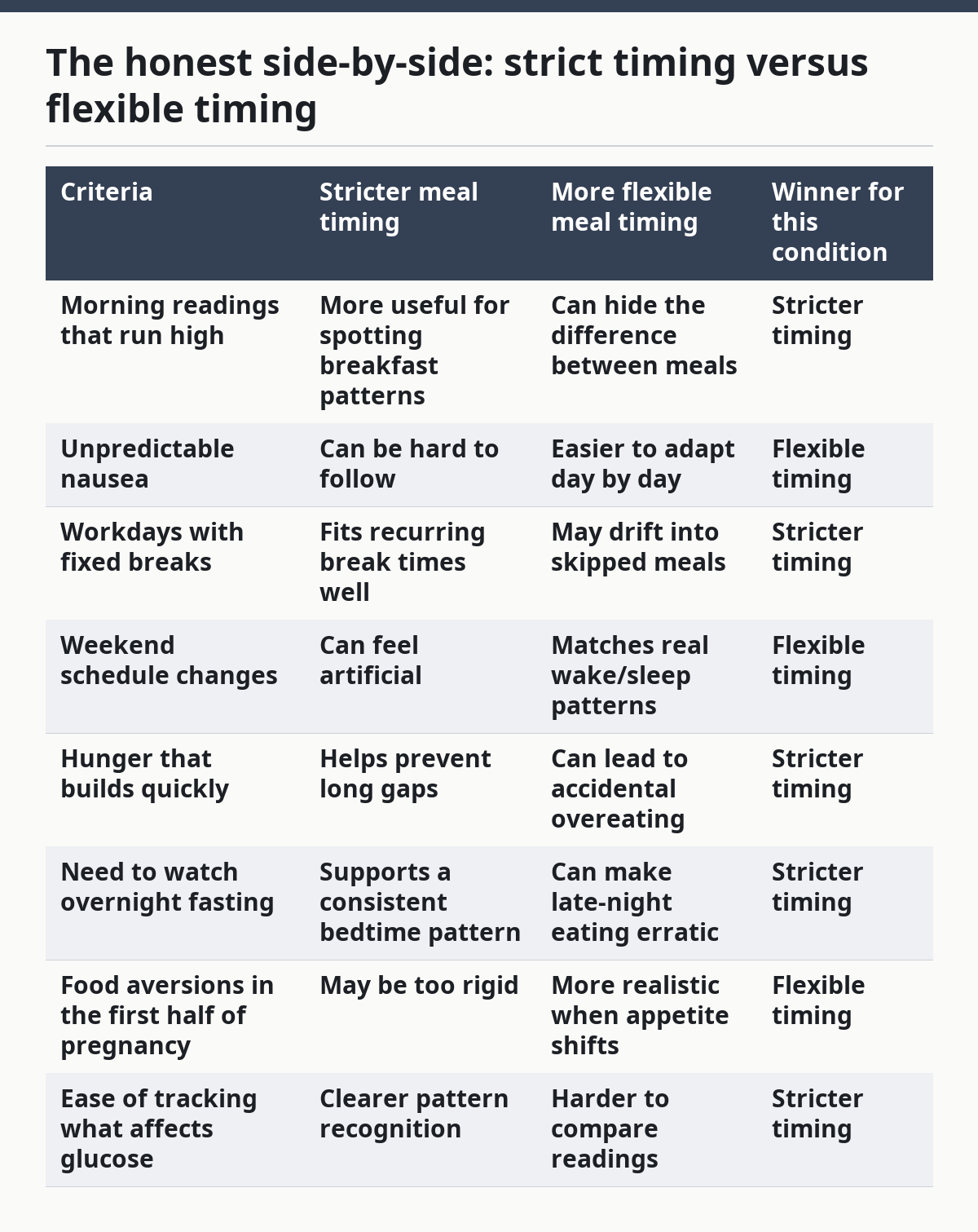
The table does not say flexibility is bad. It says flexibility has a cost: less predictable readings and less useful pattern data. It also says strict timing has a cost: if you cannot keep it up, it fails completely. So the choice is really about fit, not moral discipline.
The generic article gets this wrong by implying that “disciplined” is always better. In practice, a flexible routine you actually maintain often beats a strict one you abandon by day four. The point is not to look controlled. The point is to have enough structure that your glucose data mean something.
What most beginners miss about snacks
Snacks are not just mini meals; they are spacing tools. That is the part most people miss, and it is why snack timing can help or hurt depending on the pattern.
A snack can do at least three different jobs. It can prevent a long gap before the next meal. It can keep nausea from getting worse. It can also create unnecessary extra intake if it is added out of habit rather than need. In gestational diabetes, that distinction matters because every extra eating event gives glucose another chance to rise.
The practical question is not “Should I snack?” It is “What problem is the snack solving?” If the answer is “I will be too hungry to make a smart lunch choice,” that is a legitimate reason. If the answer is “I always snack at this time,” the habit may be the issue. If the answer is “My doctor told me my pattern needs it,” then the snack is serving a monitoring goal.
This is also where people can get tripped up by online advice. Someone will recommend a snack pattern that worked for them at 28 weeks, but your pattern at 18 weeks may be different. Morning sickness, activity level, and medication status can all change what snack timing makes sense.
The clearest recommendation here is simple: treat snacks as scheduled decisions, not background noise. If you do not know why a snack is there, it is hard to know whether it is helping.
When to reconsider the whole plan
The current plan is probably wrong if your readings are still erratic after a few days of consistent timing, or if the routine is making you skip meals, feel weak, or overeat later. That is the point where the issue may no longer be meal timing alone.
Reconsider the plan if one of these is happening:
- Breakfast is consistently the worst reading even when the food is similar.
- You are going more than a normal waking stretch without eating because the schedule is too rigid.
- Bedtime snacks are becoming a second dinner.
- Nausea is making the usual schedule impossible.
- You cannot compare one day to the next because meal times keep changing.
At that point, the question may shift from “How should I time meals?” to “Do I need a different plan, a different snack pattern, or a review of my monitoring data?” That is a conversation for a clinician, because meal timing may be only one piece of the picture.
It is also worth saying what this guide is not for. It is not for someone looking for a universal meal schedule that fits every pregnancy. It is not for someone who needs medication advice or carbohydrate targets. It is for the reader trying to make daily life less chaotic while keeping glucose patterns understandable.
What the research picture suggests
The research picture suggests that meal timing is a meaningful support strategy, but not a stand-alone solution. In the 90 PubMed records matching this topic from 2016–2026, the median study duration figure appearing in the abstracts is 26 weeks from PubMed (NCBI), computed on 2026-10-26, and the median dose figure appearing in those abstracts is 120 mg from PubMed (NCBI), computed on 2026-10-26. Those figures are simply what appears in the abstract text of the sample read, and they are not recommendations; if you are considering a supplement or medication change, consult your clinician.
The reason that matters is that meal timing studies often sit inside broader interventions. So readers should be careful about overclaiming from a single paper. A routine might look helpful because it is part of a package that includes monitoring, counseling, or diet change. Studies suggest the timing question is real, but the best-supported answer is still individual and pattern-based rather than universal.
A reader who wants a practical takeaway should think of meal timing as a monitoring tool and a stability tool. It is there to make the day more predictable and the data easier to interpret. It is not there to replace medical management, and it is not a guarantee that readings will normalize.
Two reliable organizations that commonly publish patient guidance on diabetes and pregnancy are the American Diabetes Association and the American College of Obstetricians and Gynecologists; their guidance can help frame questions for your own clinician. For general background on diabetes and pregnancy, these organizations are useful starting points, but your own care team should make the final call on timing and routine. For additional clinical context, see the U.S. National Institute of Diabetes and Digestive and Kidney Diseases and the Centers for Disease Control and Prevention.
Can I just eat at the same times every day?
Yes, a consistent schedule is often the easiest place to start. Consistency makes patterns easier to see, especially if breakfast or evening readings are the problem.
But consistency should not become rigidity. If the same schedule causes you to miss meals, feel unwell, or eat more later, the routine is no longer doing its job. A workable schedule is one that can survive an ordinary week.
Is skipping snacks ever okay?
Yes, if your care team is monitoring your readings and your hunger pattern does not require them. Some people do better with three meals and no formal snacks, while others need one or more snacks to avoid long gaps.
The reason to avoid making this decision casually is that skipping snacks can change both hunger and glucose patterns. If a skipped snack leads to a much larger meal later, it has not really reduced intake; it has just moved it.
Does timing matter more than what I eat?
No, neither one wins by itself. The meal’s composition and its timing work together.
A high-carb meal at the “right” time can still cause a spike, and a well-balanced meal at a poor time can still be unhelpful. The better question is which meal, at which time, is producing the pattern you and your clinician need to understand.
What if my mornings are the hardest part of the day?
That usually means breakfast deserves special attention. The first meal after waking is often the hardest to tolerate and the easiest to mishandle, especially if nausea or a rushed schedule is part of the problem.
A smaller, more predictable breakfast window may help with planning, but the best answer depends on your readings and your symptoms. If mornings are consistently the problem, bring that pattern to your clinician rather than trying to force the same routine every day.
Drafted with AI; not yet reviewed by a person.