Last updated: November 19, 2026
Quick answer: for Gestational Diabetes Breakfasts for Nauseated Mornings, a small bland breakfast with protein is often the most workable starting point, and 2 to 4 crackers or 1 slice of toast is enough to begin. Speak with a qualified clinician about your own situation, because nausea, blood sugar patterns, and pregnancy symptoms vary.
This guide settles what to eat first, what to keep on hand, and when a nausea-friendly breakfast stops being enough.
Key Takeaways
- A nausea-friendly breakfast is usually small, plain, and protein-led.
- Dry foods like crackers can help you get started, but they often need a second food with protein.
- Greek yogurt, eggs, and toast can all fit better than a big sweet breakfast, depending on what your stomach tolerates.
- If you can’t keep food down, the issue is no longer just breakfast choice.
- The goal is not a perfect plate; it is a breakfast you can actually eat and keep down.
What a nausea-friendly breakfast is trying to do

A nausea-friendly breakfast for Gestational Diabetes Breakfasts for Nauseated Mornings is a small meal that is easy to tolerate and less likely to spike blood sugar. Usually, that means a modest amount of plain starch, plus protein if you can manage it, with very little sugar on an empty stomach.
Wake up queasy? Your stomach feels hollow and tight, and even the smell of a hot skillet can be enough to send you away. A big breakfast bar is overkill. So is forcing a full plate. What you need is small portions, bland flavor, and a plan that begins with foods your stomach will accept.
The snag is simple: “easy on nausea” and “steady blood sugar” do not always point to the same plate. Morning sickness often steers people toward dry, simple foods, while gestational diabetes meal planning usually favors protein, fiber, and less refined carbohydrate. The best compromise is often modest — not flashy, not elaborate.
For broader meal planning, the hub on gestational diabetes nutrition and meal planning can help you zoom out from breakfast and see the full pattern.
For clinical guidance on nausea in pregnancy, see the NHS advice on nausea and vomiting in pregnancy, and for gestational diabetes care, the ACOG patient guidance on gestational diabetes.
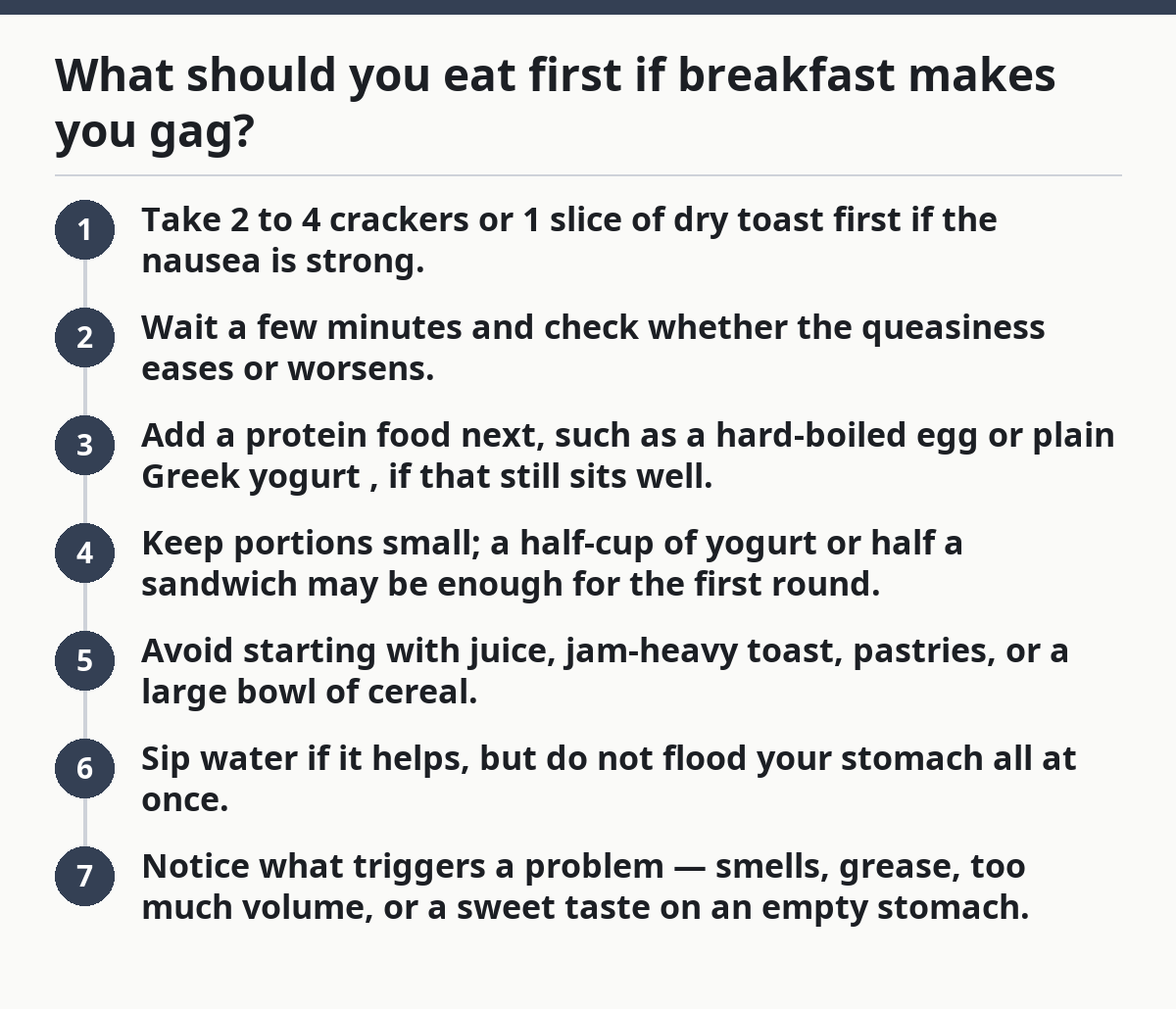
What should you eat first if breakfast makes you gag?
Start with the blandest food you can manage, then add protein if your stomach settles. In practice, that often means a few crackers, a slice of toast, or a few spoonfuls of Greek yogurt before anything richer.
You may be standing at the counter with two choices, and both smell wrong. One is a sweet cereal bowl; the other is plain toast. The toast usually wins. It is dry, simple, and less likely to hit like dessert.
Here’s the pattern that often works better than a full plate:
- Take 2 to 4 crackers or 1 slice of dry toast first if the nausea is strong.
- Wait a few minutes and check whether the queasiness eases or worsens.
- Add a protein food next, such as a hard-boiled egg or plain Greek yogurt, if that still sits well.
- Keep portions small; a half-cup of yogurt or half a sandwich may be enough for the first round.
- Avoid starting with juice, jam-heavy toast, pastries, or a large bowl of cereal.
- Sip water if it helps, but do not flood your stomach all at once.
- Notice what triggers a problem — smells, grease, too much volume, or a sweet taste on an empty stomach.
Dry food helps because it is gentle and low-odor. Protein helps because it can make the meal more satisfying and may blunt a sharper glucose rise. Studies on gestational diabetes nutrition suggest that meal composition matters, but individual tolerance is what decides what you can actually eat.
Which breakfast foods are usually easiest to keep down?

Usually, the easiest foods are plain, lightly warmed or cool, and not greasy. That puts crackers, toast, Greek yogurt, and eggs near the top of the list for many people, although the order depends on your nausea.
Open the fridge, and every strong smell suddenly feels louder. You need food, but the smell test has to pass first. A cold yogurt cup, a plain egg, or toast from the toaster often causes less trouble than bacon, sausage, or a skillet breakfast.
A practical short list:
- Crackers: Good as a starter food, especially if you wake up too sick for a real meal. By themselves, though, they are a thin breakfast and usually need protein later.
- Greek yogurt: Useful when you can tolerate dairy and want a higher-protein option. Plain is usually easier than sweetened; flavored versions can bring more sugar.
- Eggs: Handy when you can handle savory food. Scrambled, boiled, or baked eggs are usually easier than fried eggs if grease turns your stomach.
- Toast: A simple base that can be easier than thick, rich breakfast foods. Whole-grain toast may be a better fit than white bread for some people, but nausea tolerance comes first.
Use this as a starter shelf, not a rulebook:
- Plain crackers with a little cheese if dairy sits well
- Toast with peanut butter if you can handle the texture
- Greek yogurt with a few bites of fruit if sweetness does not trigger nausea
- Eggs with dry toast if you want something more filling
The best breakfast is the one you can finish without making the nausea worse. A “healthy” option that sits untouched is useless.
How do you build a blood-sugar-friendlier nausea breakfast with Gestational Diabetes Breakfasts for Nauseated Mornings?
Build it by keeping the meal small, putting protein first when possible, and avoiding a lone hit of fast carbohydrate. That usually means a few bites of crackers, then eggs or Greek yogurt, rather than a big bowl of cereal or sweet pastry.
You have 10 minutes before the day starts moving, and your stomach is already annoyed. No complicated recipe is needed. What helps is a repeatable structure that can survive a bad morning.
Use this simple order:
- Start with a bland base — 2 to 4 crackers or 1 slice of toast if that is all you can face.
- Add protein early — a boiled egg, a few spoonfuls of plain Greek yogurt, or nut butter on toast if it feels tolerable.
- Keep the portion small — think first snack, not full breakfast.
- Watch the sugar load — skip juice, sweet coffee drinks, pastries, and large bowls of cereal first thing.
- Choose low-odor foods — cold or room-temperature foods are often easier than hot, greasy ones.
- Use simple textures — smooth yogurt or soft eggs may go down better than crunchy, oily, or heavily spiced foods.
- Repeat what works — a boring breakfast that stays down is better than an ambitious one you cannot finish.
Honestly, gestational diabetes eating plans often reward consistency more than perfection. If your breakfast stays plain and predictable, you may avoid the two worst outcomes on a rough morning: skipping food entirely or eating only sugar because it is the only thing that sounds tolerable. That math stops working fast.
For food-safety basics in pregnancy, the CDC guidance on healthy eating during pregnancy is a useful reference point.
What should you avoid on a sick morning?
Greasy, very sweet, or oversized foods are the ones to skip. On a nausea-heavy morning, that often means fried breakfast foods, pastries, heavy cream sauces, and large glasses of juice.
You are already nauseated, and the smell of hot oil hits before the plate does. That meal is working against you before the first bite. By contrast, plain foods with less smell and less fat usually ask less from your stomach.
These are common troublemakers:
- Large sweet breakfasts, especially with juice
- Greasy eggs, sausage, bacon, or fried foods
- Strong-smelling leftovers
- Big portions eaten too fast
- Foods with a lot of added sugar on an empty stomach
The issue is not that these foods are “forbidden.” The issue is that they can worsen nausea and leave you with a blood sugar pattern that is harder to manage. If a food makes you gag, it is not a good breakfast for that morning — even if it usually fits your meal plan.
When should you stop trying to push through breakfast?
Stop trying to brute-force breakfast when the meal is making the nausea worse, not better. At that point, the issue is no longer just food choice, and you may need qualified guidance about hydration, symptom control, or blood sugar monitoring.
A few bites are in, and now the smell, taste, and texture all feel unbearable. Forcing a full breakfast does not help.
You cannot keep liquids down: This can mean the nausea is more than a simple breakfast problem — contact a qualified professional, because dehydration can become an issue in pregnancy.
You vomit after every attempt to eat: This means small food changes are not solving it — get medical advice rather than continuing to trial random breakfasts.
Blood sugar feels hard to manage because you are barely eating: This is a nutrition and pregnancy question that needs individualized help, not guesswork.
Your stomach is fine later but mornings are consistently impossible: This may call for a different timing pattern, but that decision belongs with a clinician who knows your pregnancy plan.
You feel dizzy, weak, or faint: Those are not normal breakfast complaints — stop pushing food and seek prompt advice.
The standard approach does not apply when the body is rejecting even the simplest foods. At that point, a nausea-friendly breakfast is not enough on its own.
The mistakes people make on rough mornings
The biggest mistake is treating nausea like a willpower problem. It is not. It is a body problem, and the wrong breakfast can make the whole morning harder.
Skip food because nothing sounds good, and by midmorning you may be shaky, irritable, and even less able to eat. The other trap is swinging the opposite direction and forcing a giant breakfast that comes right back up.
Common mistakes and better moves:
-
Starting with something sweet
- Consequence: it can hit hard on an empty stomach and make nausea feel sharper.
- Better alternative: start with crackers or toast, then add protein.
-
Eating a large plate
- Consequence: the stomach fills too fast, which can worsen nausea.
- Better alternative: use a small serving and wait 10 to 15 minutes before adding more.
-
Choosing greasy foods first
- Consequence: oil and strong smell can trigger gagging.
- Better alternative: choose dry, plain, or lightly cooked foods.
-
Ignoring protein
- Consequence: the breakfast may be easier to swallow but less satisfying.
- Better alternative: pair crackers or toast with eggs or plain Greek yogurt if you can.
-
Trying to “make up for it” later
- Consequence: you may end up too hungry and then eat too fast.
- Better alternative: keep a fallback breakfast ready for the next rough morning.
-
Waiting until the nausea is severe
- Consequence: an empty stomach can make symptoms feel worse for some people.
- Better alternative: keep a small dry snack nearby for the first hint of morning sickness.
Small, repetitive choices often beat a perfect menu. A stable routine matters more than a perfect recipe.
For a pregnancy-specific overview of when nausea needs medical attention, the Mayo Clinic guide to morning sickness is a helpful reference.
A simple backup plan for hard mornings
A backup plan helps because rough mornings repeat. The best one is a 2-step plan: keep one dry starter food and one protein food within reach, then use the smallest amount that stays down.
You do not have to solve the whole day before breakfast. Only the next 15 minutes matter.
A practical backup shelf might look like this:
- A box of plain crackers
- Toast ingredients ready to go
- Plain Greek yogurt
- Eggs that can be boiled ahead of time
- Water nearby in small sips
If one food fails, switch to another from the same short list. The point is not variety. The point is having a second move when the first one makes you queasy.
What can I eat if I feel sick in the morning?
Begin with the simplest foods you can tolerate, such as crackers, toast, plain Greek yogurt, or eggs. A small amount is better than a full plate when nausea is strong, and plain foods often sit more easily than greasy or sweet ones.
You are hungry, but the idea of a full breakfast turns your stomach. Start with a few crackers or dry toast, then try a little protein if that goes well. If food keeps coming back up or the nausea is intense, speak with a qualified professional about your own pregnancy situation.
Should I skip breakfast if I am nauseated?
Skipping breakfast is not the same as solving nausea, and it can leave you feeling worse later. If you cannot eat much, a small bland snack is often easier than nothing at all.
You decide to wait it out, and by midmorning your stomach is empty and the nausea is louder. A few bites of toast or crackers may be a better starting point than a complete fast. If you cannot keep even small amounts down, that is a sign to get medical advice.
How can I keep blood sugar steady when I can’t eat much?
Keep it steadier by eating the amount you can tolerate, choosing plain foods first, and adding protein when possible. That may mean crackers plus Greek yogurt, or toast plus egg, instead of a sweet breakfast or no breakfast at all.
Your stomach may allow only a few bites. That still counts. Small, plain food with protein is often a more workable choice than forcing a large meal or leaving your stomach empty all morning. If eating remains very limited, a clinician can help you tailor the plan to your pregnancy and blood sugar needs.
Drafted with AI; not yet reviewed by a person.