
Last updated: November 27, 2026
Quick answer: 6 side effects should be reported right away or the same day if they happen with gestational diabetes medicine. Report any new, worsening, or unusual side effect from gestational diabetes medication—especially nausea that keeps you from eating, signs of low blood sugar, vomiting, rash, trouble breathing, or anything that feels urgent. Speak to a qualified clinician about your own situation, because pregnancy changes what is normal, what is expected, and what needs prompt review. CDC, ACOG
- Key takeaways
- What side effects should be reported?
- Which symptoms are common, and which are not?
- What should you do first if a side effect starts?
- When do side effects mean you should call right away?
- How can these side effects affect treatment choices?
- What mistakes do people make with side effects?
- How much evidence is behind these concerns?
Key takeaways
- Side effects that deserve a call are not the same as the mild effects people often expect at the start of treatment, and if you are unsure, consult a clinician or pharmacist. MedlinePlus
- Low blood sugar, repeated vomiting, rash, swelling, and trouble breathing are not “wait and see” symptoms.
- Metformin, glyburide, and insulin can each cause different problems, so the medicine name matters.
- A side effect can change treatment choice even if it is not dangerous right away, so discuss it with a qualified professional. ACOG
- If you are unsure, the safer move is to contact the care team rather than assume it is harmless.
What side effects should be reported?
Side effects should be reported when they are strong, persistent, new, or out of step with what was expected from the medicine, and if you are unsure, consult a clinician. With gestational diabetes medication, that often means nausea that does not settle, diarrhea that leads to poor intake, low blood sugar, rash, swelling, dizziness, or symptoms that keep you from following the treatment plan. NHS
The topic is heavily studied, and the practical question is still the same: what symptoms should be reported to a qualified professional? Clinical trial and PubMed listings can help show that the evidence base is active, but they do not replace personal medical advice.
The practical point is simple. Mild effects can be common, but symptoms that affect eating, safety, breathing, or blood sugar deserve a report. In pregnancy, a symptom does not need to be dramatic to matter.
Which symptoms are common, and which are not?
Common side effects can be annoying but not always dangerous, while reportable side effects raise concern because they may need a change in medicine or closer follow-up. Nausea is one of the named examples here, and low blood sugar is the one symptom that needs special attention because it can become unsafe fast.
| Symptom or effect | More common or expected | Report it promptly? | Why it matters |
|---|---|---|---|
| Nausea | Can happen with some medicines | Yes, if it persists or limits eating | Poor food intake can affect the treatment plan |
| Low blood sugar | A known risk with some medicines | Yes | It can cause shaking, sweating, confusion, or faintness |
| Diarrhea or stomach upset | Can occur, especially early on | Yes, if it is frequent or severe | Dehydration and missed meals can follow |
| Rash or itching | Not something to ignore | Yes | May signal a reaction to the medicine |
| Swelling or trouble breathing | Not expected | Yes, urgent | May signal a serious reaction |
| Ongoing dizziness or weakness | Not something to dismiss | Yes | Can point to low blood sugar or poor intake |
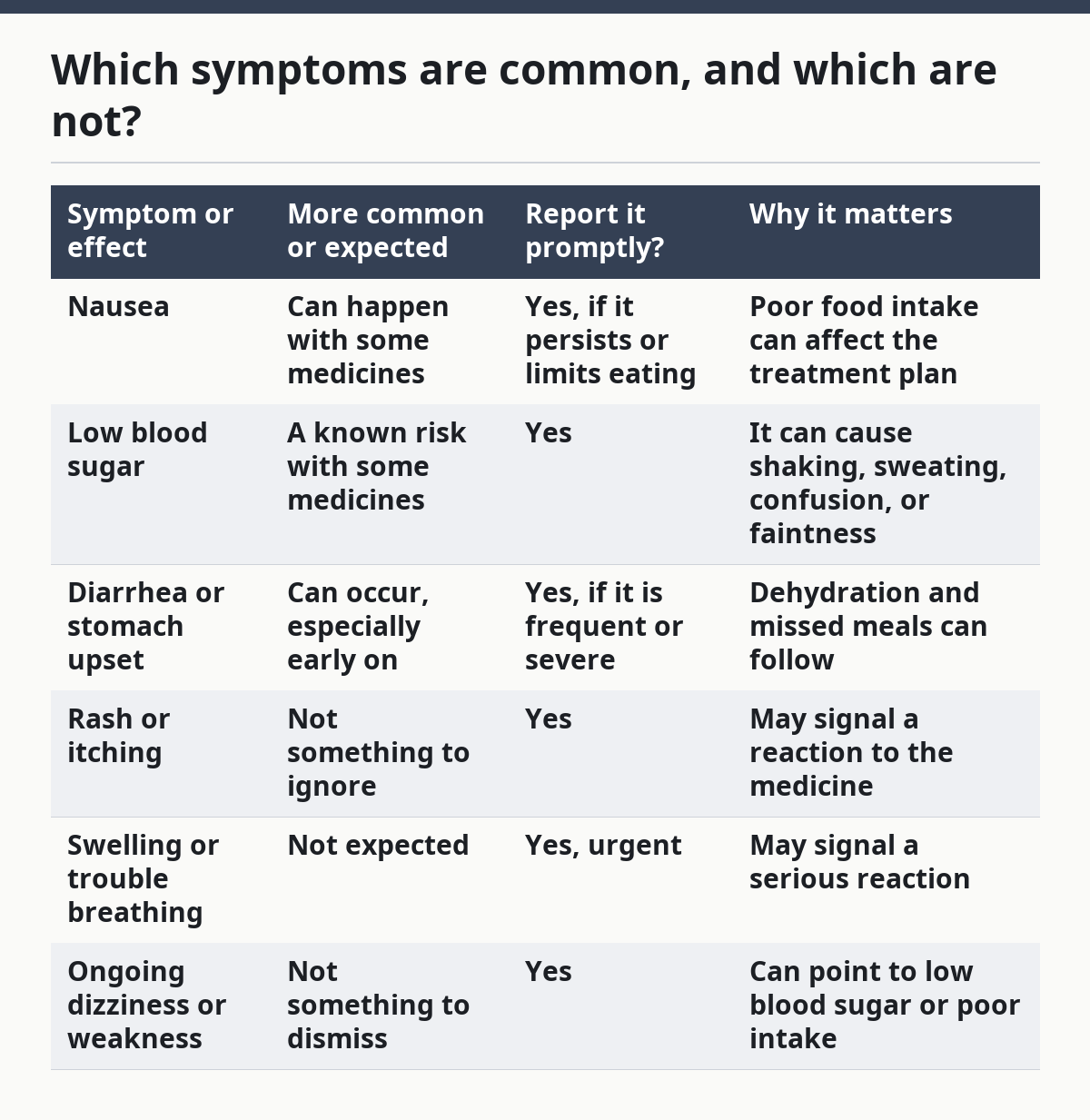
Insulin, metformin, and glyburide do not all cause the same pattern of problems. That is why a generic “side effects are normal” answer is wrong for this page and wrong for pregnancy care. If the symptom is unclear, ask a qualified clinician.
What should you do first if a side effect starts?
You should pause, check whether the symptom is mild or urgent, and contact the care team if it is new, strong, or lasting. The right response depends on the medicine, the symptom, and whether the problem affects eating, breathing, or blood sugar.
- Write down the medicine name and timing. Note whether the medicine is insulin, metformin, or glyburide, and record when the symptom started. Verify the timing against the last dose; a reaction that starts within hours can matter more than a brief, unrelated upset stomach. A problem is a symptom that repeats after each dose or appears soon after taking the medicine.
- Check whether the symptom is mild or urgent. Look for nausea, vomiting, rash, swelling, shakiness, sweating, confusion, or trouble breathing. Verify whether the symptom is new or getting worse over 24 hours. A problem is any symptom that affects breathing, consciousness, or basic daily function.
- Look at food and fluid intake. Note whether you have kept down meals, fluids, or snacks in the last 1 day. Verify if poor intake lines up with the side effect. A problem is repeated vomiting, inability to eat, or dehydration.
- If low blood sugar is a concern, treat it as time-sensitive. Low blood sugar symptoms should not be brushed off as “just feeling off.” Verify whether the symptoms fit shakiness, sweating, dizziness, or confusion. A problem is any episode that seems severe, recurrent, or hard to explain.
- Do not assume a rash is minor. Check for hives, swelling, or itching that spreads beyond one small area. Verify whether the rash appears after the medicine and whether it is getting larger. A problem is rash with swelling, breathing trouble, or face or mouth involvement.
- Use the care team’s contact route the same day when needed. Call the obstetric, diabetes, or prescribing team if the symptom is persistent, strong, or changing the plan for food and medicine. Verify you can describe the symptom clearly in one sentence. A problem is any side effect that makes you unsure whether to take the next dose as planned.
- Bring a short symptom record to the call. Include the symptom, time, medicine name, and whether it improved. Verify the pattern over at least 1 to 2 days if the issue is not urgent. A problem is a pattern that repeats, worsens, or starts to interfere with glucose control or nutrition.
That sequence is not a substitute for medical advice. It is a way to sort routine discomfort from a side effect that deserves prompt review.
When do side effects mean you should call right away?
You should call right away when the symptom suggests a reaction, a safety risk, or a medicine that is no longer a good fit. The line is not perfect, but in pregnancy it is better to overreport than to wait for a small problem to become a bigger one.
Rash, hives, swelling, or trouble breathing: This may signal a serious medicine reaction — Get urgent medical help now.
Vomiting that keeps you from eating or keeping fluids down for more than a short period: This can lead to dehydration and poor intake — Contact the care team the same day.
Shaking, sweating, confusion, faintness, or a feeling of being “off” that fits low blood sugar: This can become unsafe quickly — Report it promptly and follow your clinician’s instructions.
Repeated nausea or diarrhea that lasts beyond the first days of treatment or keeps returning: This can affect nutrition and adherence — Call the team to discuss whether the medicine still fits.
Any symptom that appears after a dose change or new medicine start: The timing may point to the drug — Report it so the dose plan can be reviewed by a qualified professional.
You cannot tell whether the symptom is from the medicine or something else: Pregnancy symptoms can overlap with side effects — Ask the care team rather than guessing.
A generic side effect list misses this point: the reason to report is not just discomfort. It is whether the symptom changes safety, eating, or treatment choice, and a clinician can help sort that out.
How can these side effects affect treatment choices?
They can change which medicine is used, how closely symptoms are watched, or whether the plan needs another look. Side effects matter because the “best” medicine on paper is not helpful if it causes nausea that stops meals or low blood sugar that makes daily life unsafe.
The difference between insulin, metformin, and glyburide is part of the decision. Insulin is often discussed when blood sugar control needs a more direct tool, but symptoms linked to low blood sugar must be taken seriously. Metformin and glyburide can bring different stomach or blood sugar concerns, so a side effect profile can steer the next choice.
That does not mean every side effect means the medicine must stop. Sometimes the change is a closer check, a timing adjustment, or a switch to a different option. A clinician needs the symptom details to decide whether the effect is tolerable, expected, or a reason to change course.
For a broader look at medication options for gestational diabetes, see the hub page that sits above this guide.
What mistakes do people make with side effects?
The biggest mistake is waiting until the symptom is severe. That can turn a manageable issue into a same-day problem, especially when low blood sugar or dehydration is involved.
Another mistake is blaming every symptom on pregnancy itself. Pregnancy can cause nausea and fatigue, but medicine-related symptoms often have a pattern: they start after a new drug, worsen after a dose, or repeat in the same way.
A third mistake is failing to name the medication when calling the care team. Insulin, metformin, and glyburide are not interchangeable in how they are used or what problems they may cause, so “the diabetes pill” is not enough detail.
A fourth mistake is assuming that one bad symptom means the medicine has failed. Sometimes it means the plan needs fine-tuning, not abandonment. The correct move is to report the problem and let a qualified professional sort out the next step.
A fifth mistake is pushing through severe nausea or diarrhea without saying anything. If you cannot eat well, the treatment plan itself can start to break down. That is a treatment issue, not just a comfort issue.
How much evidence is behind these concerns?
The evidence base is active, but the safest rule is still the same: if a symptom is persistent, strong, or concerning, report it. Authoritative guidance from CDC, ACOG, MedlinePlus, and NHS all supports prompt review of concerning side effects in pregnancy. CDC, ACOG, MedlinePlus
What side effects should I report to my doctor?
Report side effects that are new, severe, repeated, or different from the brief stomach upset or adjustment your clinician said to expect. Nausea that stops eating, vomiting, rash, swelling, breathing trouble, shakiness, sweating, or confusion all deserve attention. If the symptom changes your ability to take the medicine or eat normally, it is worth a call, and a qualified professional can help decide next steps.
Can gestational diabetes medicine cause low blood sugar?
Yes, some gestational diabetes medicines can be linked to low blood sugar. The risk and pattern vary by medicine and by person, so symptoms like shaking, sweating, dizziness, or confusion should not be ignored. Because low blood sugar can become unsafe, it should be reported promptly.
When should I worry about side effects from metformin or insulin?
You should worry when the side effect is persistent, severe, or affects breathing, eating, or safety. A short-lived stomach upset is different from vomiting, dehydration, a rash, or symptoms that seem like low blood sugar. If the side effect is new after starting or changing medicine, contact a qualified professional soon.
Drafted with AI; not yet reviewed by a person.