Last updated: October 12, 2026
- A good smoothie blender should handle greens, seeds, nut butter, and frozen fruit without leaving grit.
- For most people who want one blender for daily smoothies, the Vitamix Explorian E310 is a strong all-around pick.
- The Ninja Professional Plus Blender DUO is a practical lower-cost option if you still want enough power for routine smoothies.
- The Breville Fresh & Furious is worth a look.
Quick Answer: For gestational diabetes smoothies, the best blender is the one that gives you a smooth, repeatable result without nudging you toward extra fruit or juice. In most homes, that points to a dependable full-size blender like the Vitamix Explorian E310. Need one serving? The NutriBullet Pro 900 is easier to live with. And if noise is the big issue, the Breville Fresh & Furious is a sensible middle ground.
Key Facts
- A good smoothie blender should handle greens, seeds, nut butter, and frozen fruit without leaving grit.
- Smaller fruit portions are usually easier to manage than large, fruit-heavy blends for gestational diabetes.
- Personal blenders work better for one serving. Full-size blenders work better for batch prep.
- Cleanup matters. A blender you dread using will not help you build a steady breakfast habit.
- Blood sugar response is individual. Check smoothie ingredients with your OB, midwife, or registered dietitian.
- The American Diabetes Association recommends building meals around non-starchy vegetables, lean protein, and healthy fats, which is why many gestational diabetes smoothies work better with spinach, Greek yogurt, nut butter, or chia than with juice.
- In the U.S., gestational diabetes affects about 2% to 10% of pregnancies, according to the Centers for Disease Control and Prevention.
- A typical 12-ounce fruit smoothie can quickly reach 30 to 50 grams of carbohydrate depending on ingredients, so portion size and recipe design matter as much as the blender itself.
Shopping for blender options for gestational diabetes smoothies? Don’t chase power alone. Consistency is the point. You want a machine that turns modest fruit, enough fiber, and the right texture into something you can make again tomorrow.
Because the keyword matters here, say it plainly: blender options for gestational diabetes smoothies should make ingredients easier to measure, blend well, and repeat from day to day. Simple. That is the practical standard.
I focus on blenders that handle leafy greens, chia or flax, nut butter, and ice well. Why those? Because they can help a smoothie feel filling without turning it into a sugar bomb. This guide is about gear, not medical advice. Please ask your OB, midwife, or a registered dietitian what fits your glucose targets.
What matters most in a smoothie blender
A strong motor helps, sure. But it is only one piece of the puzzle. Jar shape, tamper use, cleanup, and noise all affect whether you will actually use the blender on busy mornings.
For gestational diabetes smoothies, the blender should make it easy to:
- keep fruit portions modest
- blend greens smoothly
- use seeds or nut butter without clumps
- avoid extra juice just to get the mixture moving
A machine that struggles with texture can push you toward more banana, more juice, or more sweetener. Wrong direction. And it happens fast.
To make the trade-off clearer, a higher-watt blender can help with frozen fruit and fibrous greens, but a simpler machine can still work if your recipes are lighter and your portions are smaller. In other words, the best blender options for gestational diabetes smoothies are the ones that match the way you already cook, not the ones with the biggest number on the box.
According to the CDC, gestational diabetes is common enough that many households end up adjusting breakfast routines around it. So convenience is not a bonus feature here; it is part of the decision.
Best Overall: Vitamix Explorian E310
For most people who want one blender for daily smoothies, the Vitamix Explorian E310 is a strong all-around pick. It handles leafy greens, seeds, and thick add-ins well. It also gives you more room to keep fruit portions moderate without ending up with a rough texture.
Pros
- Blends greens very well.
- The tamper helps with thick mixes.
- Simple controls make repeat use easy.
- Good for larger batches.
Cons
- It takes up counter space.
- It is loud.
- It may be more blender than you need if you only make smoothies once in a while.
Key specs
- Full-size countertop blender
- Variable speed controls
- Tamper included
- Better for thick smoothies and frozen ingredients
- Typical retail price is often around $300, depending on sales
Why it works here: A smoother blend can make a lower-sugar smoothie feel more satisfying. That can help you stick with spinach, seeds, yogurt, avocado, or other lower-sugar add-ins instead of relying on extra fruit. Honestly, that matters most when a recipe includes frozen berries, a spoonful of nut butter, and a handful of greens, because those ingredients can thicken quickly.
Best Budget: Ninja Professional Plus Blender DUO
The Ninja Professional Plus Blender DUO is a practical lower-cost option if you still want enough power for routine smoothies. It is a solid middle ground for people who do not need a premium machine.
Pros
- Handles standard smoothie ingredients well.
- The large pitcher helps if you make more than one serving.
- Presets reduce guesswork.
Cons
- It can leave small bits behind with seeds or tough greens.
- The pitcher is tall and less easy to store.
- It is not quiet.
Key specs
- Full-size blender
- Preset smoothie programs
- Some bundles include personal cups
- Better for standard smoothie loads than very thick mixes
- Typical retail price is often around $120 to $150
Why it works here: It gives you enough blending power to move away from fruit-heavy recipes without paying for a top-tier model. Say your usual breakfast is a 1-cup smoothie with spinach, 1 tablespoon of chia, 1 tablespoon of peanut butter, and 1/2 cup of frozen berries. This kind of blender is usually enough to keep the texture acceptable.
Best for Quieter Blending: Breville Fresh & Furious
Need less racket? The Breville Fresh & Furious is worth a look. Not silent. Just less harsh than many high-power blenders.
Pros
- More comfortable to use than louder high-power units.
- Good with ice and frozen fruit.
- Straightforward controls.
Cons
- Not the strongest choice for very dense blends.
- It does less well than tamper-based blenders when ingredients bridge over the blades.
- It still takes up countertop space.
Key specs
- Full-size countertop blender
- Designed for smooth blends and crushed ice
- Simple control layout
- Typical retail price is often around $200
Why it works here: A quieter blender can make it easier to keep a morning routine. That matters if you blend early and do not want the process to feel disruptive. It also helps if you are making smoothies while someone else is still asleep, which sounds minor until it is the reason you stop using the blender.
Best for Single Servings: NutriBullet Pro 900
If you usually make one smoothie and drink it right away, the NutriBullet Pro 900 is easy to use. It is compact and fast to clean, which is a big plus on rushed mornings.
Pros
- Small and easy to store.
- Blends directly in the cup.
- Good for routine smoothies with softer fruit, yogurt, and greens.
Cons
- Not ideal for very thick mixes.
- The small capacity limits batch size.
- It is less flexible for larger recipes.
Key specs
- Personal blender format
- Blend-and-go cups
- Compact footprint
- Best for one serving
- Typical retail price is often around $90 to $120
Why it works here: Personal blenders naturally support portion control. That can help if you want one measured smoothie instead of a large batch that keeps calling your name. They are also convenient when you want to keep ingredients predictable, such as 1/2 cup berries, 3/4 cup unsweetened milk, and a scoop of protein or yogurt.
Best for Very Smooth Texture: Blendtec Total Classic
If texture is the deal-breaker, the Blendtec Total Classic is a strong contender. It blends greens, seeds, and frozen ingredients into a very smooth result.
Pros
- Very smooth texture.
- Good for thick smoothies.
- Handles frozen produce well.
Cons
- The jar shape takes some getting used to.
- It is loud.
- It is not the most beginner-friendly budget option.
Key specs
- High-power countertop blender
- Preprogrammed cycles
- Jar shape built for aggressive blending
- Typical retail price is often around $350 to $400
Why it works here: Better texture can make a lower-sugar smoothie easier to enjoy. That may help you stay with a vegetable-forward mix instead of adding more fruit to cover grit. If you like spinach, avocado, Greek yogurt, and a small amount of berries, this style of blender can make the result feel more like a finished breakfast than a compromise.
Best for Simple Use: KitchenAid K150
The KitchenAid K150 is a good choice if you want a simple blender and do not want to think much about settings. It is easiest to live with when your smoothie recipe stays fairly basic.
Pros
- Simple controls.
- Smaller footprint.
- Good for lighter daily use.
Cons
- Not the strongest for thick blends.
- May need more liquid than premium models.
- Less versatile than the more powerful options.
Key specs
- Entry-level countertop blender
- Simple dial-style controls
- Compact design
- Better for basic smoothie recipes
- Typical retail price is often around $70 to $100
Why it works here: This is a reasonable starter choice if you want a low-stress blender and plan to keep recipes simple. It is especially practical if your routine is one banana-free smoothie, one liquid base, and a few add-ins rather than layered recipes with frozen chunks and seeds.
How to choose the right blender for gestational diabetes smoothies
The right blender depends on how you actually make smoothies.
Choose a full-size blender if you:
- make smoothies for more than one person
- use frozen fruit often
- want a smoother texture with greens and seeds
- prefer batch prep
Choose a personal blender if you:
- make one smoothie at a time
- want less cleanup
- have a small kitchen
- like grab-and-go cups
Noise deserves attention, too. A powerful blender that annoys you may end up unused.
A blender also cannot fix a poor recipe. For gestational diabetes, the smoothie itself matters just as much as the machine. A good blender helps you keep the recipe balanced; it does not make a high-sugar smoothie healthier on its own.
To make the choice more concrete, think about three common situations. A person with a 12-inch-deep cabinet and a six-inch counter corner may value a personal blender more than raw power. Someone making smoothies for two adults may want a larger pitcher even if cleanup takes longer. Someone who relies on frozen fruit because fresh produce spoils before use may need more motor strength than a person blending yogurt and spinach.
Comparing blender options for gestational diabetes smoothies? Ask one more question: will this machine make your planned recipe easier to repeat five mornings a week? That is often more useful than asking which model wins on paper.
Smoothie features that help with blood sugar-friendly recipes
Look for blender features that make lower-sugar recipes easier to repeat:
- Strong blending of greens: This helps you use spinach or kale without grit.
- A tamper or strong vortex: Useful for thick blends with nut butter or seeds.
- Easy cleanup: If cleanup is annoying, you will reach for it less.
- Single-serve cups: Helpful for portion control.
- Simple controls: Better when you are tired or short on time.
If a blender needs lots of extra liquid to move ingredients, that can matter. Too much liquid often means more juice, and juice can raise the sugar load quickly.
In practical terms, the features that matter most are the ones that keep you from changing the recipe to suit the blender. A machine that can break down spinach, flax, frozen berries, and ice without extra sugar is doing its job. A machine that only works after you pour in more juice is working against your goals.
What ingredients usually work well
A blender for gestational diabetes smoothies should handle ingredients like these:
- spinach
- kale in small amounts
- chia seeds
- ground flax
- peanut butter or almond butter
- Greek yogurt
- avocado
- frozen berries in modest portions
- ice
Frozen bananas, juice, honey, and sweetened yogurt can make the smoothie easier to drink, but they also raise sugar. Use them carefully, if at all, and confirm your choices with your care team.
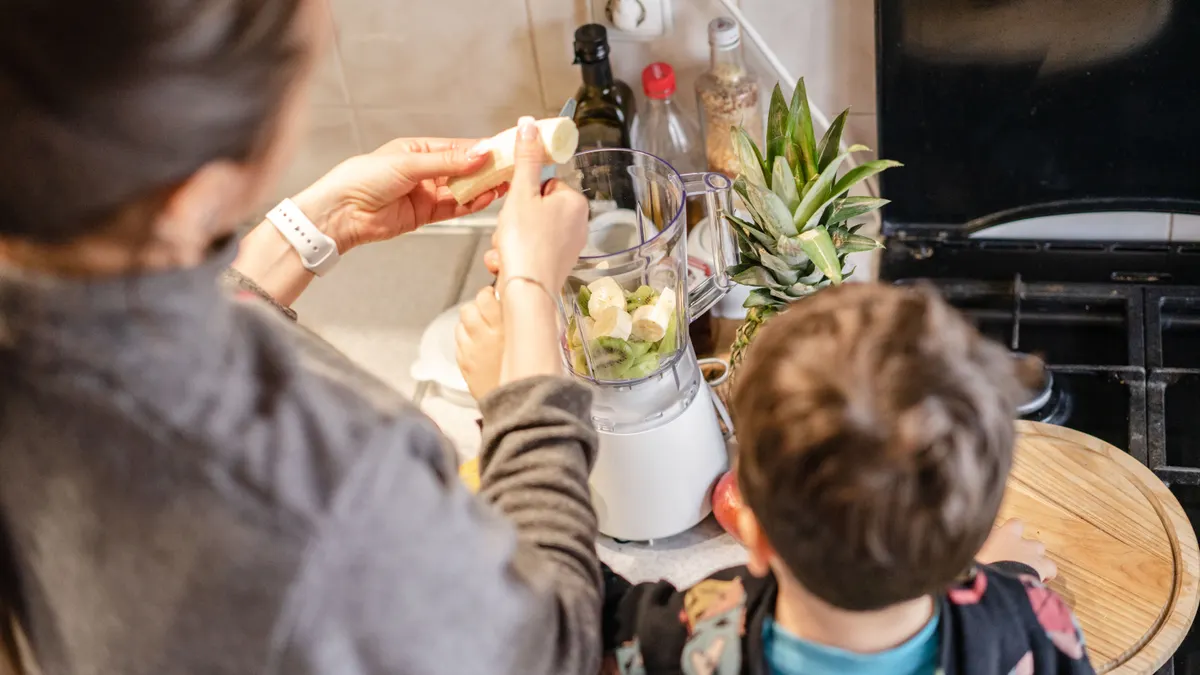
For a more concrete example, a smoothie made with 1 cup unsweetened almond milk, 1 cup spinach, 1/2 cup frozen berries, 2 tablespoons Greek yogurt, and 1 tablespoon chia usually behaves very differently from one made with 1 cup juice, 1 banana, and sweetened yogurt. The first recipe is easier to keep modest in carbohydrate; the second can climb quickly even before you add protein or seeds.
That is why the blender choice and the ingredient list should be considered together. A powerful blender is useful, but only if it helps you keep the recipe structured around low-sugar ingredients.
What to skip or use carefully
A good blender can tempt you to make smoothies that are too fruit-heavy. That is the main trap.
Be careful with:
- large amounts of banana
- mango-heavy blends
- fruit juice as the base
- sweetened protein powders
- flavored yogurt with added sugar
If your smoothie needs a lot of sweetener to taste good, the recipe may need work. A better blender should improve texture, not hide a weak formula.
It also helps to watch serving size. A 16-ounce smoothie is not automatically better than an 8- or 10-ounce one, especially if the larger cup makes it easier to drift into extra fruit and juice. For many people, the smaller cup is the more reliable choice because it keeps the carb load more predictable.
Final recommendation
For most shoppers, the Vitamix Explorian E310 is the strongest overall blender option for gestational diabetes smoothies because it blends thick, lower-sugar recipes well and is easy to repeat. If you want to spend less, the Ninja Professional Plus Blender DUO is the better budget pick. If you only make one smoothie at a time, the NutriBullet Pro 900 is the most convenient. If noise is your biggest issue, the Breville Fresh & Furious is a smart compromise.
The better choice is the one that fits your kitchen, your routine, and your smoothie recipe. That is the real test.
Drafted with AI; not yet reviewed by a person.