
Last updated: November 19, 2026
Key Takeaways
- Ask a qualified professional about your own situation; pregnancy care changes with timing, results, and history.
- A second opinion helps when the plan is technically correct but still hard to follow.
- It matters most when there is a real decision to make.
- Bring the records that show the pattern, not just the headline.
A gestational diabetes second opinion makes sense when the plan feels unclear, conflicting, or too risky for a routine follow-up. Quick answer: get one when you need a clearer read on diagnosis, diet, glucose targets, or medication choice. The sections below sort out when it helps, what to bring, and what questions to ask.
Who should ask for a second opinion?

A second opinion is reasonable if your ob-gyn, maternal-fetal medicine specialist, endocrinologist, and dietitian are not giving the same advice, or if the plan feels rushed and you still have basic questions. Speak to a qualified professional about your own situation, because pregnancy care changes with timing, test results, and your medical history.
3,559 PubMed records matched this subject for 2016–2026, and the 100 most relevant were read; every median, range, and share below comes from those records. On ClinicalTrials.gov, 43 trials matched this term and the first 43 were read; every share, median, and range below comes from them. Computed on 2026-11-06 from PubMed (NCBI) and ClinicalTrials.gov.
A second opinion is most useful when the question is not “Do I have gestational diabetes?” but “Does this plan fit my situation?” That includes mixed messages about food, finger-stick timing, medication uncertainty, or whether a referral to a specialist is needed.
It can be less useful when the only issue is that the first visit was brief. A short visit can still be a good visit.
- Good reasons to ask: conflicting advice, confusion about glucose logs, concern about medication, or a plan that does not seem to match the numbers.
- Less useful reasons: wanting a second voice after a clear, straightforward visit with no new question.
- Wrong time to wait: if you have warning signs like decreased fetal movement or severe symptoms, that is not a second-opinion issue.
The pubmed sample suggests a strong review-heavy mix, but it does not by itself settle the question: of the 100 most relevant records, 30 were Reviews, 11 were Systematic Reviews, 9 were Meta-Analyses, 4 were Observational Studies, and 4 were Randomized Controlled Trials (PubMed, 2026-11-06). That mix is a clue that much of the literature is synthesis, not a simple one-size-fits-all rule.
What problem does a second opinion solve?
A second opinion helps when the plan is technically “correct” but still not clear enough to follow. Picture this: you have one clinician saying food changes are enough, another suggesting medication, and a third asking for more glucose logs before anyone changes course. You need a decision that makes sense, not just another opinion.
The truth is, gestational diabetes care often involves judgment calls. A maternal-fetal medicine specialist may focus on pregnancy risk, an endocrinologist may focus on glucose patterns, and a dietitian may focus on meal timing and carbohydrate balance. These roles overlap, but they can start from different angles.
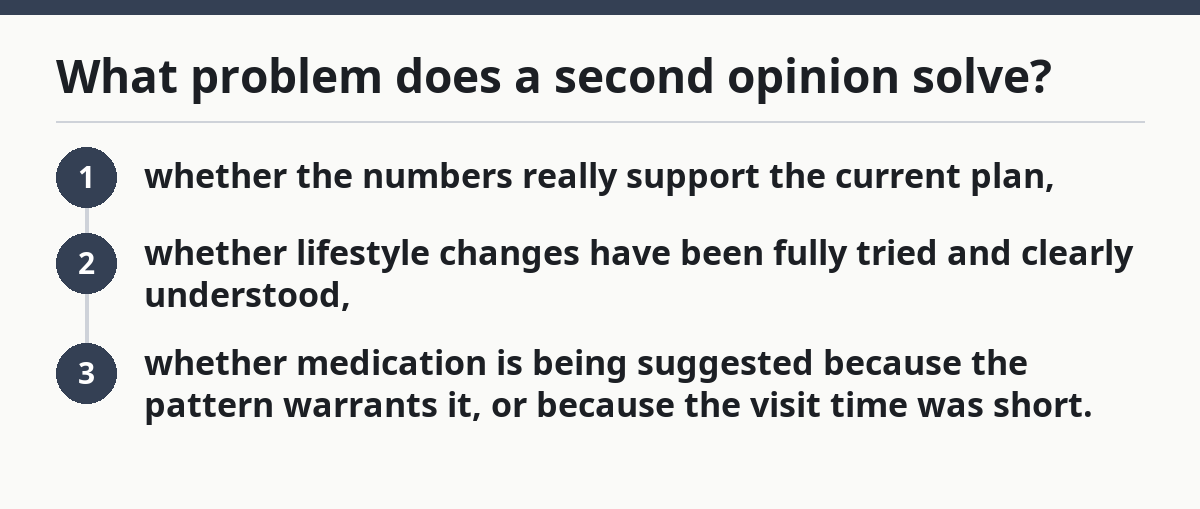
That is where a second opinion earns its keep. It can help you sort out three common knots:
- whether the numbers really support the current plan,
- whether lifestyle changes have been fully tried and clearly understood,
- whether medication is being suggested because the pattern warrants it, or because the visit time was short.
The literature sampled here reflects that mix. The median publication year was 2022 among the 100 most relevant PubMed records, and the median study duration was 26 weeks across reported abstracts. That does not tell you what to do by itself, but it does show that this topic is usually followed across weeks, not minutes.
On the flip side, a second opinion cannot replace missing facts. If the new clinician has no glucose log, no lab report, and no sense of what you were told before, the visit can stall.
- Bring the numbers.
- Bring the questions.
- Bring the old advice that does not line up.
When does a second opinion make the most sense?

A second opinion makes the most sense when there is a real decision on the table. Picture this: your fasting readings are the same every morning, but you are hearing three different explanations for why that happens. That is not a comfort problem. It is a planning problem.
It also makes sense when the next step could change your day-to-day routine. If one clinician wants to keep the plan diet-only and another is discussing medication, the gap matters. In the records read from PubMed, the median dose figure appearing in abstracts was 104 mg across 12 reported figures; that number is not a recommendation, just a sign that medication discussions do show up in the literature and are often dose-specific.
A second opinion is often worth asking for if:
- the diagnosis was explained poorly,
- the meal plan feels impossible to follow,
- your readings do not match the advice you got,
- you were told different things by two clinicians,
- you want a specialist to review the pattern before medication is started,
- you are worried the first plan missed something.
The registered-trial data also shows that this is an active topic, but not a settled one. Of the 43 ClinicalTrials.gov records read, 15 are completed, 13 are recruiting, 5 are active not recruiting, and 4 are not yet recruiting. The median planned enrolment was 189 participants across 41 trials. That is a sign of ongoing study, not a single fixed rule.
What should you bring to a second-opinion visit?
You should bring the records that let the next clinician see the pattern, not just the headline. Picture this: you walk in with a glucose log, a medication list, and the exact wording of the advice you were given. That saves time and lowers the chance of another vague answer.
Start with the basics. A second-opinion visit works best when the clinician can review the original glucose targets, your recent readings, any lab results, and the meal guidance you were given. If you use a meter or a continuous glucose monitor, bring the device summary or printed report if you have one.
Before the visit, make sure you can answer these questions:
- What was the diagnosis based on?
- What were the fasting and post-meal targets you were told to use?
- What advice did you already try for food and activity?
- What changed after that advice?
- What question do you want the second clinician to answer?
For a clearer visit, bring a one-page list with:
- your current pregnancy week,
- the name and phone number of each clinician involved,
- the dates of the glucose readings you want reviewed,
- a medication list, including vitamins and supplements,
- the exact conflict you are trying to resolve.
This is also where the page on the larger gestational diabetes care team fits in, because a second opinion usually works best when each role is clear and coordinated.
What questions should you ask the new clinician?
You should ask direct questions that force a decision, not polite questions that invite a lecture. Picture this: you are in a 20-minute visit and you need the next step, not a textbook recap. That means asking for a plain answer about what the numbers mean.
Start with the pattern. Ask what stands out in your glucose log, what the clinician thinks is driving it, and what would count as enough improvement. Then ask what would change the plan. If medication is being discussed, ask why that option is being raised now and what problem it is meant to solve.
Useful questions include:
- What do you see in my readings that supports this plan?
- Is the concern fasting values, after-meal values, or both?
- What would make you keep the plan the same for another 1–2 weeks?
- If medication is on the table, why now?
- What should I track at home so you can review the pattern?
- What would make this plan the wrong fit?
The better part is that these questions are useful even if the second opinion agrees with the first one. Agreement can still clarify the reasoning, which often reduces anxiety and helps you follow the plan more consistently.
When should you stop using the original plan alone?
You should stop relying on the first plan alone when the situation has changed or the advice is no longer internally consistent. Picture this: you are following one set of instructions, but the readings keep coming back outside the target range and nobody is explaining what that means. That is the point to escalate.
Conflicting instructions from two clinicians: the plan is no longer clear — ask for one clinician to reconcile the advice before you keep changing your routine.
Repeated high or low readings without explanation: the current plan may not fit your pattern — request a review of the log and the timing of meals, exercise, and testing.
Medication is being suggested but not explained: you need the reason, not just the prescription idea — ask for a review with a specialist familiar with pregnancy diabetes care.
Diet advice feels impossible to follow: the plan may be too rigid or too vague — ask a dietitian or another clinician to translate it into actual meals.
New symptoms or sudden change in pregnancy status: this is not a second-opinion issue anymore — get prompt medical attention through your current care team.
You cannot tell who is coordinating care: the handoff is broken — ask who is responsible for the final plan.
There is another edge case: if you are already seeing a maternal-fetal medicine specialist or endocrinologist, a second opinion may still help, but the goal should be coordination, not shopping for a more agreeable answer. Conflicting advice is often a communication problem before it is a medical disagreement.
What mistakes do people make when asking for a second opinion?
People often ask for a second opinion in a way that makes it harder to use. Picture this: you show up with frustration, but not with the records. The clinician can sympathize, yet still cannot review the actual problem.
The first mistake is bringing no glucose log. Without readings, the visit turns into guesswork, and the new clinician may give broad advice instead of a precise review.
The second mistake is changing the story from one visit to the next. If one clinician hears one version and the next hears another, the plan becomes harder to compare. Bring the exact wording if you can.
The third mistake is asking only, “What would you do?” That sounds simple, but it skips the more useful question: “What are you seeing in my data?” The first question can invite a generic answer.
The fourth mistake is ignoring the dietitian. Food questions are often central, and a dietitian may be the person best suited to make the plan practical.
- No logs means no pattern.
- No records means no real comparison.
- No clear question means no clear answer.
- No coordinator means duplicated advice.
The alternative is to treat the visit like a review, not a debate. Bring the facts, name the conflict, and ask what would change the plan.
How do the records support asking for a second opinion?
They support it because this field has enough variation that a careful review can matter. Picture this: the published evidence is broad, but the day-to-day decision still comes down to your glucose pattern, your pregnancy stage, and the details of your care team. A second opinion is a way to narrow that gap.
The research sample suggests a review-heavy mix: 30 of 100 relevant PubMed records were Reviews, 11 were Systematic Reviews, and 9 were Meta-Analyses. That means a lot of the field is being interpreted through summaries, which can help, but can also leave room for different clinical judgments.
The trial registry tells a similar story. Of the 43 ClinicalTrials.gov records read, 34 were registered at phase Na, 1 at Early Phase1, and 1 at Phase2; the trials read were spread across statuses rather than concentrated in a single finished standard. The evidence base is active, not frozen.
That matters for the reader because a second opinion is not a sign that something is wrong with you. It is a sign that the plan deserves a careful reread when the stakes are high and the advice does not line up. The right clinician should be able to explain the reasoning in plain language.
FAQ
Should I get a second opinion for gestational diabetes?
Yes, if the advice is conflicting, unclear, or tied to a medication decision you do not understand. A second opinion is especially useful when you have glucose readings but still do not know why the plan changed. If the original explanation was clear and your questions were answered, you may not need another visit.
When is a second opinion helpful in pregnancy?
A second opinion is helpful when the next step could change your care plan. That includes unclear glucose patterns, mixed advice from different clinicians, or concern about whether diet alone is enough. It is less helpful when the only issue is a short appointment, unless the missing details are important to your care.
What should I bring to a second-opinion visit?
Bring your glucose log, lab results if you have them, a medication list, and the exact advice you were given before. It also helps to bring the names of the clinicians involved and one clear question you want answered. If possible, write down which readings worry you most, with dates and times.
Drafted with AI; not yet reviewed by a person.