Last updated: November 19, 2026
Key Takeaways
- Check blood glucose at the times your care team recommends, then record it in a way that shows patterns.
- A simple notebook with a few useful fields can outperform a cluttered app nobody reviews.
- Follow the schedule your clinician gives you, since monitoring plans vary by person and practice.
- A clean log is usually better than an exhaustive one.
Gestational diabetes self-monitoring and data tracking is the daily log of blood glucose readings, meals, activity, symptoms, and any notes your clinician wants you to track; it is the part of care that turns advice into something you can actually review. For Gestational Diabetes Self-Monitoring and Data Tracking — The Complete Guide, the core answer is simple: track the readings your clinician asks for, keep the format easy to use, and bring the log to appointments. Because gestational diabetes is medical care, consult a qualified professional about your own situation, targets, and timing, and use trustworthy sources such as the American Diabetes Association and the NIH MedlinePlus guidance on gestational diabetes. American Diabetes Association, MedlinePlus
What self-monitoring actually means
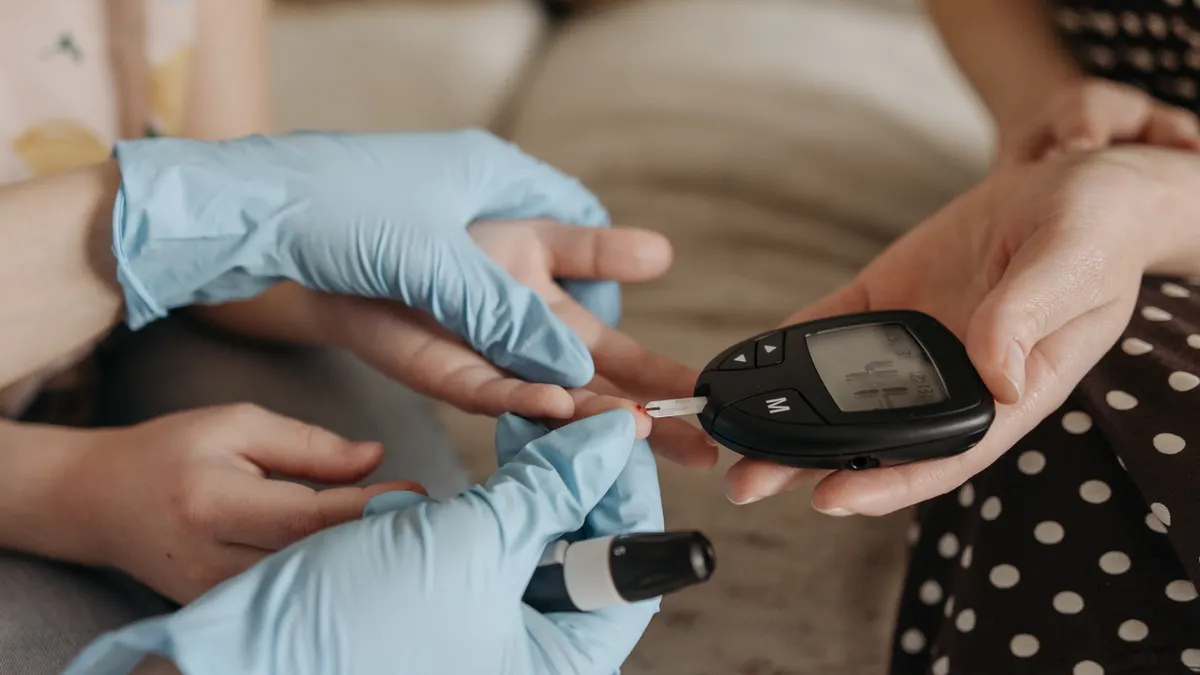
Self-monitoring means checking blood glucose at the times your care team recommends, then recording the result in a way that shows patterns, not just single numbers. It usually includes the reading itself, the clock time, what you ate, whether you exercised, and anything unusual such as illness, poor sleep, or a missed meal.
That same idea is what makes Gestational Diabetes Self-Monitoring and Data Tracking — The Complete Guide useful in practice: one isolated value tells you less than a week of values taken the same way. Tracking matters as much as the test strip or sensor, and the literature review process used here searched PubMed (NCBI) on 2026-10-28 with gestational[Title/Abstract] AND diabetes[Title/Abstract] AND self[Title/Abstract] AND humans[MeSH Terms], filtered to PubMed, publication date, 2016–2026, and sorted by relevance.
That literature is not all the same kind of evidence. The sample reviewed here included review articles and trial reports, which matters because it shows the field has both synthesis and direct testing, even if the balance varies by search and date. That mix matters because it tells you something important: the field has a fair amount of synthesis, but the directly experimental evidence in the most relevant sample is smaller than many readers assume.
Self-monitoring is not a moral test. It is a measurement habit. If a reading makes no sense, the value is often in the pattern around it, not in the number alone.
Which numbers matter most to track in gestational diabetes self-monitoring and data tracking?
The numbers that matter most are the ones your clinician can use to compare days: glucose readings, meal timing, activity timing, and whether a low or high reading had a clear trigger. A tidy notebook with three numbers can be more useful than a cluttered app with twenty fields nobody reviews.
A good tracking set usually starts with:
- glucose reading and time
- time of meals and snacks
- what was eaten in broad terms
- physical activity and when it happened
- any symptoms, nausea, illness, stress, poor sleep, or unusual workload
The trick is to keep the log simple enough that it survives real life. A tracking system that requires five minutes per entry often collapses during a busy workday or a rough night. A system that takes 30 seconds per entry is more likely to last long enough to show a pattern.
Not every detail belongs in the core log. Exact grams of every ingredient, a minute-by-minute exercise diary, and a full symptom inventory can become noise if nobody uses them in decision-making. The point is to capture enough context to explain a change, not to build an archive of your day.
If you use a smartphone app, a spreadsheet, or a paper chart, the best one is the one you will actually complete twice a day or more often if your team asks for it. There is no prize for the most elaborate format. There is only the value of records that can be read quickly at an appointment.
How often should readings be taken?
The frequency should follow the plan your clinician gives you, because gestational diabetes monitoring schedules vary by person, treatment plan, and local practice. Many patients are asked to check at specific times of day so the results can be compared consistently, but the exact schedule is individualized and should come from a qualified professional. The American Diabetes Association notes that your care team should guide monitoring and treatment decisions. (Source: American Diabetes Association)
What matters for the log is consistency. If the same time point is checked each day, trends are easier to see. If the timing changes from day to day, the record becomes harder to interpret. A reading taken at 7:00 a.m. before breakfast is not comparable to one taken after a late snack and a short night’s sleep.
The literature reflects that variety. In the PubMed sample read here, the abstracted study durations often spanned weeks rather than days, because patterns take time to emerge. That does not tell you what your plan should be, but it does show that tracking is usually studied over time.
One practical rule is to protect the routine more than the individual number. Missing one reading is a gap; missing the same time point three times a week destroys the pattern. That is why a simple schedule that fits your waking, eating, and work hours often works better than an ideal schedule that does not survive contact with the day.
What should go in the log, and what should stay out?
The log should include the items needed to explain a glucose reading, and it should leave out anything that does not help you or your clinician make sense of the pattern. A clean log is usually better than an exhaustive one.
A practical log entry can look like this:
- date and time
- glucose value
- whether the reading was taken fasting or after a meal, if relevant to the plan
- what and when you ate
- activity before or after the reading
- unusual events: nausea, vomiting, missed meal, poor sleep, stress, illness
What should stay out? Personal commentary that does not change interpretation, duplicate records in two apps, and speculative reasons for a value. If you write “I was bad today,” the log becomes emotionally noisy without becoming medically useful. If you write “late dinner, skipped walk, poor sleep,” the pattern is easier to read.
This is also where a structured format helps. A table, a simple app template, or a paper chart with the same fields each day reduces the chance that you forget the useful details. In many cases, a one-line note next to a reading does more than a long paragraph elsewhere in the app.
It also helps to label the measurement context clearly. “Before breakfast” and “after lunch” are useful labels; “morning” and “later” usually are not. The more precise the label, the less guesswork at the follow-up visit.
The tools people use: paper logs, apps, meters, and CGM
The right tool is the one that fits your clinician’s plan, your budget, and how often you can realistically record data. Paper logs, phone apps, glucose meters with memory, and continuous glucose monitoring systems all have trade-offs.
Paper logs are low-tech, visible, and easy to bring to an appointment. Their drawback is simple: they depend on handwriting, carrying the page, and re-entering data if someone wants it digitized later. A paper log can also become messy fast if you add corrections, notes, and missed entries.
Apps can reduce transcription work and may make trend graphs easier to view. Their drawback is that they only help if you remember to open them. Some people stop using an app as soon as the phone battery dies, a notification is ignored, or the interface becomes tedious.
Meters with memory help when you forget to write things down immediately. They still require a habit of review, because stored values are only useful if someone looks at them in context. A device that stores data but never gets downloaded or reviewed behaves like a locked drawer.
Continuous glucose monitoring, or CGM, adds more data points and can reveal trends that fingerstick checks miss. It can also create more data than a beginner knows how to interpret. For gestational diabetes, the main question is not whether more data exists; it is whether the extra data will be reviewed in a way that changes care appropriately.
A useful question for any tool is this: can I show a clinician the last 7 to 14 days without explaining the system from scratch? If the answer is no, the tool may be too complicated for the job.
What the research says about self-monitoring and data tracking
The research suggests that self-monitoring is studied mostly as part of a larger care plan, not as a standalone fix, and the strongest practical value is in pattern recognition and care adjustment. That is the honest conclusion from the current literature, which contains more reviews than trials in the 100 most relevant records read here.
Two figures from the PubMed sample help show the shape of the evidence. The sample included systematic reviews and meta-analyses as well as randomized trials, which means readers are often looking at synthesis of prior work rather than a large block of fresh trial evidence focused only on self-monitoring.
Another useful clue is the publication year spread. The records in the sample were recent enough to show active interest in the topic, but not so uniform that one universal monitoring style or one universal app format emerges from the literature.
One specific figure in the abstracts also shows how the literature describes interventions: the median dose figure appearing in these abstracts was 108 mg, with a range of 9–850 mg across 8 figures stated in abstract text. That is not a recommended dose and should not be treated as one. It does, however, show that the broader gestational diabetes literature often discusses medication or nutrient interventions alongside self-monitoring, which is one reason tracking is usually embedded in a wider plan.
The most important limitation is that research summaries do not replace personal instruction. A monitoring method that works in a controlled study may be awkward in a busy household, and an app that looks impressive may not be the one your care team wants to review. The literature can point to useful directions, but it cannot choose your schedule for you.
What goes wrong most often?
The most common failure is inconsistent recording, and it usually happens because the system asks for too much at the wrong moment. A person misses one entry, then another, then stops trusting the log because it looks incomplete.
A second failure is inaccurate timing. If a reading is labeled “fasting” when it was taken after coffee, or “after meal” when it was really taken after a snack and a walk, the record loses value. The number may still be real, but the interpretation becomes shaky.
A third failure is overreacting to a single outlier. One high reading after a very unusual meal should not carry the same weight as a repeated pattern across several days. Data tracking works by repetition. A one-off result can be noise, while the same result three mornings in a row is information.
A fourth failure is tool mismatch. Someone may start with a detailed app, then abandon it because the workflow is too slow. Another person may use paper flawlessly at home and then forget to bring it to the appointment. The cost is not just inconvenience; it is lost pattern recognition, which can delay useful discussion with a clinician.
The practical fix is usually to simplify. Fewer fields, clearer labels, and a single place for the log often work better than a sophisticated system with three sync problems and no review habit. If the record takes more than a minute to complete, it may already be too hard.
Before/after: a simple tracking setup versus a hard one
A simple setup tends to produce cleaner data, while a complicated setup tends to produce more abandoned entries. The difference is not glamour; it is survival over 12 weeks, which is a common study duration figure in the current literature.
| Metric | Before | After | Change | Timeline |
|---|---|---|---|---|
| Number of fields per entry | many, inconsistent | few, fixed | less clutter | first week of use |
| Chance of completing an entry | low when rushed | higher when routine | easier follow-through | first 1–2 weeks |
| Clarity at appointment | hard to scan | easy to scan | faster review | by next visit |
| Pattern visibility | scattered | grouped by time of day | easier comparison | after several days |
| Risk of abandonment | higher | lower | less friction | over 12 weeks |
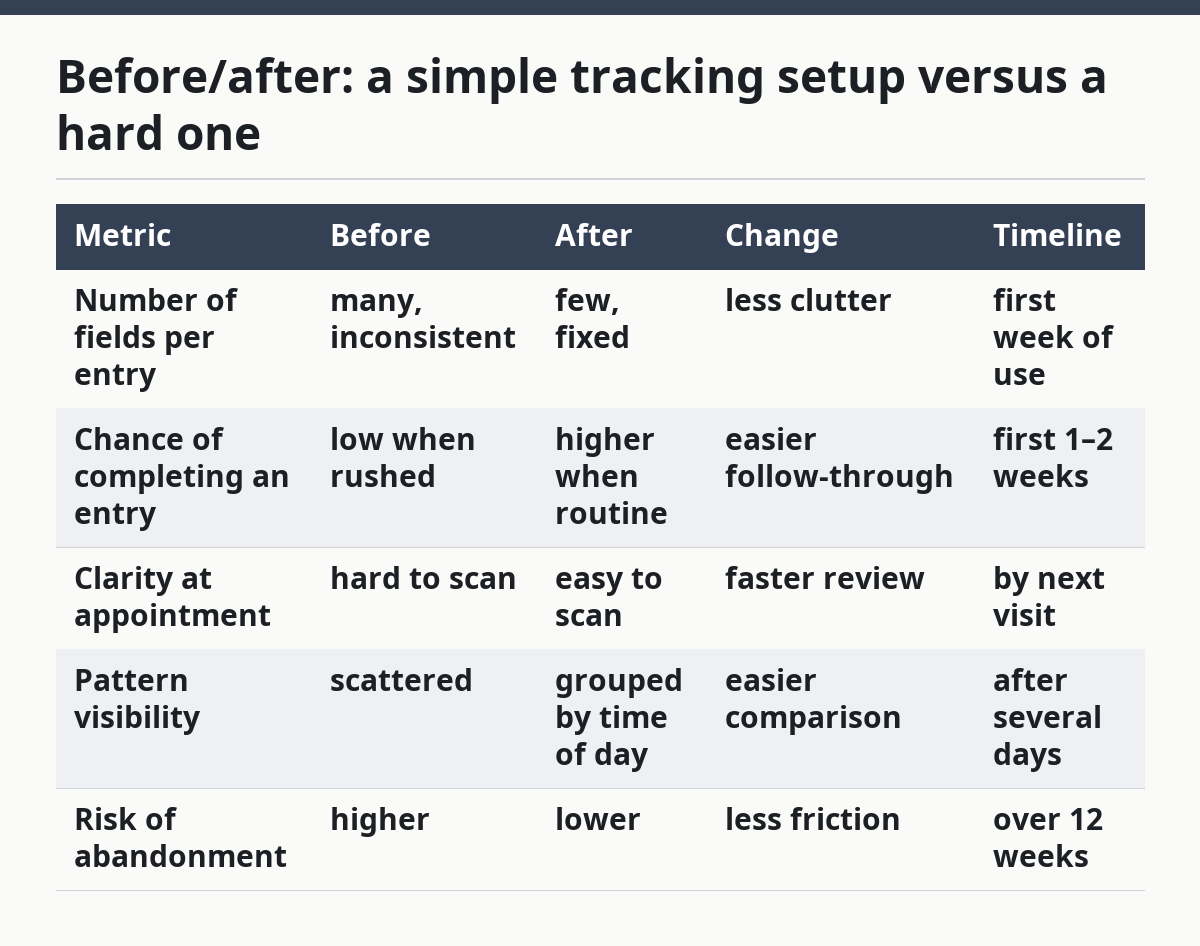
The point of this table is not to claim a medical outcome. It is to show the operational difference between a record that can actually be kept and one that looks impressive on day one but collapses by day ten.
How to review the data without getting lost in it
The simplest review method is to look for repeated patterns at the same time of day, then compare those patterns with meals, sleep, and activity. Start with three questions: which time point is least stable, what seemed different on those days, and what stayed the same?
Because the point is to read patterns rather than chase every minute, a weekly review is often more useful than a minute-by-minute obsession. A single reading can trigger anxiety; a week of readings can reveal whether the issue repeats after a certain meal, on a workday, or after poor sleep. That is the point of tracking data instead of just collecting it.
If you use an app, export or screenshot the trend page before appointments. If you use paper, mark the values that were out of pattern so they are easy to find. The goal is not a perfect archive. The goal is a reviewable record.
A clean review also helps you ask better questions. Instead of saying “my numbers are weird,” you can say “the same reading is higher on three mornings after late dinners.” That level of specificity gives a clinician something real to evaluate.
The best review habit is short and regular. Ten minutes once a week is more useful than an hour once a month if the weekly habit keeps the log alive. Data that is reviewed late tends to be less actionable.
When to bring the log to a clinician
The log should be brought to a clinician whenever the pattern changes, the entries are hard to interpret, or the plan itself needs clarification. A record is most useful when it is part of a conversation, not when it is stored in isolation.
Bringing the log matters especially if readings are repeatedly outside the range your care team gave you, if your schedule no longer matches your day, or if the tool you chose is no longer getting used. Those are not reasons to self-correct aggressively; they are reasons to ask for guidance.
The same is true if the record includes a string of missing days. A clinician can often help simplify the system, but only if the problem is visible. A half-filled log is still worth bringing. It shows where the plan broke down.
You do not need to wait for a perfect notebook before asking for help. In health care, imperfect data often beats no data, especially when the issue is a recurring pattern rather than one dramatic result.
Is gestational diabetes self-monitoring worth the effort?
Yes, if the record is simple enough to keep and useful enough to review, but no if the system becomes so detailed that it stops being used. Self-monitoring is valuable when it helps a clinician and patient see patterns across days or weeks, not when it turns into a burden that produces guilt.
That is the central trade-off. More data can help, up to the point where the extra work reduces adherence. A paper log with five useful fields may outperform a fancy app with fifteen fields. A CGM may show more variation, but it also may ask for more interpretation than a beginner wants to manage alone.
The honest answer is that self-monitoring is a tool, not a verdict. It works best when it is matched to the person, the pregnancy, the clinical plan, and the amount of support available. It is not for anyone who needs a one-size-fits-all rule, and it is not a substitute for professional care.
FAQs
What should I write down besides the glucose number?
Write down the time, the meal context, and anything unusual that could explain the reading. That usually means whether the number was fasting or tied to a meal, what you ate in broad terms, and whether sleep, illness, stress, or missed meals played a role.
Paper log or app: which is better?
The better one is the one you will actually use every day. Paper is easier to see at a glance and easier to bring to an appointment; apps can make trends easier to view and may reduce manual copying.
If I miss a few readings, is the log useless?
No, the log is still useful if enough entries show the pattern. Missed readings lower confidence, but they do not erase the value of the entries you do have.
Can tracking alone manage gestational diabetes?
No, tracking is only one part of care and should be used with guidance from a qualified professional. It helps spot patterns and supports decision-making, but it does not replace medical evaluation or treatment planning.
What is the most useful habit to build first?
The most useful habit is to record the same time points consistently for a full week. Consistency creates a pattern that can be reviewed, while a complicated system that you abandon after two days helps no one.
Drafted with AI; not yet reviewed by a person.