

Last updated: November 19, 2026
Quick answer: bring your glucose meter, your test log, your insurance card, a current medication list, and a few notes about meals and symptoms. For a gestational diabetes glucose monitoring visit, that usually gives the clinician the numbers, the meter settings, and the context needed to review your readings quickly and make practical next steps.
Key Takeaways
- Bring the meter, log, and supplies that let the clinician confirm your glucose readings.
- Keep the record honest and easy to review; do not “tidy up” missing or high numbers.
- Start with a complete check-in packet so the visit runs smoothly.
- Ask about accuracy, costs, refills, and whether your monitoring plan is sustainable.
If this is your own visit, speak with a qualified clinician about your situation first; gestational diabetes can vary a lot from one pregnancy to another.
Studies matching this subject on PubMed: 5,750 records for 2016–2026, with the 100 most relevant read and every median, range, and share below computed across those records; 23 related trials are registered on ClinicalTrials.gov, with the first 23 read and every share, median, and range below computed across them. Computed on 2026-10-27, from PubMed (NCBI) and ClinicalTrials.gov.
What this visit is for, and what it assumes you already have
This gestational diabetes glucose monitoring visit is for reviewing blood sugar monitoring, not for starting the whole pregnancy plan from scratch. It usually assumes you already have a glucose meter, a way to record readings, and some idea of when you have been checking blood sugar.
A glucose monitoring visit is the right place to bring the facts the clinician needs to interpret your readings: times, values, meals, medication names, and any meter problems. It is not the place to arrive empty-handed and expect the whole pattern to be reconstructed from memory, because that rarely works well over 1 or 2 weeks of numbers.
The main thing I want clear from the start is this: a monitoring visit is a follow-up checkpoint. It helps the clinician see whether the readings you collected line up with the targets they have given you, which is the subject of the linked hub on gestational diabetes glucose monitoring and targets. This page does not replace that guidance and does not explain how to monitor blood sugar.
Who this is for: pregnant patients with gestational diabetes who are already checking glucose, or who are about to bring their first log to review. Who this is not for: someone who has new symptoms, is unsure whether they have gestational diabetes at all, or needs a new monitoring plan. Those situations need qualified medical advice rather than a packing list.
For a useful visit, I would also assume you know the basics of your clinic setup: the date, the location, and whether the appointment is in person or by telehealth. A telehealth review still needs the same information, and in some cases a photo or screenshot of the meter display helps if the app is not syncing. For related guidance on glucometer accuracy and use, see the ADA Standards of Care and the FDA’s blood glucose meter information. American Diabetes Association, FDA blood glucose meter information
What should I bring to a gestational diabetes glucose monitoring visit?
You should bring the items that let the clinician verify your readings, your meter, and your current supplies. The minimum practical set is simple: glucose meter, test log, insurance card, medication list, and any meal or symptom notes that explain outliers.
A useful rule is to bring the original source whenever possible, not just a memory of it. If your meter stores readings, bring the meter itself even if you also keep a notebook or phone log. If your clinic gave you a paper log, bring that too. If your insurance or pharmacy benefit is tied to a specific brand of strips or lancets, bring the card that shows that coverage.
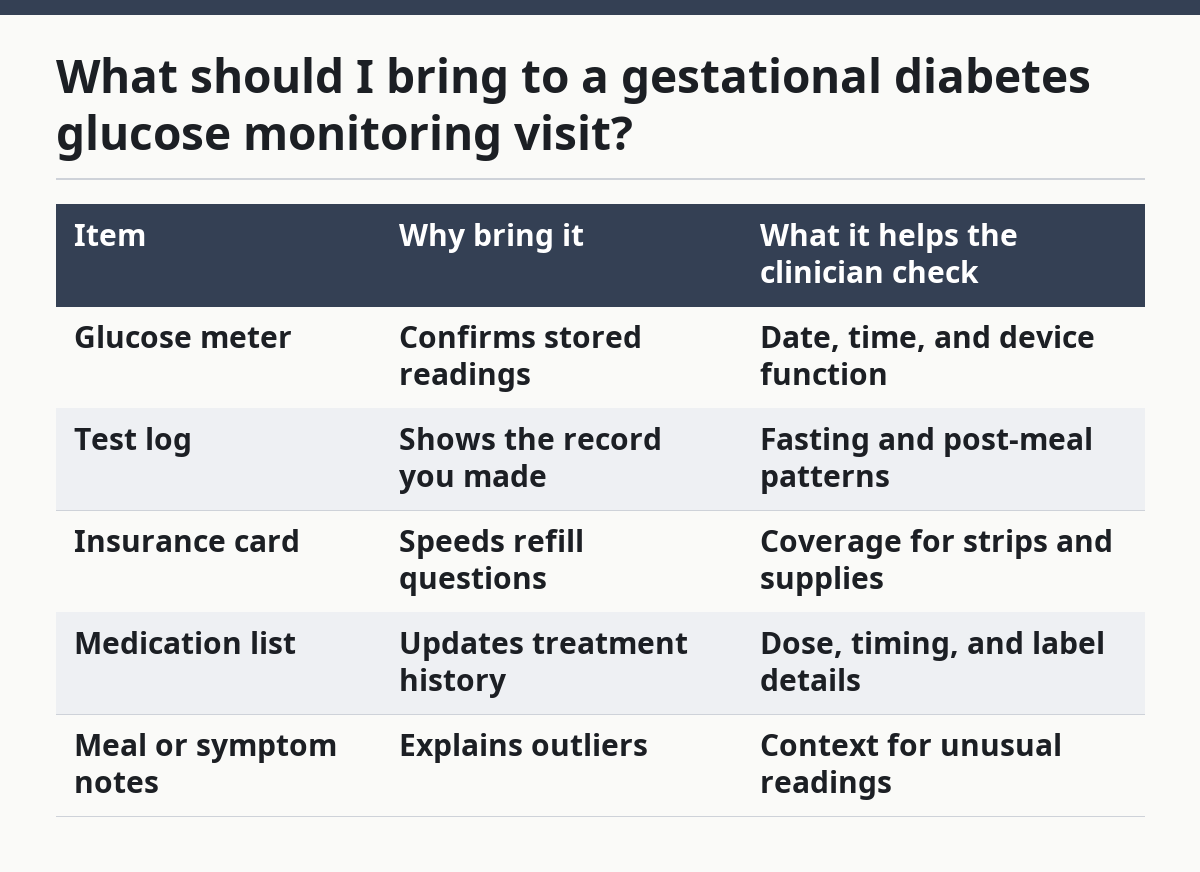
A quick comparison can help you pack the right items for a gestational diabetes glucose monitoring visit:
| Item | Why bring it | What it helps the clinician check |
|---|---|---|
| Glucose meter | Confirms stored readings | Date, time, and device function |
| Test log | Shows the record you made | Fasting and post-meal patterns |
| Insurance card | Speeds refill questions | Coverage for strips and supplies |
| Medication list | Updates treatment history | Dose, timing, and label details |
| Meal or symptom notes | Explains outliers | Context for unusual readings |
Two authoritative source pages worth knowing are the American Diabetes Association’s diabetes technology guidance and the U.S. Food and Drug Administration’s patient information on blood glucose meters. Those sources cover device and monitoring concepts at a general level, but your own obstetric or diabetes clinician should make the final call on what matters in your pregnancy. For general pregnancy diabetes education, see MedlinePlus and the CDC. MedlinePlus: gestational diabetes, CDC: gestational diabetes
How to prepare the 24 hours before you go
You prepare best by making the visit easy to verify, not by trying to clean up the record. Do not delete “bad” readings, skip missing entries, or rewrite values from memory; the pattern matters more than a polished notebook.
Start with your glucose meter. Confirm that it has a fresh battery, that the date and time are correct, and that any paired app is working. If the meter stores dates incorrectly, the readings can be hard to sort by meal and time of day. A wrong clock is a real problem because fasting and post-meal readings are not interchangeable in pregnancy follow-up.
Next, gather your test log. That can be a paper diary, a spreadsheet, or a phone app, as long as it shows the reading, the time, and what you ate or did around that time. If you use an app, bring a charged phone and, if possible, a screenshot or export of the last 1 to 2 weeks. A good log is readable in under a minute; a pile of unlabeled numbers is not.
Then collect your medication list. Include the name of each medicine or supplement, the strength printed on the bottle, and how often you take it as listed on the label. That list should cover prenatal vitamins, aspirin if prescribed, iron, insulin if applicable, and anything taken for nausea, reflux, thyroid disease, or blood pressure. Even a medication that seems unrelated can matter when the clinician is reviewing meal patterns, appetite, or symptoms.
Do the same for meal notes. You do not need a food diary down to the gram. What helps is a simple record of meal timing, the broad food type, and anything unusual such as skipping breakfast, a very late dinner, or a high-carbohydrate snack. One day of notes is often less useful than 3 to 7 days that show your actual routine.
Finally, put the practical items together: insurance card, photo ID if your clinic asks for it, a pen, and your questions. If your visit is in a 15-minute slot, those pieces save time. If your clinic handles supply orders, bring any prescription labels or prior paperwork related to strips, lancets, needles, or replacement meters.
A step-by-step checklist for the appointment
Start with a complete check-in packet and use it to make the review straightforward. The goal is not to impress anyone with a perfect binder; it is to let the clinician compare numbers, timing, and context without guesswork.
- Bring the meter itself, not just the app. Place the device, charging cable if it uses one, and any manufacturer box or instructions in your bag. Verify that the meter turns on and displays recent readings. A dead battery, wrong date stamp, or unreadable screen can make the visit less useful.
- Bring at least 1 to 2 weeks of readings. Include fasting values and post-meal values exactly as recorded. Verify that dates and times are visible. Missing timestamps make it hard to tell whether a reading followed breakfast, lunch, dinner, or a snack.
- Bring the test log in the format you actually used. Paper log, phone note, spreadsheet, or app export all work if they show the same information. Verify that each entry includes the reading, the time, and what was happening around that time. A log with only numbers leaves the clinician guessing.
- Bring your medication list as a current snapshot. Include the name, dose on the label, and when you take each medicine or supplement. Verify that nothing has been added, stopped, or changed without being written down. An outdated list can lead to confusion about what you are actually using.
- Bring meal notes for the days with unusual readings. Jot down meal timing, portion size in plain language, and obvious triggers such as restaurant meals or missed snacks. Verify that the note matches the day and time of the reading. If a high number followed a late meal, that context matters.
- Bring your insurance card and supply information. Include the card for medical coverage and, if separate, the pharmacy card. Verify the brand names for strips, lancets, and any sensor or meter supplies if your plan is specific. A mismatch between prescribed and covered supplies can delay refills.
- Bring questions about the next 1 to 2 weeks. Write down what you need clarified about reading timing, supply refills, replacement parts, or follow-up scheduling. Verify that the questions fit the visit’s purpose. If the page is about interpreting the numbers, this is not the place to replan the entire pregnancy care schedule.
- Bring a note of any symptoms or barriers. List dizziness, nausea, trouble getting enough test strips, or difficulty checking at work. Verify whether the issue is occasional or repeated. A barrier that shows up 3 or 4 times a week changes what the clinician needs to know.
If you want a quick quality check before leaving home, ask: can the clinician see the meter, the reading, the date, the time, and the context in under 30 seconds? If the answer is no, you probably need to add or reorganize something.
What questions should I ask about readings, supplies, and refills?
You should ask the questions that affect whether your monitoring is accurate, affordable, and sustainable for the next few weeks. A visit is more useful when it covers the mechanics of monitoring, not just the numbers already on the page.
The most useful questions are specific. Ask which readings the clinic wants to review, how often they want the log brought in, and what to do if your meter and app disagree. If a result looks far from the rest, ask whether it should be repeated right away or simply written down as one data point. Different clinics handle outliers differently, so the answer should come from your own care team.
Supply questions matter just as much. Ask whether your insurance covers the strips you are using, whether the brand matters, and what to do if the pharmacy substitutes a different meter or strip type. If you are running low, ask who sends the refill, how far ahead to request it, and whether a paper prescription or electronic order is needed.
It also helps to ask about the log format. Some clinics want a printed sheet, some want a portal message, and some are fine with a phone screenshot. If your glucose meter uploads data, ask whether the clinic can view the report directly or wants you to bring a copy. A visit can stall for 10 minutes if nobody can open the file.
If you are unsure how your meal notes should look, ask for the simplest format that will be useful next time. One to 2 lines per meal is often enough: time, meal, and anything unusual. That is far better than trying to recreate every bite from memory at the door.
Common mistakes that make the visit less useful
The biggest mistake is arriving with only a memory of readings. That usually produces vague answers and a weaker review. The better alternative is a written log or meter download with dates and times attached.
A second mistake is bringing the log but not the meter. If the numbers look inconsistent, the meter may need to be checked against the log or re-synced with the app. Without the device, the clinic cannot verify whether the stored readings match what was written down.
A third mistake is cleaning up the log before the visit. Deleting “bad” entries or rewriting meals makes the data less honest and less useful. The correct alternative is to leave the record intact and explain the context of any unusual reading.
A fourth mistake is forgetting the insurance card or supply information. That can delay refills for strips, lancets, or other monitoring supplies by days. The better alternative is to keep the card in the same pouch as the meter or log so both travel together.
A fifth mistake is bringing a medication list that is months out of date. That can matter if a new prescription, supplement, or over-the-counter medicine has been added since the last visit. The better alternative is to write down the current label information the day before the appointment.
A sixth mistake is assuming the visit is only about numbers. If you have trouble affording supplies, checking at work, or eating on a fixed schedule, that context belongs in the room. Those barriers can change what a monitoring plan looks like, even when the readings themselves are the main topic.
When a standard checklist is not enough
A standard checklist needs modification when the routine assumptions break down. That matters more in pregnancy, because the next step depends on the quality of the data in front of the clinician.
If you use a meter with Bluetooth syncing and the app has not uploaded correctly, bring screenshots and the device itself. A missing upload is not the same as missing readings, but it can make the record look incomplete. A paper backup can keep a 5-minute technology problem from becoming a 20-minute appointment problem; if you are unsure how much backup you need, ask your clinician.
If you have changed pharmacies, changed insurance, or been given a substitute strip brand, flag that before the visit begins. Strip compatibility is a practical issue, not a side note. If the meter and strips do not match the usual setup, readings may be harder to compare with earlier entries.
If nausea, vomiting, missed meals, or a changing work schedule have made your pattern unusual, bring those notes prominently. A week with 3 skipped breakfasts does not mean the same thing as a normal routine week with one high reading. The clinician needs to know whether the record reflects real-life variation or a temporary disruption.
If you are using insulin or another medicine that affects blood sugar, bring the exact bottle or pen label and the schedule as written. Do not rely on the name alone. In monitoring follow-up, the label and the timing are the parts that help the clinician reconcile your numbers with your treatment record; if anything seems unclear, ask a qualified clinician to review it with you.
If your appointment is by telehealth, prepare a 1-page summary or a screenshot set in advance. Telehealth is fine for review, but it is less forgiving of scattered information. In a remote visit, a concise folder of meter data, medication labels, and meal notes is often better than a stack of loose papers.
What a good visit looks like
A good visit ends with fewer mysteries, not more. The clinician should be able to see which readings are being tracked, which supplies are working, and which parts of the routine are getting in the way.
You should leave knowing whether the clinic wants any changes to your log format, meter use, or supply ordering process. You should also know whether the next review needs a printed report, an app screenshot, or the meter itself.
Drafted with AI; not yet reviewed by a person.
