

Last updated: November 19, 2026
Gestational Diabetes Eating After a Late Lunch: How to Reset the Rest of the Day
Quick answer: if lunch runs late by about 30 minutes or more, the safest practical move is usually to reset the rest of the day around that new time, not to “make up” for it by stacking meals. Eat the next snack on a workable clock, move dinner later if needed, and keep the bedtime snack from landing on top of dinner. Because gestational diabetes is high stakes, use a qualified professional’s advice if your readings are running high or your schedule keeps changing. This guide on gestational diabetes eating after a late lunch keeps the focus on timing, not on forcing a perfect day. The American Diabetes Association and NIDDK both stress that meal planning and glucose targets should be individualized.
Key takeaways
- A late lunch usually calls for a schedule reset, not a skipped snack or a doubled meal.
- The biggest risk is a long stretch between lunch and dinner that leaves blood sugar harder to predict.
- Dinner can often move later if lunch moved late, but the bedtime snack may need to shift too.
- The right response depends on your usual meal plan, your glucose targets, and how late lunch was.
- If late lunches happen often, the fix is usually a new daily rhythm, not a one-time workaround.
Therefore, a late lunch is not a failure; it is a timing problem. A practical response is to keep the rest of the day spaced out, watch for a long gap, and avoid stacking dinner too close to bedtime. The hub on gestational diabetes nutrition and meal timing covers the wider routine this fits into, and you can confirm your own plan with a qualified professional if your schedule is unusual.
According to PubMed records for this topic, the field has shifted toward timing and nutrition details, but PubMed records are not a treatment guide; they are a research snapshot. For patient-facing guidance, consult a qualified professional and refer to authoritative sources such as the American Diabetes Association and NIDDK’s gestational diabetes page. Selection rule: gestational[Title/Abstract] AND diabetes[Title/Abstract] AND nutrition[Title/Abstract] AND humans[MeSH Terms], filtered to PubMed, publication date, 2016–2026, sorted by relevance, sample read 100. Sources: PubMed (NCBI). Computed on: 2026-11-10.
What changes after a late lunch?

Because a late lunch changes the spacing of the whole day, not just that one meal, meal timing matters more than usual. In gestational diabetes, long gaps and tight overlaps can make glucose harder to predict, especially when snacks and dinner are already part of the day. The goal is to restore a workable rhythm after the late meal.
A “late lunch” here means lunch landed later than your usual schedule, not that you skipped it entirely. If lunch was pushed back by 30 minutes or a few hours, the practical question becomes whether your usual snack, dinner, and bedtime snack still fit. The answer depends on how your day is normally arranged, but the basic pattern is the same: shorten the next gap, then keep the rest of the day from bunching up.
In contrast, a generic article often gets this wrong by treating every meal as separate; consult a qualified professional if your plan is changing often. It is not separate. A late lunch can push dinner toward the evening and can make a usual bedtime snack feel too close to dinner. That is the part to sort out first.
How do I reset the rest of the day?
You reset the rest of the day by re-spacing lunch, snack, dinner, and bedtime snack so the next gap is not overly long or overly tight. The exact timing varies by your usual plan, but the sequence is simple: eat lunch, decide whether the snack still fits, move dinner if needed, and check whether the bedtime snack should shift with it.
- Mark the new lunch time. Write down the actual time you ate lunch, even if it was 20 minutes later than planned. Verify the rest of the day against that time. If you keep using the old schedule, the gaps can drift without you noticing.
- Look at the next snack first. If you normally have a snack between lunch and dinner, decide whether it still belongs on the day’s new clock. Verify that it does not leave you feeling overly hungry before dinner. A problem is a gap that becomes so long you are counting down to the next meal.
- Check the lunch-to-dinner span. If dinner would now fall much later than usual, consider moving dinner later rather than forcing the old dinner time. Verify that the gap is still practical for you and your care plan. A problem is dinner landing so soon after lunch that you are barely hungry.
- Protect the bedtime snack from dinner overlap. If dinner shifts later, the bedtime snack may also need to shift or be adjusted. Verify that the snack is not happening right on top of dinner. A problem is a snack that turns into an extra meal because dinner was already late.
- Keep the dinner portion steady. Do not compensate for a late lunch by making dinner unusually large. Verify that dinner still looks like dinner, not a catch-up meal. A problem is the evening meal becoming the day’s biggest meal, which can be hard to fit around a bedtime snack.
- Use the next reading, if you have one, as a check. If you monitor glucose, use the next planned check according to your care plan to see whether the revised timing is working. Verify that the number is in your expected range for you. A problem is repeated readings that suggest the current spacing is not working.
- Decide whether tomorrow needs a schedule change. One late lunch can be handled on the spot; repeated late lunches may need a different routine. Verify whether this was a one-off or part of a pattern. A problem is trying to patch the same timing issue every day.
So the median publication year in the 100-record PubMed sample was 2021 (PubMed, NCBI), which fits the current emphasis on real-life timing rather than rigid one-meal thinking. For practical timing questions, the American Diabetes Association and the National Institute of Diabetes and Digestive and Kidney Diseases both have patient education pages on gestational diabetes and meal planning: https://diabetes.org/ and https://www.niddk.nih.gov/health-information/endocrine-diseases/gestational-diabetes.
Should lunch be followed by the usual snack?

Yes, if your usual plan includes a snack and the timing still makes sense, but the snack may need to move rather than disappear. A late lunch changes the clock, so the question is less “snack or no snack” and more “does this snack still fit before dinner and bedtime?”
If the late lunch was only slightly late, the snack may stay where it usually would. If lunch was much later, the snack may slide later too, or it may no longer be useful because dinner is close enough. The most important thing is to avoid creating a long gap that leaves you too hungry, then makes dinner harder to manage.
On the other hand, a snack that crowds dinner is a common mistake. Another is skipping the snack and then arriving at dinner overly hungry, which can make portion control harder. The better alternative is to adjust the whole afternoon, not just one slot.
When should dinner move?
Therefore, dinner should move when the late lunch would make the lunch-to-dinner gap awkward or when keeping the old dinner time would put meals too close together. This is one of the most common adjustments after a late lunch, and it usually matters more than people expect.
If lunch was delayed by a meaningful stretch, forcing the old dinner time can create a very short interval. If dinner is moved later, the bedtime snack may need to move too so it does not overlap dinner. That timing shift is the part people often miss.
| Timing choice | What it helps with | What can go wrong | Best fit |
|---|---|---|---|
| Keep dinner at the usual time | Keeps the evening routine unchanged | The lunch-to-dinner gap may be too short | Lunch was only mildly late |
| Move dinner later | Spreads the day more evenly | Bedtime snack may get pushed later too | Lunch was clearly late |
| Keep dinner and skip the snack | Reduces overlap | Can leave a long gap later in the evening | Only when your usual plan allows it |
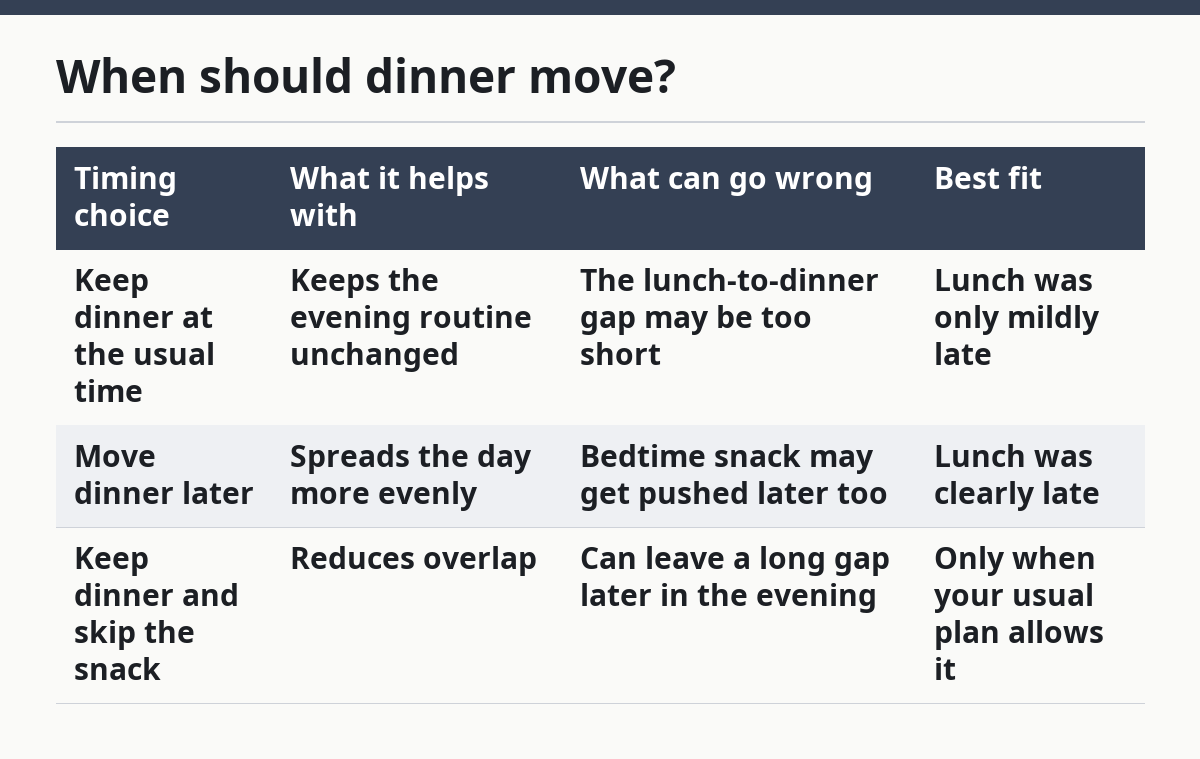
Overall, the table is not a prescription. It is a way to see the trade-off: either dinner moves, the snack moves, or the day becomes cramped. In gestational diabetes, cramped timing is the problem to solve.
What mistakes make the day harder?
The most common mistake is trying to “save” the schedule by keeping every later meal exactly where it was. That usually creates a squeezed evening, and squeezed evenings are harder to manage. The fix is to move one part of the plan, not cling to all of it.
Treating lunch like a standalone event: This can leave the rest of the day untouched on paper but messy in real life. The consequence is a long or short gap later. The better alternative is to re-map snack, dinner, and bedtime snack together.
Skipping the snack without checking dinner timing: This can leave you too hungry by dinner. The consequence is a larger or less predictable evening meal. The better alternative is to decide on the snack based on the new gap, not habit.
Keeping bedtime snack at the old time after a late dinner: This can create overlap or a second evening eating block. The consequence is a crowded evening schedule. The better alternative is to shift the snack with dinner or reassess whether it still fits.
Turning dinner into a catch-up meal: A late lunch does not call for an oversized dinner. The consequence is that the evening can become heavier than planned. The better alternative is to keep dinner steady and use timing, not size, to correct the day.
Ignoring repeated late lunches: One late lunch is a one-day problem; repeated late lunches are a schedule problem. The consequence is constant stress around meal timing. The better alternative is to review the daily routine with a qualified professional if this keeps happening.
When does this approach not fit?
This approach does not fit when the late lunch is part of a bigger pattern that your current plan cannot absorb. If your meal timing keeps shifting, the issue is no longer just “what do I do today?” It is “does this schedule still work at all?”
Your glucose readings are repeatedly outside your expected range: timing may not be the only issue — contact a qualified professional about your plan. A late lunch strategy is not meant to replace medical guidance.
Dinner keeps landing too close to the bedtime snack: the day may be too compressed — adjust the meal rhythm with professional input. Overlap can make the evening hard to manage.
You are skipping snacks because the day feels crowded: the schedule may be too tight — ask for a plan that fits real life. A pattern of skipped eating can be more disruptive than a late meal.
Late lunch happens several times a week: this is a routine problem, not a one-off delay — get help revising the schedule. Repeated fixes can become exhausting.
Your meal plan already has strict timing from another condition: one-size timing changes may not be appropriate — confirm changes with a qualified professional. That includes any plan built around medication timing or specific glucose targets.
Because meal timing advice varies by person, the article in the PubMed sample that matters most for this topic was weighted toward reviews rather than trials. Use that as background only, and keep the practical plan flexible with help from a qualified professional if needed.
What should I do tomorrow if lunch keeps running late?
Ultimately, you should adjust the day’s default schedule, not improvise from scratch each time. If lunch is consistently late, the morning snack, lunch, dinner, and bedtime snack may need a new spacing pattern that matches your real day instead of the ideal one.
That may mean planning for a later lunch window, moving dinner a little later, or changing when the afternoon snack happens so the long gap never gets too long. The right answer depends on your routine and your glucose pattern, so this is a good point to bring in a qualified professional. A 1-day workaround is useful; a 5-day pattern deserves a plan.
FAQ
Should I still eat a snack after a late lunch?
Usually, the snack depends on how much time is left before dinner and what your normal plan looks like. If dinner is still far away, a snack may still fit; if dinner is close, the snack may need to move or shrink within your usual plan. The key is to avoid creating an overly long gap or crowding the evening.
How late is too late for lunch?
There is no single clock time that is too late for everyone. The practical issue is whether the late lunch throws off the rest of your meal spacing or pushes dinner and bedtime snack into each other. If this keeps happening, the schedule itself may need revision with a qualified professional.
Do I need to move dinner if lunch runs late?
Often, yes, if keeping dinner at the usual time would make the lunch-to-dinner gap too short. Moving dinner later can restore a better rhythm for the day, but it may also mean shifting the bedtime snack. The best choice depends on your usual schedule and glucose plan.
Drafted with AI; not yet reviewed by a person.
